



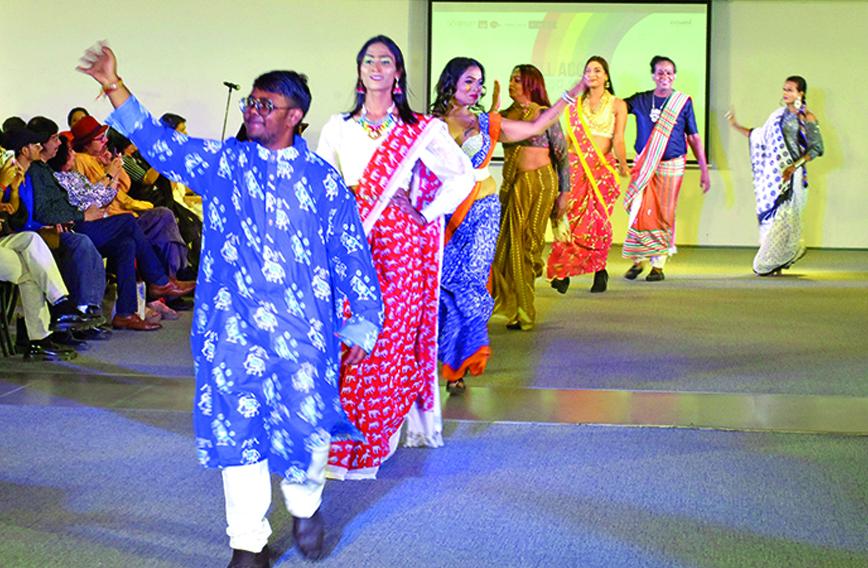
An unusual line-up of models sashaying down the ramp: ‘I’ve never felt so happy’
Walking the ramp with fashion for the soul
Aiema Tauheed, Kolkata
Behala Keertika, an NGO, and the Kolkata Centre for Creativity (KCC) organized a fashion show that broke the rules. An unusual line-up of models sashayed down the ramp. They wore clothes with wild prints and eye-catching colours.
Among the models was an acid attack survivor, an elder from the transgender community, a social activist, a writer, actress, and even a few employees from KCC.
Prasanta Sarkar, a fashion designer from the LGBTQIA+ community, walked the ramp wearing a saree with prints of sandesh, a famed Bengali sweet. He paired his saree with a shimmery black blouse. Why should only women wear sarees!
Sarkar works with cotton and focuses on sustainable fashion. “I take up modelling gigs whenever I get the chance,” he said. “There are fewer opportunities for people like us to find jobs or good positions. I’m really happy I got a chance to walk the ramp today.”
Acid attack survivor Pinky Mondol, her face lit up with a smile, said, “I’ve never felt this happy.” She first wore a salwar suit, her dupatta draped over her head, and later reappeared in a playful papaya-printed dress for the finale.

“We have created a shared space of empathy and immense possibilities,” said Priyadarshinee Guha, associate vice-president of KCC, standing against a white wall onto which the words ‘ALL ACCESS’ and a rainbow — symbolizing pride — were projected. “Among us today are individuals whose journeys have been marked by struggle, pain, and at times, society’s cruel indifference. We are honoured by the presence of domestic abuse survivors, acid attack survivors, and our transgender brothers and sisters.”
Behala Keertika, established in 2001, works for child rights, women’s rights, and the transgender community. The organization runs a Child Protection Home that currently shelters 25 children. KCC, which hosted the event, promotes a range of art from visual and performing arts to art in education. Inclusion is at the heart of its work.
People filled the seats on either side of a carpeted floor about 25 feet wide — the runway for the evening. After a brief lamp-lighting ceremony, Guha announced, “We begin this evening with the Pride Walk.”
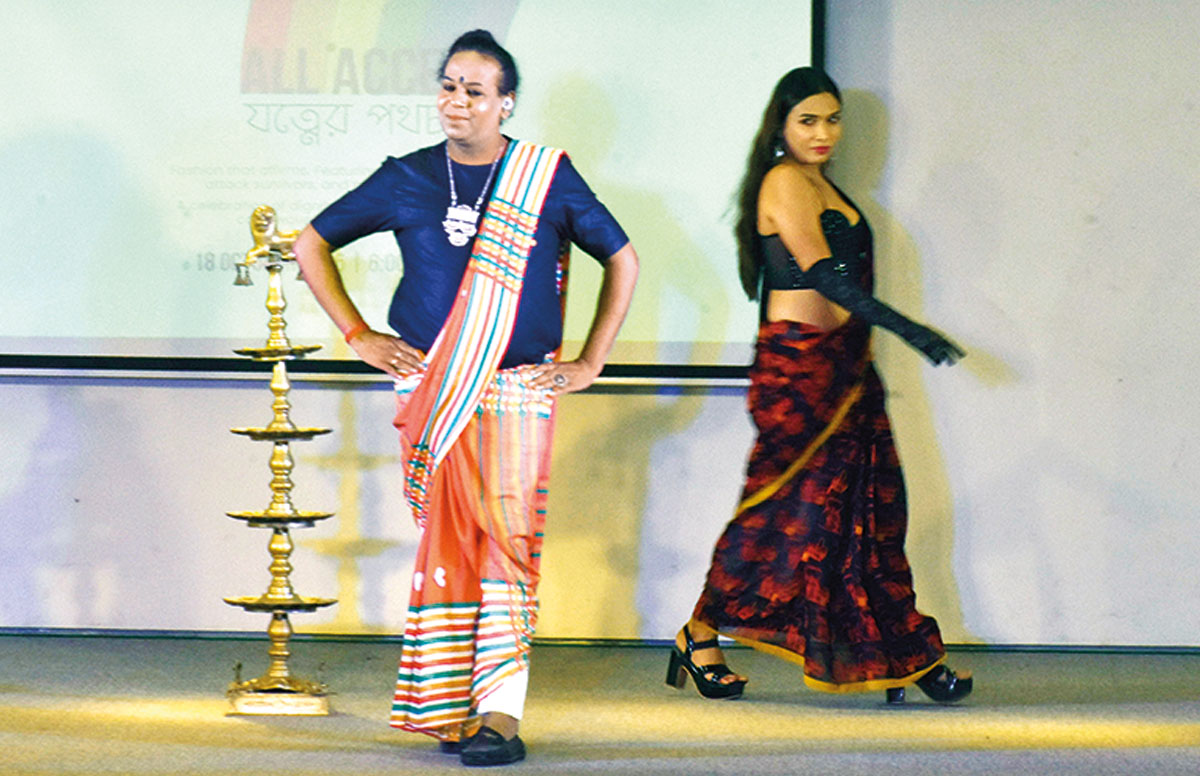 Prasanta Sarkar: ‘Why should only women wear sarees?’
The room glowed as the lights brightened and “I Want to Break Free” by Queen filled the room. The models displayed sarees with whimsical, unique prints — crabs, watermelons, snails — on natural fabrics. Alongside were kurtas in solid tones and brilliant prints. Another noteworthy track that participants walked to was “Amar Hath Bandhibi,” a Bengali folk song on freedom sung by Sahana Bajpaie.
The models walked nervously at first and then with insouciance. They smiled, waved and even interacted with the audience. In the finale, all participants walked the ramp once more, forming two lines as they moved gracefully forward and back in unison, joined by the choreographers.
The choreographers for the evening were Sayantani Mukherjee, director of Ikonic Fitness and Dance, and Rubena Chatterjee, a dancer who has been performing since the age of five. “This was a fashion walk, so they were more conscious,” she said, smiling. “But they have rhythm, every human being does.”
Two well-known fashion designers came on board, generously contributing garments for the show. One was Kakali Biswas, whose women-led label, Dora by Phoenix, is known for its fun prints and designs that challenge conventional ideas of the saree.
The other was House of Swapna by Robin Mallick, a menswear label merging traditional craftsmanship with modern flair to create elegant, affordable designs.

“The basic concept of our prints is to have fun — and that fun cannot be restricted to the typical,” said Biswas. “The fabric is all handmade. Our block prints and spray prints are crafted by artisans in Kolkata. After that, we create the designs.”
Among the standout pieces was a mul cotton saree listed as ‘Social Media Sensation’. It was draped with a shimmery silver blouse. The saree had hand block printed polka dots, while its pallu was adorned with icons of Facebook and Instagram, a witty nod to the digital age. Another signature piece had prints of Snowy, the beloved dog from Tintin, evoking the nostalgia of a timeless comic classic.
Biswas’ daughter, Medha Nandi, who heads the brand’s creative division, said, “We want to ensure that everyone gets their chance to wear our garments and look fabulous in them.”
“The damru print, for instance, reminded me of Shiva. Since Shiva himself is Ardhnarishwar (half-male and half-female), why shouldn’t anyone wear it? Why must a saree be bound by gender-specific roles?” asked Nandi.
Comments
Currently there are no Comments. Be first to write a comment!