



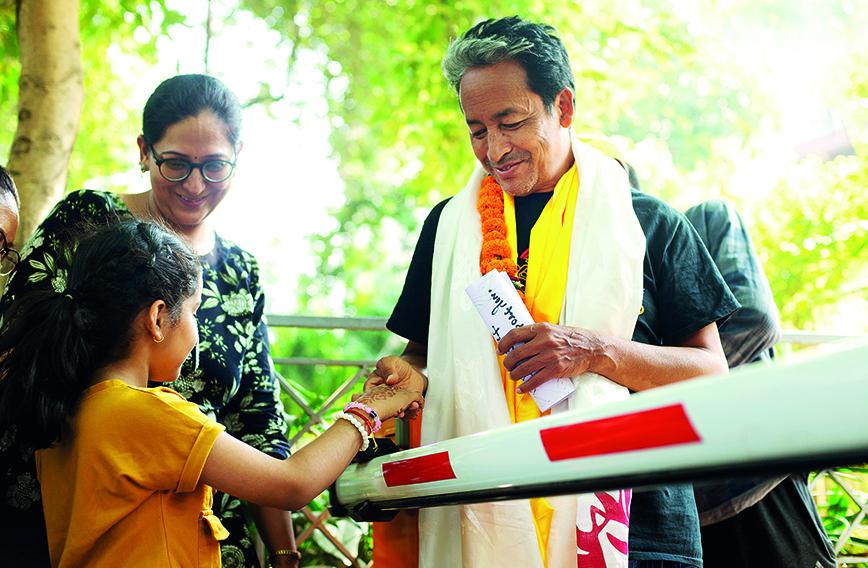
File photo of admirers greeting Wangchuk at Ladakh Bhavan in Delhi during his 2024 fast
Sonam Wangchuk is trying to save the Himalayas
Civil Society News, Gurugram
EVEN as Sonam Wangchuk was arrested and silenced in a Jodhpur jail, his message to protect the environment continued to reverberate across the Himalayan states — not in slogans and protests but amplified by Nature herself in benumbing devastation.
Never before have people in the Himalayas had to contend with such widespread occurrence of mountainsides crumbling, roads vanishing and homes being destroyed. There have also been accompanying deaths and, perhaps worse than death itself, the trauma of uncertainty.
In West Bengal, after heavy rain 28 lives were lost in Darjeeling and the entire Gorkhaland Territorial Administration was cut off. There were downpours in Himachal Pradesh too where floods had earlier rampaged through Manali and apple-growing country. Sikkim was similarly plunged into turmoil.
Wangchuk has been accused of being an anti-national, but the causes he has been raising have been about the environment, the involvement of local people in development and the growing crisis being brought on by global warming.
The people of Ladakh have a long and glorious record of loyalty to India. Over generations they have served in the armed forces. Their presence on the border has been a deterrent to China. But now they have been experiencing a sense of disenfranchisement. There is also a lack of opportunities. Their concern is that their traditional way of life and their fragile ecosystems are under threat.

Wangchuk was arrested in Leh under the tough National Security Act (NSA) when demonstrators seeking the Sixth Schedule for Ladakh turned violent and burnt the BJP office there. Leh looks to Wangchuk for leadership, but he is not a rabblerouser. His charisma comes from being an environmentalist and inventor who founded an iconic school in Leh to promote alternative education. Videos on the day of the violence show him appealing to the young demonstrators to cool down and take the path of peace.
But feelings in Leh had crossed a point in a way that Wangchuk had been warning the government about. In 2024, when Wangchuk and 150-odd followers walked from Leh to Delhi, it was with a wake-up call. The government needed to at least discuss the Sixth Schedule status Ladakh had been promised after it became a Union Territory. Its water sources and grasslands needed to be protected in ways local people knew best.
Far from getting a hearing in Delhi, Wangchuk and his fellow walkers, mostly simple village folk and Ladakhis who had served in the armed forces, were corralled into Ladakh Bhavan where they remained fasting in protest and lying out in the open on the driveway.
The fast continued even as Wangchuk’s own health deteriorated with a fever and fears of dengue and dysentery. Twice every day he would meet a random bunch of people, mostly admirers and journos from small websites. The leaders of the farmers’ agitation turned up. There were some politicos who stopped by. The protest finally ended when a joint secretary from the home ministry showed up with a written promise that the government would discuss the Sixth Schedule demand.
When we met him under a tree outside Ladakh Bhavan for an extended interview while he was still on the fast and there had been no word from the government, we asked him how difficult it was to take up an environmental cause as he was doing. He had an interesting reply. Environment, community concerns and development were inextricably linked, he said. The national interest lay in trusting and empowering local communities. People who had looked after the Himalayas for generations knew best how to take care of the mountains.
“For the Himalayas as a whole I think there should be special provisions that give local elected bodies powers to take stewardship of their areas, mostly environmentally and culturally, because these cultures have kept the Himalayas alive and safeguarded for millennia,” he said.
The Sixth Schedule of Article 244 of the Constitution would give indigenous tribal communities in Ladakh more control over how their areas are governed in terms of environment, land, forests, customs and so forth. This status had been promised by political parties twice in manifestoes.
Ladakh especially needs the Sixth Schedule after it was made into a Union Territory in 2019 along with the abrogation of Article 370. When it was a part of the state of Jammu and Kashmir, Ladakh’s people had a greater say over how they were governed. Now they looked to a distant Centre and development decisions were being made without consulting them.
Especially worrisome from the Ladakhi perspective has been the investments that have been encouraged in the name of providing jobs. Solar power companies disrupt traditional livelihoods in animal rearing and the jobs they may provide are not what the Ladakhis need. Had there been consultation, both local concerns and the corporate interests could have been easily reconciled.
“These seeming wastelands are the source of food for tens of thousands of groups. Sheep. Yaks. They don’t know that this is how life survives in Ladakh. It’s not like lush green pastures. The pastures in Ladakh are very different,” explained Wangchuk.
He said: “They think these are all easily available for solar power plants. If the locals had been asked, they would have shown other places where animals don’t graze. If I had been asked, I would have shown them how to take solar power from the tops of mountains and leave the pastures to the goats and sheep below. It would have been a win-win situation where the local herders would get twice their fodder and the nation, solar power.”

“We should not see these mountains just as a resource to be exploited in a few decades by a few millionaires and billionaires. And then you are left with the devastation that you see in Sikkim, in Himachal, in Uttarakhand,” said Wangchuk.
“It is very sad that governments give a free hand to corporations. Corporations squeeze and extract their profits in a decade or two and then leave the place. It is a use-and-throw style. And then when disaster strikes, like floods in Sikkim, or, you know, roads and entire mountains collapsing, that is dealt with through taxpayers’ money. And then, finally, the local people have to bear the consequences for generations,” he said.
For Wangchuk, the solution is local empowerment and proper popular representation so that the decisions taken have the involvement of people and keep their interests in mind.
“If your cause is big, nothing is difficult. If it is a non-issue, then anything is difficult. So, in absolute terms this may not be easy but when compared to the scenario which will take shape in the coming decades, this is nothing,” he said.
“You know, in a place like Ladakh, which is on the ultimate border, flanked by hostile countries like China and Pakistan, when people, especially the youth, are unhappy, frustrated, it can lead to a big upheaval in the future. Maybe liberation movements. I am not saying it should. But it can. And if my little effort today helps in preventing that, even if it takes my life, it’s just one life, not 5,000. So, it (the challenge and sacrifice) is very small when compared to what we are seeing,” he said.
Comments
-

Viraf Mehta - Nov. 7, 2025, 4:11 p.m.
Dear Umesh, There are two- sides to this story and whilst no one would disagree with most of the latest set of post-UT demands related to the protection of Ladakh's future, or that the Govt should be even more responsive to feelings of locals, one should be wary of highlighting individual personalities, including SW, and need to adopt a more cautious and critical approach in its analysis of his personal aspirations and social worker/ activist/ political roles! Best Viraf PS I live in Leh full time nowadays