



SANJAYA BARU
Ahopeful Indian prime minister once said that MAGA (Make America Great Again) can also help MIGA or Make India Great Again. The end of a quarter-century-old India-US ‘strategic and global partnership’ has just been announced. Speaking at the Raisina Dialogue in New Delhi, the deputy secretary of state of the United States, Christopher Landau, put it candidly: “The US will not give India the same kind of economic advantages it gave China. US will not allow India to become its competitor. The Trade Deal will keep ‘America First’.”
This should not come as a surprise to anyone following the India-US bilateral relationship over the past decade. The departure from the Atal Bihari Vajpayee-Manmohan Singh era in the bilateral relationship began in 2017 when Donald Trump began targeting India on the trade front. The withdrawal of the Generalized Scheme of Preferences, that gave beneficial access to the US market for certain Indian exports, was the first step. While President Trump’s target was China, India suffered collateral damage.

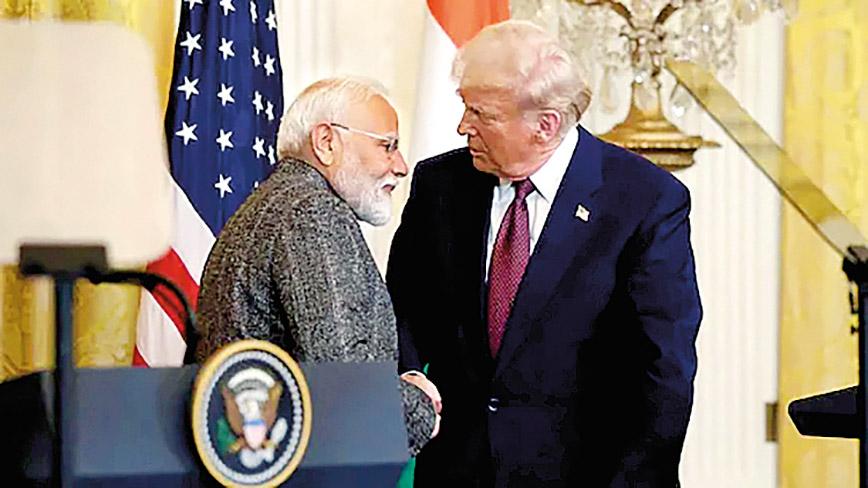
Prime Minister Narendra Modi responded to the ‘transactionalism’ of Trump by deploying his personal charm, walking hand in hand with the US president at a huge rally in Houston and declaring on the eve of the 2020 US presidential elections “Ab ki bar Trump sarkar” at yet another huge rally, this time in his home state of Gujarat. But that was wasted investment since Trump was trounced.
President Joseph Biden persisted with transactionalism, demanding India buy more defence equipment from the US in order to keep the relationship going. Many geopolitical and foreign affairs commentators explained this by stating that the India-US bilateral relationship was no longer ‘strategic’ but had become ‘transactional’. The faithful, however, persisted. The focus of the strategic partnership is now on technology, they said. The US will now give India access to high and advanced technology. Various agreements were cited as evidence. Many in the think tanks and in the media in New Delhi kept faith.
The first shocker came from one of the earliest American advocates of US-India partnership, Ashley Tellis of the Carnegie Endowment. In a lengthy analysis of the bilateral relationship published in 2024, Tellis made the telling point that an earlier assumption that India’s rise would in itself be in the interests of the United States no longer has any takers in Washington, DC. Everyone who matters in the US, said Tellis, asks the question, “What’s in it for us?”
I was reminded of what a visiting group of US Congress members told Manmohan Singh in early 2008: “It is 123 for 126” — implying that their support for the 123 Agreement, required to enable the civil nuclear deal to go through, was based on the understanding that India would place an order for 126 fighter jets. In the event, India chose to buy from the French. But then, India has spent billions buying other stuff from the US to keep the relationship going.
Under President Trump, ‘America Maange More’! The US wanted India to buy more goods and reduce the bilateral trade surplus. The US wanted India to bring down its tariffs. The US wanted India to not insist on data localization. And then the US wanted India to stop buying oil from Russia. Trump’s message was that song from My Fair Lady — “Don’t talk of love, show me!” Go hug the world, but bend before me.
Trump’s shockers came one after another. It all began with Trump inviting Chinese President Xi Jinping for his inauguration in January 2025 and not inviting Modi. Foreign minister S. Jaishankar rushed to Washington to secure an invitation for the PM but managed to just get one for himself. Then came Operation Sindoor and Trump’s repeated claims that he imposed a ceasefire on warring neighbours and deserved a Nobel Peace Prize. India insisted the US had no role in its decision to hold fire. The Pakistanis not only thanked Trump but nominated him for the Nobel Prize.
Then the India-baiting Pakistani Field Marshal, Asim Munir, secured a historic lunch invitation from the US president. An unprecedented gesture. Diplomats in Delhi and Washington noted the fact that when Modi dropped in at the White House, Trump was not even at the door to receive him. And Trump kept meeting Pakistani leadership and was buddy-buddy with them and they were doing ‘Sirji’ to him all the time.

Nothing makes a Modi bhakt in India more angry than someone being nicer to Pakistan than India. They are willing to excuse countries that favour China more than India because they understand that money talks. China is bigger and richer. So how can we object if all our friends keep their relations with China intact. But Pakistan? A failed and flailing state. Our sworn enemy. How can anyone be nice to Pakistan? Well, Trump decided to be.
Despite all these slights and put-downers India decided to stop buying Russian oil. Modi decided to visit Israel and repeatedly hug Benjamin Netanyahu, perhaps hoping that the rich Jewish lobby in the US would get Trump to get off Modi’s back and be nice. India even decided to remain quiet when Israel and the US bombed Iran and assassinated its Supreme Leader, Ayatollah Ali Khamenei. The US heaped further humiliation on India by bombing an Iranian naval vessel close to Indian waters and then announcing that it would “allow” India to buy Russian oil to make up for the disruption in Gulf supplies.
Insult after insult. Then arrives Mr Landau, saying, “Yes, we created a problem for you by enabling China’s rise but we will not solve that problem by enabling your rise.” Get the message? MAGA does not need MIGA.
Sanjaya Baru is an economist, former newspaper editor and author. His most recent book is ‘Secession of the Successful: The Flight out of New India’.
Comments
Currently there are no Comments. Be first to write a comment!