




SANJAYA BARU
Why is it that while the challenge of air pollution has been able to attract some public and policy attention in the national capital, there is as yet little focus on the other urban challenge — noise pollution? While noise pollution was officially identified as a major social problem in urban India a quarter-century ago, with the notification of the Noise Pollution (Regulation and Control) Rules, 2000, few state governments are willing to address it determinedly.
A sociological explanation offers itself up as a possible hypothesis. Air pollution does not discriminate between Lutyens Delhi, where everyone from the prime minister down lives, and a Karol Bagh or a Daryaganj. Noise pollution, on the other hand, is not as much of a challenge in the tree-lined avenues of upmarket Delhi while it rattles the mind across the metropolis.
Noise pollution rules notified under the Environment Protection Act, 1986, aim to stem the rising tide of urban noise through several sources, especially loudspeakers, traffic, construction, and public events. The rules acknowledged the fact that noise exceeding certain medically acceptable decibel levels not only disrupts peace but also affects the quality of life and health of residents, especially the young and the old.

The hazardous effects of sustained, repeated and high-decibel noise pollution are many and include hearing loss, inducement of stress, anxiety and contribute to cardiovascular and cerebrovascular disease. Individuals prone to nervous stress are particularly vulnerable to sharp and sustained noise. Noise pollution also delays recuperation and rehabilitation of ailing patients in hospitals, which is why traffic rules do not permit honking in the vicinity of hospitals. This rule is today observed in its callous breach.
Mention should be made that sustained neighbourhood noise has a deleterious impact on the learning abilities of children and youth studying at school, college or at home. In fact, most urban neighbourhoods are no longer conducive to serious reading and study and the education of the young.
Living intermittently in a residential neighbourhood in New Delhi and Hyderabad, I have identified three prime sources of noise pollution that have become a public nuisance: (a) Vehicular traffic, especially honking by most drivers; the use of sirens by police vehicles escorting ministers and other senior government functionaries and political busybodies (a nuisance across the country); (b) loudspeakers deployed by mosques, temples and other religious places, as well as by political parties and social activists; and (c) construction activity.
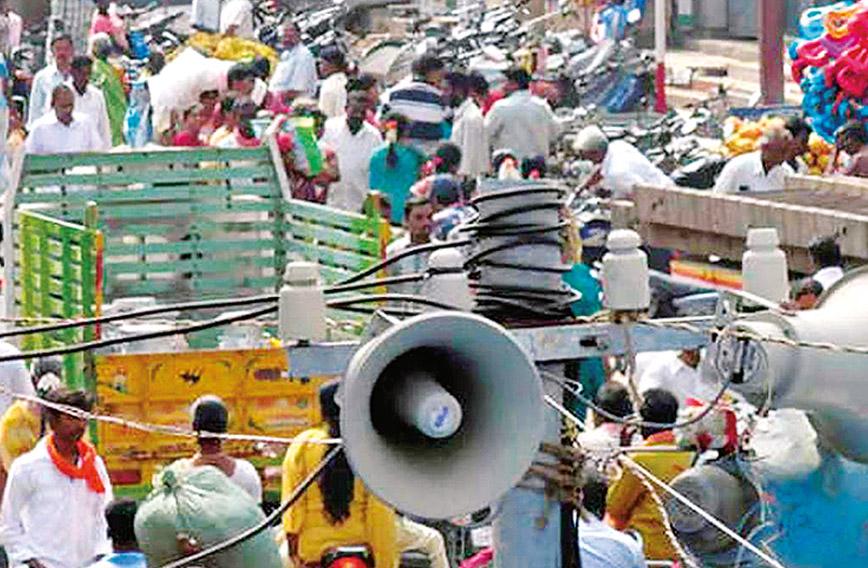
The use of loudspeakers in public places and residential areas has generally been limited in most cities to between 6 am and 10 pm. Any use after 10 pm requires special permission. This has not inhibited rampant use of loudspeakers through the night. During religious festivals loudspeakers are routinely deployed. This can range from loudspeakers blaring music from pandals with idols of a succession of Hindu gods to high-decibel speakers being placed in huge vehicles that carry idols around cities before their immersion, or accompany devotees such as the Kanwariyas. The blaring of film and religious music at exceedingly high decibels through the night have made these events a major cause of noise pollution in several cities across India.
Next to the Hindu community come the Muslims with muezzins calling the faithful to prayer with their often ill-trained and guttural voices, over multiple loudspeakers. Hearing the screeching and often an audibly unmusical voice of a muezzin at a mosque, summoning the faithful to worship, in the early waking hours, one wonders how the faithful were summoned in the age before loudspeakers. In that distant era when humans did not have watches and alarm clocks the loud summoning of the faithful by a muezzin is understandable. But with everyone having a mobile phone does one require a loudspeaker to remind one that it is time for prayer, time to eat, time to fast?
When ministers drive around with police escort cars blaring sirens how does one expect the government and the police to be sensitive to the problem of noise pollution? Apart from the failure of authorities in checking noise pollution there is a cultural dimension to the challenge. Most Indians tend to be noisy.

This fact was recently highlighted by a directive issued by civil aviation authorities urging airline passengers to use earphones while listening to music or viewing entertainment on a flight. Indeed, one often has to request fellow passengers to speak softly so that one can read a book or get some shut-eye. The upwardly mobile Indian is a very noisy animal.
Urban India has become sensitized to an extent to the hazards of air pollution because it is beginning to feel the deleterious effect of toxic air, with rising incidence of lung disease. However, there is very little appreciation of how noise pollution is also a health hazard.
The time has come for a national campaign against noise pollution. Three immediate steps that can be taken and that would immediately reduce decibel levels would be (a) ban on use of loudspeakers at all places of worship, marriages and other social events at all times; (b) ban on loudspeakers being placed on trucks carrying idols during festivals; (c) ban on use of sirens by police vehicles escorting ministers and all other government vehicles, except ambulances.
Urbanization is not just about building the hard infrastructure of roads, flyovers, Metros, high-rise buildings, drainage and public parks. It is equally about creating a shared culture of urban living, of which minimizing noise is an important element.
Sanjaya Baru is an economist, former newspaper editor and author. His most recent book is ‘Secession of the Successful: The Flight out of New India’.
Comments
-

Sreenath Dixit - May 8, 2026, 4:33 a.m.
I was unfortunate to be living in a place surrounded by marriage halls ((in)famously called 'Gardens' ) in Old City , Hyderabad for a decade and a half. The marriage season was an excruciating time for our entire family. Many a times I would get up due to high decibel noise in the dead of the night and call the police. For the police, which is always busy with many other priorities, noise pollution is not a violation to be addressed. Besides, with vehicular traffic ever increasing, I don't see any respite in the near future. I can only wish that at least our next gen will have more peaceful surroundings.
-
Sridhar Srinivasan - May 7, 2026, 11:16 a.m.
Absolutely agree. Fellow passengers in trains openly listen to songs/videos not realizing the disturbance they cause. Honking is a major problem. There are cab drivers who incessantly honk even if it is a clear road !! (guess they are so used to this habit). Indians generally tend to be a loud as well when they converse/speak. Apart from the above recommendations, some ideas to address this are 1. Inculcate the harmful impact of noise pollution to children right from the primary grades. School education is the best place to drive home the importance of serious social issues 2. Stringent penalty for non-compliances 3. Local MLAs and the political class need to be engaged in this as well. First, they should be educated on this matter and then they should create awareness on this across the community