




In Odisha, each redeveloped housing colony has spaces for children to play
Homes in slums: Odisha shows how it can be done with rights
Rina Mukherji, Pune
THE Odisha government’s Jaga Mission for Slum Transformation is easily a standout project in India’s slum redevelopment landscape. It ticks all the right boxes and would meet the approval of pernickety social activists. It has people’s participation, land rights, delivery of services, infrastructure, gender rights, technology, NGOs and more.
The Jaga Mission is now the world’s largest slum redevelopment initiative. It’s being implemented across cities and towns in Odisha.
Twenty-eight Urban Local Bodies (ULBs) are now slum-free. Currently, 1,680 slums in various ULBs have been upgraded, and four new settlements have been set up in lieu of habitats where land rights could not be given.
“A holistic partnership with the community and the facilitating role of the government is the prime reason for its success,” says G. Mathi Vathanan, additional chief secretary, Government of Odisha and director-general of the State Administrative Training Academy.
What can the rest of India, or the world, learn from the Jaga Mission? A six-part webinar by INHAF, a non-profit in Ahmedabad devoted to improving collapsing urban India, discussed slum development globally, and included a session on the Jaga Mission.

The inaugural session on September 30 began with a keynote address by UN Habitat Executive Director Ana Claudia Rasbach, who referred to the housing crisis being faced across the world. Currently, a billion people globally are housed in informal settlements and slums. “Housing is not just shelter. It spells dignity, and self-esteem,” she said. UN Habitat is mobilizing data to produce the World Cities Report 2026, and help countries with the means and knowledge to provide housing for their populations.
K. Srinivas, secretary, Ministry of Housing and Urban Affairs, said there needs to be better understanding of how slums arise. It is well known that slums form when poor people migrate to the city to find work. Also, as cities expand, they swallow villages which slowly degenerate into slums. People flock there in search of inexpensive rental housing. Most often villages don’t have the infrastructure or services to accommodate so many people.
These settlements, he emphasized, require a different approach. Both kinds of habitations and their residents need to be brought on a par with the rest of the city and have the same amenities.
So far, the government has been underlining the importance of ownership rights. But, he emphasized, what was important was the need to provide affordable rental accommodation for the floating population of young, mobile job-seekers all over India who come to cities. For this, a public-private partnership, (PPP) he felt, was essential.
Greg Mundro, director, Cities Alliance, a global partnership alliance, cited the difference between informal settlements and slums. While informal settlements get upgraded with services over time, slums only worsen, he said. He listed areas for global action, namely, land, spatial planning, governance, policies, community empowerment, data, finance and skills. He also explained how his organization was working in India, Brazil and South Africa to provide decent housing.
Alexander Apsan Frediani of the International Institute of Environment & Development (IIED) chronologically listed how approaches to slum development and upgradation have evolved over the years. Growth with equity and neoliberalism have now been replaced by the current buzzword, sustainable human development. Since 2020, the emphasis is on justice, inclusion, an anti-discriminatory approach, infrastructure, and systemic change to build caring, sustainable cities.
Somsook Boomyabancha, secretary-general of the Asian Coalition of Housing Rights, spoke of community-led slum upgradation and development projects that have been undertaken across Asia, especially those in Bofarang and Chumpao City in Thailand. In Chumpao City, 13 housing projects with 1,050 families were taken up. The projects involved beneficiaries and that helped to bring down costs. The communities worked with the architects and contributed to the layout. The upgraded slums have a community hall, a welfare centre for the elderly and a community garden where residents grow organic vegetables within the settlement.
Beth Chitikwe Biti of Slum Dwellers International objected to slums being viewed as a problem. Instead, citing cases in Kenya and Namibia, she referred to slums as “opportunities” for communities to come together. She recounted how women in the slums of Namibia had formed a collective, then formed a savings group, and ultimately, with the help of government allocation, financed their own housing needs.
Similarly, Maria Silvia Emmanueli, who heads Habitat International, Latin America, talked of how women from slum communities in South America had come together during the Covid-19 pandemic to prepare a document on human rights, focusing on the right to water, sanitation and a clean environment. This document emphasized neighbourhood improvement through mutual aid networks.
In the second session held on October 7, administrators from the Odisha government discussed the nuts and bolts of the Jaga Mission. Most municipalities consider slum dwellers to be mere encroachers. The Odisha government turned this notion on its head. Migrants are essential for urban growth is its belief.
A project’s success is best gauged by what its beneficiaries have to say. Khushi, a transgender and president of the Pragati Vihar Slum Dwellers’ Association in Bhubaneswar, spoke gratefully about what the project meant for them. “We were helpless, ostracized by everyone. Now we can look forward to leading a dignified life. Forty-two households have land rights and one-third of families have started building their homes under the PM Awas Yojana (PMAY).”
A fisherman from Konarak, Pikki Tatilu, president of the Noliasahi Slum Dwellers Association, Konarak, recounted how the 1999 super cyclone had blown away their flimsy huts. “We had set up homes in a low-lying area, where dumping was rampant along with water stagnation. The government filled up the land, and we were granted pattas. We now realize this land is ours. Nobody can move us from here.”
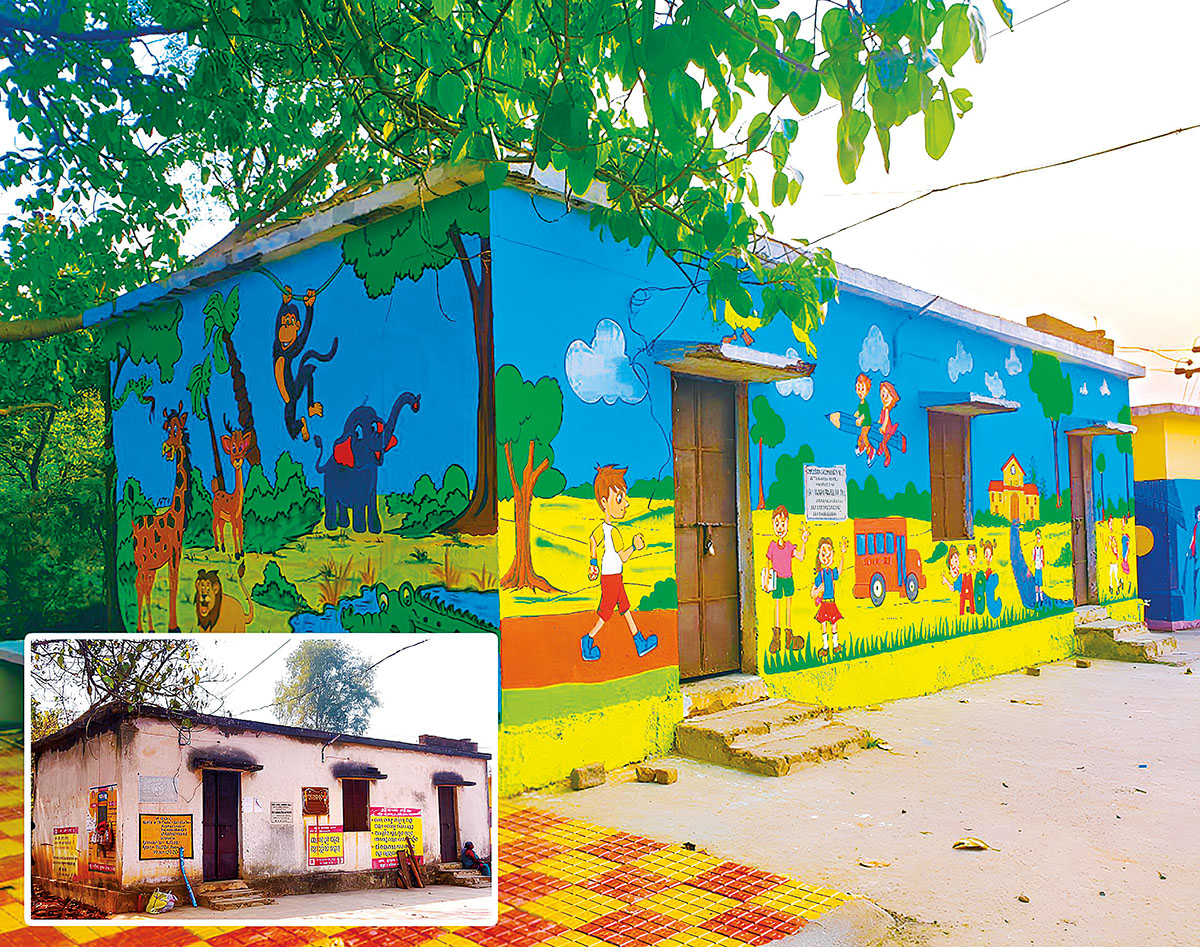 Before and after: In Odisha, the Jaga Mission provides all facilities
Explaining how the Jaga Mission achieved its objectives, Vathanan listed components of the programme: land rights, a liveable habitat, housing assistance through the PMAY, divergence of land, empowerment of beneficiaries, especially women, and turning slums into vibrant economic centres.
The Odisha Land Rights to Slum Dwellers Act, 2017, and the Odisha Municipal Corporation Amendment Act, 2022, were changed. Drone imagery and other technologies were used for mapping settlements. NGOs were involved. In 2019, slums in 115 cities all over Odisha were mapped.
According to law, 25 percent of the budget of every ULB was marked for slum upgradation. Change of classification in land has, so far, benefited 35 percent of slum families in Odisha.
Slums were found on different types of land: government lands, temple lands, forest lands, industrial lands, hazardous lands and king’s lands.

In most cases, in-situ settlement was arranged. New habitats were found for slums on untenable land like hazardous land or forest land. Wherever necessary, land classification was changed to facilitate upgradation or resettlement.
In the case of forest land, the Forest Department and Forest Development Committees were brought in to assess the situation. But, in every case, the new settlement was never set up more than a kilometre from the existing habitation.
In every case of in-situ settlement, re-densification was undertaken too, with the new settlement being provided street lights, a community centre, a playground, piped water, and individual toilets in every home.
This was after an infrastructure gap analysis was done with the help of the respective slum community. Thus, the community was involved in every step of the process. Slum Dweller Associations were formed and presidents elected. The idea was to spot local talent and not bring in people from outside.
Finally, in every household, women were given joint ownership and land rights, spelling empowerment and progress. Land can be mortgaged and is valid as proof of address but it cannot be resold.
Backed by the Tata Steel Foundation, Janaagraha, the Bill & Melinda Gates Foundation, and Tata Trusts, besides many other organizations, the Jaga Mission is an ongoing project of the Odisha government that has already received accolades, including the UN Habitat Award.
Comments
Currently there are no Comments. Be first to write a comment!