



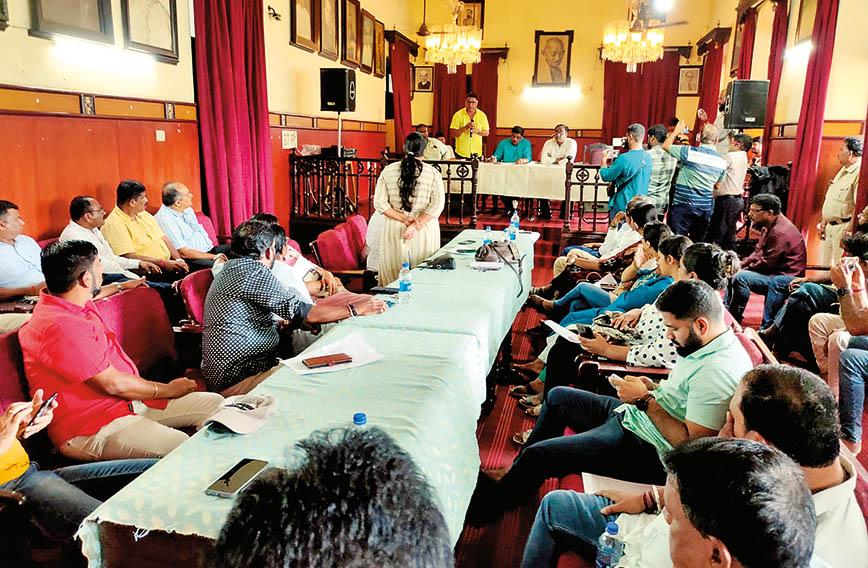
A meeting at the Margao municipal corporation
Shadow Council wants Margao master plan to be out in the open
Praveena Sharma, Panaji
A master plan sought to be foisted on Margao, South Goa’s only major city, has been in abeyance for four years because of resistance by residents who fear that real estate developers are being favoured at their cost.
The residents want the master plan to be placed before public meetings at which its provisions will be openly discussed. So far, only select gatherings have been allowed to review the plan.
The Margao Shadow Council empowers residents to keep tabs on decisions taken by elected representatives in the Margao Municipal Council.
The Margao Shadow Council is the only one of its kind in India and could be a model for democratic decision-making. In how it deals with the master plan, there will be lessons for urban governance in other cities.
In 2022, Town and Country Planning (TCP) Minister Vishwajit Rane decided to frame master plans for four cities: Mormugao, Valpoi, Ponda and Margao.

The master plans would create a framework that would dictate the shape of their urban development under the four municipal councils till 2041.
Four years later — and after the appointment of Mumbai-based StudioPOD Design Private Limited for the job — the municipal councils of Ponda and Valpoi cleared their master plans without a whimper of protest or public consultation.
Somewhere along the way, the plan for the port town of Mormugao fell by the wayside. It is no longer mentioned in correspondence and meetings regarding the master plans of municipal councils.
The Goa State Urban Development Agency (GSUDA) has, however, met with a tough wall of resistance against the master plan for the Margao Municipal Council (MMC) thanks to the Shadow Council.
 |
|
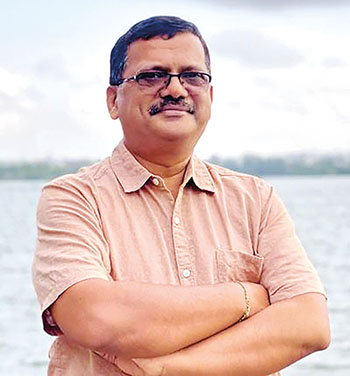
Coutinho, president, Shadow Council |
The Shadow Council was established in 2016. There was a similar council in Mapusa in Noth Goa but it was disbanded under pressure from the government.
Savio Coutinho, president of the Shadow Council for Margao, says these behind-the-scenes councils are officially recognized in other countries but in India, they operate “on their own”.
“We take up various issues whenever we spot them, raise them before the public, and fix responsibilities and accountabilities for government agencies. Because of this, there is some fear among the authorities that somebody is watching them,” he said.
Another thorn in GSUDA’s side is the resolute Vijai Sardesai, an MLA from Fatorda constituency, which is a suburb of Margao but lies within the jurisdiction of the MMC.
Sardesai and Coutinho have alleged a lack of transparency and an absence of consultative processes in formulating the Margao Master Plan 2041. Both are demanding the presentation of the master plan to the citizens of Margao at public meetings, where stakeholders can offer suggestions or raise objections.
In a letter written to the director of municipal administration on January 18, 2024, Coutinho accused civic bodies of being “selective” in inviting attendees for the Margao Master Plan 2041 presentations held on January 2, 2024, at two venues: the MMC building and Nanutel Hall.
Curiously, the presentation at Nanutel Hall was attended “mostly by builders and real estate developers”. He expressed outrage at the presence of Yogiraj Kamat, the son of former Chief Minister and current Margao MLA Digambar Kamat, at this presentation. The elder Kamat had won the Margao seat in the 2022 assembly polls for the seventh time.
“The most astonishing thing that we observed was the presence of Margao MLA’s son, Mr Yogiraj Kamat. Here, we wish to know in what capacity the son of Margao MLA Digambar Kamat was invited for the presentation,” wrote Coutinho, who served as the chairperson of MMC from 1997 to 2010.
 |
|
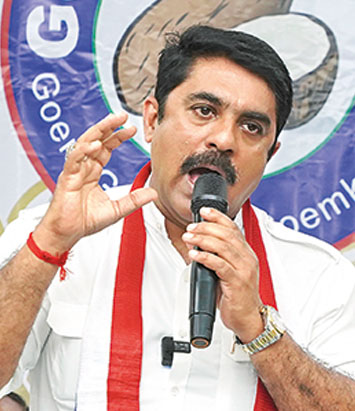
Vijai Sardesai, MLA from Fatorda |
The former MMC chief also viewed the unveiling of the Margao Master Plan 2041 — held exclusively for councillors and MMC staff — as a sham, given that less than 50 percent of the councillors attended. He highlighted the fact that only one councillor was vocal at the meeting while the rest remained “mute spectators”.
“This makes it clear that they (the mute attendees) either have no say or are not bothered about the plan’s details,” he wrote.
“We strongly demand that a presentation for the general public be arranged on immediate priority before the finalisation of the master plan,” Coutinho wrote in his letter.
To date, the municipal administration has not heeded his demand, stalling the MMC’s approval of Margao’s master plan. Meanwhile, GSUDA has already disbursed a part of the consultation fees to StudioPOD Design Private Ltd. The two parties entered into an agreement on August 14, 2022, for “consultancy work for preparation of Master Plan 2041 for Ponda Municipal Council, Margao Municipal Council and Valpoi Municipal Council at the quoted amount of Rs 1.95 crore, excluding GST”.
Coutinho is finding it increasingly difficult to peer through the thick veil of secrecy covering the plan. Despite being a former chairperson of the city’s civic body and well-acquainted with its mechanics, he is often left completely at sea.
“Even today, we don’t know the details (of the Margao Master Plan 2041). Nobody is telling us clearly. They were supposed to publish the master plan on the website, but that has also not been done,” lamented Coutinho.
In the meantime, the term of the elected MMC has expired. On May 27, an administrator for the MMC was appointed by the Goa government. The government has enacted the Goa Municipalities (Amendment) Ordinance, 2026, which requires the cancellation of the ongoing ward boundary delimitation exercise and has pushed back the elections, leaving administrators to run the councils. Coutinho fears that the administrator could now be “bulldozed” into clearing the master plan.
“Until now, they could not get the MMC to approve the Margao Master Plan 2041. Now that an administrator has been appointed, they may try to bulldoze it through him. I am just saying they are capable of doing it; I don’t know whether they will actually do it,” says Coutinho.
Sardesai, who served as Goa’s TCP minister from March 2017 to July 2019, corroborated Coutinho’s allegations regarding the opacity and vagueness of the Margao Master Plan 2041. He asserted that consultative meetings with the general public are an essential part of developing a master plan for a municipal council and cannot be bypassed.
“I have been the TCP minister of the state in the past. During my tenure, in the same area (Margao), I approved an Outline Development Plan (ODP), which is normally considered very controversial because of the changes in (land use) zones. I did it with full transparency, with public participation, and by factoring in all the opposition. I even extended the time given for raising objections as and when demanded by the activists,” he told Civil Society.
The politician, who firmly believes in following a democratic process in decision-making, previously resolved a sensitive issue regarding the relocation of a religious structure. He did so by engaging with civil society groups and securing consent from the affected community, all while adhering to the urban planning authority’s advice.
“We have a very socio-politically conscious electorate, which understands that if some things are needed, then there are no two ways about it. I don’t understand this practice of not taking people into confidence. If this (non-transparent and non-consultative process) goes on, then the master plan cannot be accepted,” he announced.
Sardesai rejected the general practice in most municipal councils of working in secrecy and following a non-participatory process. “The practice in my constituency is to discuss everything in a public forum. Why should you not discuss it? Let’s be open about everything. What do we have to hide?” he asked.
It is not just the general public that has been kept in the dark regarding the blueprint of the master plan; even Sardesai has little clue about it. A green patch of land used for farming by agriculturists for centuries, spanning around two lakh square metres of prime land, is at the heart of the friction.
The agricultural land opposite the Margao railway station was acquired by GSUDA in the early 2000s. The Fatorda MLA claims the farmland was acquired for a “phoney project of a truck terminus”.
“(It was) stopped by me after I became the MLA. For 15 years, I have not allowed this. I feel their eyes are on that land. They must have planned something on that land. This must be a builder’s plan. Somebody must be thinking they are going to transact on this land. We are not going to allow it,” says Sardesai emphatically.
According to him, a “real estate scam” is being packaged as the Margao Master Plan 2041 by the government and will do little to address urban nightmares like traffic snarls, parking issues, recurring flooding, deteriorating sanitation, a crumbling waste management system, and other problems that have arisen due to the aggressive pace of urbanization in Margao and its suburbs.
“A master plan cannot be a real estate scam. Those people (the farmers) have been cultivating that land for years. I have been giving them seeds, fertilizers, and everything else for the past 25 years, and I will continue to do so. Those fields will not be touched. The city (Margao) has a rural-urban nature, and we are going to preserve it. It will be preserved at all costs,” he vows.
Over the decades, Margao has transformed from a small town into the second-largest urban agglomeration and the commercial capital of Goa. Since the 1970s, it has experienced rapid urbanization accompanied by rising commercial activity and in-migration. This has led to an explosion in both human and vehicular populations.
As per the 2011 census, the population of the city proper was 87,650, while the broader metropolitan area was around 1.06 lakh. The metropolitan area’s current population is estimated at around 1.58 lakh. The city has always been a hub of economic activity and job opportunities. Some studies point to swift population growth at the turn of this century due to the rise in the service and construction sectors, which have attracted workers from other parts of Goa as well as Karnataka, Bihar, and Uttar Pradesh. This rising population has also seen a spike in vehicle density.
All of this has necessitated reimagining the city’s urban spaces. However, Coutinho believes urban development plans in Goa have to be handled differently compared to other Indian states because of its unique land-handling pattern, which is tilted in favour of private or community ownership.
“In certain areas where they have shown some form of development, it is not feasible because, unlike other states where most of the landholding is with the government, in Goa it is in private possession. So, you cannot say we will provide so-and-so project here on somebody’s private land,” explains Coutinho.
He cites a controversial case during his tenure as MMC chief involving the Comprehensive Development Plan (CDP) for Margao, which was prepared by architect firm Rahul Deshpande & Associates on behalf of the Goa State Infrastructure Development Corporation. It was presented to stakeholders and the public in January 2009 and was eventually scrapped after they raised uncomfortable queries.
 |
|
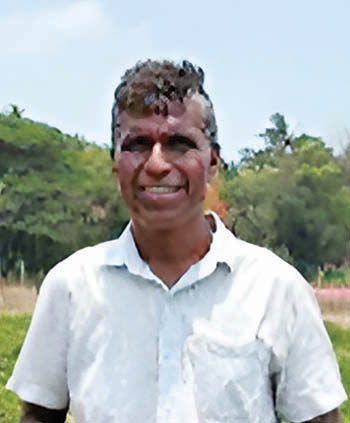
Claudias Dias in his field |
“I was being pressured at that time to blindly give approval (to the CDP). Citizens asked for changes to the plan (during the presentation to the public) and sent it back to the government. It never came back, but 40 lakh (paid to the consultant) went down the drain in planning,” revealed Coutinho.
For him, what is happening now is a replay of the CDP episode that unravelled during Digambar Kamat’s tenure as chief minister — except that the current government is deeply secretive.
Such governmental intrigue is rattling 54-year-old Claudias Dias, a resident
of Aquem Baixo, which is part of the Greater Margao urban area. His family, along with 40 others, grows paddy and vegetables on the two-lakh-square-metre plot opposite the Margao railway station. He says they operate like an unregistered cooperative society. He claims the records of his farmland are in the name of his grandmother, Natalia Faliero.
“During the Portuguese rule, our ancestors used to earn sidao (a special dividend or share of financial benefit distributed to shareholders from the surplus revenue generated by communal lands) on this land,” he said.

In the early 2000s, GSUDA took over the land for a transport project that never materialized. He now fears a fresh attempt could be made to acquire the land through the Margao Master Plan 2041.
He stated that his cooperative society collectively produces 18,000 kg of paddy in every agricultural cycle on this land. If the land’s zoning is altered in the Margao Master Plan 2041 from agricultural to any other category, over 40 families are likely to lose their livelihood.
“They will forcibly change the land-use category of this land. Now there is (Section) 39A (of Goa’s Town and Country Planning (TCP) Act which allows the chief town planner to rezone specific private plots). So, we wouldn’t be able to do anything. The government first brings in these acts or laws so you can’t do anything. Even the court won’t be able to help me,” said Dias helplessly.
Comments
Currently there are no Comments. Be first to write a comment!