



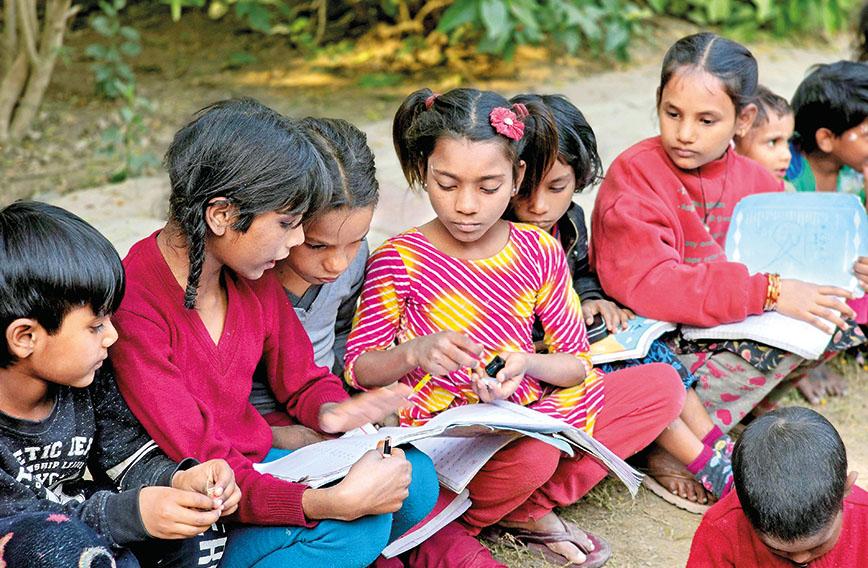
The children are enrolled in government schools
Tackling the root cause of begging
Kavita Charanji, New Delhi
 |
|
Raghvendra Pratap Singh |
In 2020, 18-year-old Raghvendra Pratap Singh, a student at Delhi University, teamed up with friends to start a voluntary group called Helping Hut. They wanted to help children begging at railway stations and bus stands by providing informal education. But the Covid pandemic derailed their plans.
Instead, Helping Hut reached out to volunteer groups in other cities and set up helpline numbers in as many as 35 cities to respond to people’s need for oxygen and other medical facilities.
Post-pandemic, Helping Hut didn’t dissolve but returned to its original plan. Led by Singh, it decided to help child and adult beggars. The group’s objective is to make cities free of beggars by ensuring adults earn an income, and children get an education. Under its ‘Beggar-free Project’, beggars are counselled and people motivated not to offer them money.
Helping Hut’s first priority was to set up an Udaan Street School for child beggars. “We feel that children will follow their parents and turn into habitual beggars. And once begging becomes habitual it will be that much harder to change their mindsets,” says Singh, who is now project associate with the Indian Institute of Science (IISc) in Bengaluru.
The aim of Udaan Street Schools is to prevent such intergenerational misery. Currently, there are Udaan teaching centres in Delhi, Gwalior, Mhow and, most recently, Varanasi and Dehradun.
At the Udaan Street School in Pragati Park in Delhi’s Dwarka, children are kept busy with fun classes and playtime. Most are in formal school but among them is seven-year-old Balvir Kumar who is out of school because he doesn’t have an Aadhaar card.
Kumar’s father is a construction worker while his mother works as a guard. Why does Balvir not have an Aadhaar card? “They live in a makeshift house with a plastic cover for a roof. They are ignorant about the importance of the document,” says Rishika Giri, a volunteer with Helping Hut who works with Firstgig Source. “We try and enrol children in government schools. We help them get basic documents like the Aadhaar card,” says Giri.
Udaan runs two-hour afternoon classes at Pragati Park. Classes are held regularly and not merely on weekends, says Singh.
There is Sunita whose son attends classes here. She says she wanted to study when she was young but her father passed away, ending her dream. “Helping Hut has been very supportive and provides education to my son,” she says.
Meanwhile, 11-year-old Gayatri Kumari, the daughter of a rickshaw puller, is clear that she wants to be a teacher when she grows up. She studies in a government school, thanks to Helping Hut volunteers.
The objective of the NGO’s “Beggar Transformation” project is to empower beggars and enable them to live with dignity. They are encouraged to learn new skills, find employment and lead productive lives. It is a better path to self-sufficiency than offering money, says Singh.
A former tailor became a beggar during the pandemic since it was the only way he could survive in those days. Helping Hut came to his rescue by giving him a sewing machine. It also helped to set up his shop and get it going. He is grateful to the organization. “God sent me this machine through Helping Hut. Now I have some hope to live,” he says.
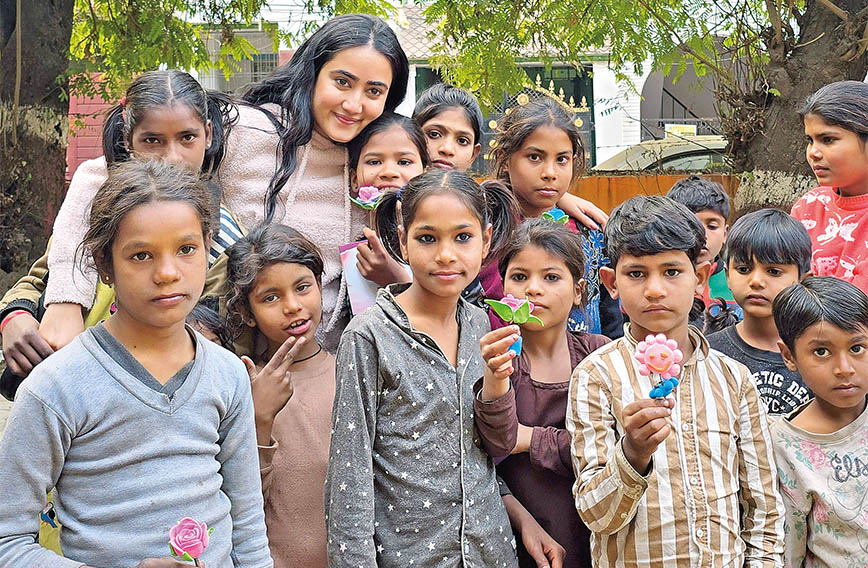 Volunteers help at an Udaan Street School for child beggars
Helping Hut also runs an Utthan Abhiyan campaign which educates underprivileged people about government schemes that benefit them such as Ayushman cards, ration cards, BPL cards and gas registration. Helping Hut enables them to connect with these schemes.
The NGO has a clear-cut strategy to reach the underprivileged. It identifies a few slum areas in every city where it has volunteers. A survey reveals the requirements of the slum and accordingly the Helping Hut team decides its priorities. In slum areas female volunteers fan out to inform women about basic sanitation, the importance of using sanitary pads and how to use them.
Helping Hut insiders say that over the past five years they have reached out to around 85,000 people. This includes students who are provided education, as well as recipients of food, clothes, rations and sanitary pads. They have also led drives for distribution of meals, stationery and clothes. Over 2,000 volunteers are registered with Helping Hut, while 640 students are registered for the Udaan campaign. Helping Hut has a partnership with National Services Scheme (NSS) and Rotary Club.
State governments are likely to support the initiative to ban beggary. The Indore administration imposed a complete ban on begging and alms-giving from January 1, 2025. It is also aimed to register FIRs against those giving money to beggars. Indore is one of 10 cities identified under SMILE (Support for Marginalized Individuals for Livelihood and Enterprise), a Government of India initiative to make cities beggar-free.
The NGO depends on monetary assistance from friends, volunteers, college professors and acquaintances who are encouraged to donate a small amount every month.
Weaning people off begging is not easy. Most projects have failed. However, Singh is confident of taking the NGO ahead. He cites the example of a group of women in Gwalior who picked and sold garbage. Helping Hut trained them to make useful products like small toys made of wool. Singh is now planning to launch similar recycling projects in multiple cities.
Comments
Currently there are no Comments. Be first to write a comment!