



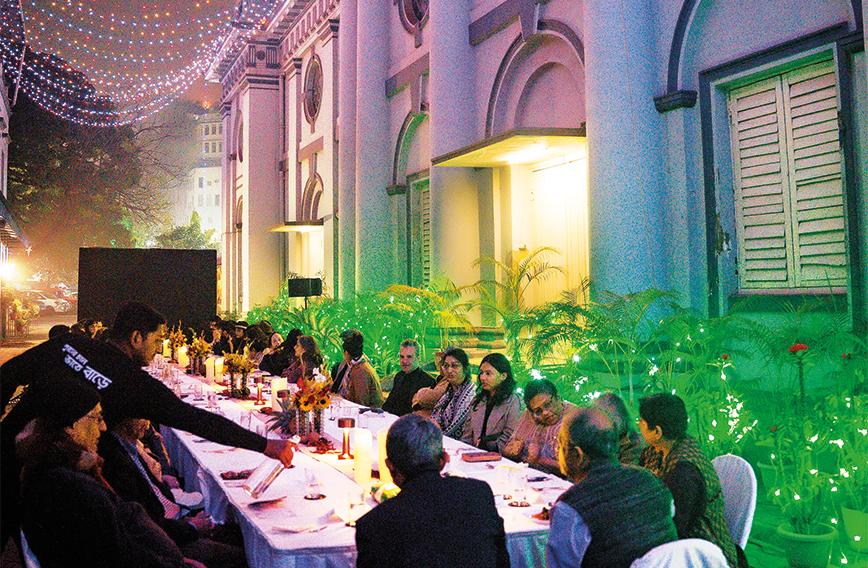
Over a five-course meal, 44 guests sat together at a long table in the open at the Burrabazar cathedral
Kolkata shows what it’s like to be eating together
Aiema Tauheed, Kolkata
In Tangra, a predominantly Chinese locality, chowmein and fried rice are offered as bhog at the local Kali temple. In Mominpore, bakeries like K. Ali sell German bread alongside Christmas cake. Anglo-Indian households are known to make Bengali rice cakes or pithas at home. And the most famous example of all: Nahoum’s, a Jewish bakery, has Muslim bakers and mostly Hindu customers.
A city that eats together stays together. Kolkata remains a glowing example of communal harmony in times when the rest of India is getting increasingly polarized on religious lines.
Hole-in-the-wall joints cater to the city’s large community of pork lovers. During Durga Puja, pandal-hopping includes mutton and egg rolls. Yet Kolkata was named India’s Most Vegan-Friendly City for 2025 by PETA India.
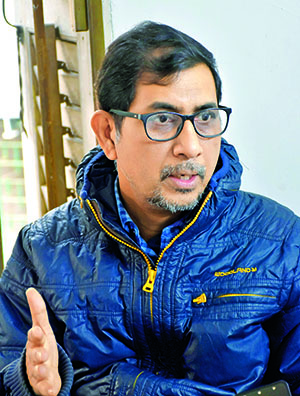 |
| Sabir Ahamed |
Strengthening such epicurean bonds is the Sabar Institute whose ongoing campaign, Know Your Neighbour, uses cultural exchange to foster coexistence. It began in 2016, prompted by how little Kolkata’s communities knew about one another under a lengthening shadow of communal tension across the country.
Sabir Ahamed, national research coordinator at the Pratichi Institute Trust and founder of Sabar Institute, says the initiative started with neighbourhood walks through areas like Zakaria Street. Ahamed is deeply invested in using street history to break stereotypes around communities. He recalls how the walks drew an overwhelming response, including women who entered the Nakhoda Masjid for the first time.
During Ramzan, Zakaria Street turns into a long stretch of food stalls, creating a vibrant social life. People converge to enjoy the cuisine. Ahamed realized people were living together but were not intermingling. Against the backdrop of sporadic communal violence, the neighbourhood walk emerged as a way to bridge that divide.
Sabar Institute soon discovered that food was an amazing bridge between communities. It evoked memory, shared experiences and united cultures.
Since then, Know Your Neighbour has expanded to include a range of activities such as workshops, food walks and community events designed as shared, participatory spaces. Interfaith gatherings like Dosti ki Iftar and Dosti ka Utsav create opportunities for conversation, bringing people from different backgrounds together in everyday settings.

One such initiative is Chair for the Reader, held twice a month, where students learn what the Constitution says and the ideas of B.R. Ambedkar. Alongside, there are interactions with prominent writers and thinkers like Amartya Sen.
Food is where mutual respect grows. Before organizing a community meal, dietary preferences are checked so everyone feels included. There are options for all. Ahamed recalls the care taken with haleem — a spiced, slow-cooked meat and wheat stew, silky and rich, topped with fried onions and ginger, and eaten with rumali or khameeri roti.
For one event, they served chicken haleem, inviting a diverse community of people. To his surprise, guests were visibly disappointed. “Chicken haleem isn’t haleem,” they protested, half in jest. “We came for the beef haleem.”
Ahamed recalls being invited by non-Muslim families to breakfast during Ramzan. Small, thoughtful gestures like keeping a clean space for namaz after iftar and ensuring meat is halal speak of a culture of mutual respect. “I think this only happens through interaction, talking, discussing, and exposure,” he says.
Sensitizing people, especially the youth, to different cultures is central to fostering communal harmony and coexistence. The approach is simple: dialogue and exposure.
 |
|
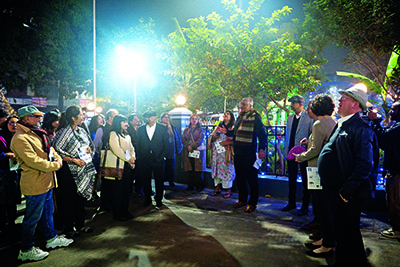
A brief walk through the Burrabazar cathedral’s layered history led by Father Franklin Menezes |
Visits to old temples, mosques, and churches open doors to understanding. Events such as Dosti ka Utsav invite Muslims, including young women who may have lived insulated lives due to social restrictions, to experience Durga Puja firsthand.
Dosti ki Iftari brings together people for meaningful conversations over iftar. Breakfast with Bakarkhani offers another platform: participants savour winter delicacies like bakarkhani, paya, and dal-puri while discussing history, culture, and food with experts.
This culture of togetherness through food extends into curated events. The first chapter of Eating with Bengal, an initiative by eatery Amar Khamar, unfolded at the Cathedral of the Most Holy Rosary in Burrabazar. Sujoy Chatterjee, co-founder of Amar Khamar, explained that it helped people think about Bengal’s “naturally hybrid, coexisting, multicultural cuisine”.
After a brief walk through the cathedral’s layered history, Father Franklin Menezes, in charge of the cathedral, spoke about the importance of breaking bread together to a diverse gathering of people.
Under the open sky, 44 guests sat together at a long table. Over a carefully curated five-course meal, food, history, and culture converged, tracing how Portuguese influences entered Bengal’s kitchens and continue to shape its palate.
In future, Amar Khamar plans to highlight other influences, perhaps global, perhaps deeply local. “Creating dialogue is very important for us,” Chatterjee adds. “And that happens effortlessly with food.”

“It’s called commensality,” says historian Jayanta Sengupta, director of Alipore Museum, who also delivered a keynote at the event. “Food is ultimately something that we share.”
He points to the iconic Kolkata biryani as a living example. Rice originated in India and then travelled to many other countries. With Alexander’s campaigns, rice journeyed to Central Asia, where it became part of pulao traditions. The Mughals introduced dried fruits and nuts, blending them with Indian spices. And the potato — now inseparable from the Kolkata biryani — was carried to India by the Portuguese.
What we eat without a second thought carries layers of migration, exchange and memory. “We love it without realizing how many traditions, how many cultures, how many histories have converged in it,” said Sengupta.
To eat together, he explained, is to share more than food. “Sharing a meal is sharing cultures and sharing lives. You speak to the people eating with you, and you share your stories.”
Comments
Currently there are no Comments. Be first to write a comment!