




Kolkata street as a canvas of everyday things in life
Aiema Tauheed, Kolkata
Kolkata’s Colour Corridor is a riot of colours on two walls with images evoking the past. Set against ageing buildings, deep within Ballygunge, the murals stir nostalgic memories of growing up in the city.
There is the unobtrusive table fan, a grandfather’s wicker chair, the morning ritual of chai-biscuit next to a half-folded newspaper, a colour television perched on a cupboard, old switchboards you no longer see.
A St+ART India Foundation project, the Colour Corridor has transformed a nondescript road into an open-air gallery for citizens, inviting all to come take a look.
“When I work on public art, it gives me immense joy to see people interacting with it,” says Sayan Mukherjee (pictured), the artist who led this effort. “My theme is ‘home outside home’. What if your home spills onto the street?”
Mukherjee draws on familiar domestic objects, items found within households, to anchor the murals in everyday collective memory. The artists dipped into Asian Paints’ Chromacosm — an expansive repository of 5,300 shades.

An alumnus of the Indian Art College with a Bachelor of Fine Arts degree, Mukherjee spent nearly a decade working for advertising agencies such as Ogilvy and JWT. After he became art director, he moved to the US for a residency at the School of Visual Arts. His first mural was painted at Eden Gardens in 2017. Public art remained the core of his practice.
The two walls on both sides of the road add up to around 8,300 square feet. This space was painted in around 15 days by Mukherjee and a team of artists from the Indian Art College in Dum Dum.
The Ballygunge walls were dim and disregarded, with bricks jutting out and the surface crumbling. The walls were cleaned, repaired and transformed into a canvas by St+ART India Foundation before the artists turned up armed with paints and brushes.
The challenges Mukherjee faced while creating the Colour Corridor are largely common in street art. The lane is narrow, traffic flows constantly, and motorists rarely slow down for artists at work.
“Painting on a canvas is one thing,” he says, “but painting on a public wall is completely different.” The artists contended with constant interruptions, people brushing against wet paint, even damaging the walls mid-process. At times, he recalled, people stopped to urinate against sections that were still being painted. There were people on bikes and in cars who shouted nasty remarks at the earnest artists.
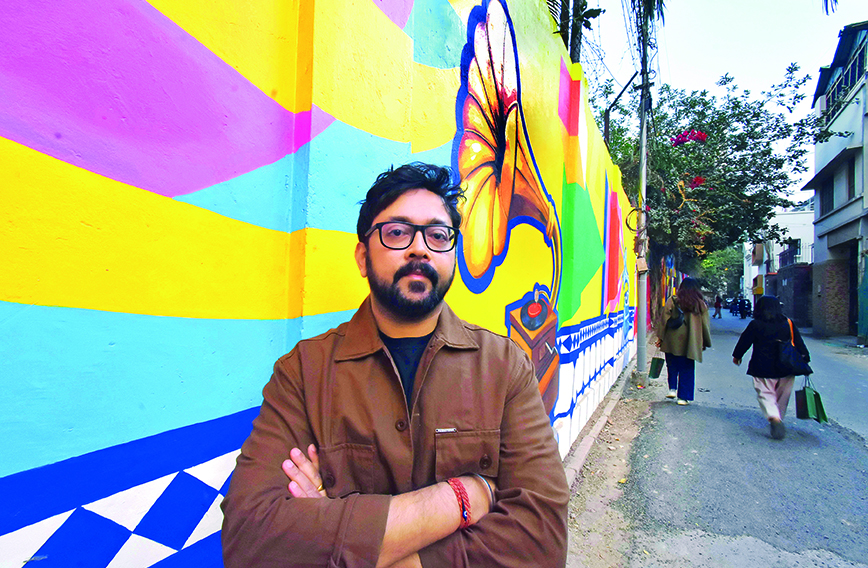
Mukherjee is nonchalant. The rewards, he says, far outweigh the difficulties. Local residents stop during their evening walks to speak with the artists, telling them they have never seen the wall look this beautiful since their childhood.
“People are actually loving it,” he says.
Those who live near the corridor supported the artists. Not only did they grant permission, they also checked on the progress being made, and offered tea and samosas in the evenings. “We’ve had a good interaction with the crowd,” he reflects.
People travel from near and far to see the Colour Corridor. The city has a symbiotic relationship with art. “It’s an age-old relationship,” says Suranjan Basu, a retired accountant with a camera in hand. People linger, take photographs, and quietly absorb the murals. Basu lives in north Kolkata and spent nearly an hour making his way here.
Debasmita Saha, who works for a company, discovered this lane through social media. She came all the way from Beliaghata, travelling for nearly 45 minutes. “It captures the essence of Kolkata,” she says. “The food, the chess, the chairs, seeing all of this as a Bengali feels familiar.”
For Anindita Roy Sarkar, a homemaker who also runs a small boutique, this is her second visit to the site. The directions on social media were confusing, she says, and she finally arrived at the right spot after walking from lane to lane. “Whenever there are murals or graffiti, I make it a point to stop. The colours always draw me in,” she says.
Ananyo Dey, who works a nine-to-five job and pursues photography as a passion, had been waiting for the murals to be completed. He finally made the trip from Ultadanga today.
“Most of these objects were part of my childhood,” he says, pointing to the jhaal muri painted on the wall. “It reminds me of winter evenings spent with family, sharing jhaal muri.”
“Art, I think, is rooted in our genes,” says Gargi Choudhury, who works for a company and is a photographer in her free time. She pauses before the image of Goddess Durga. “It reminds me of Pujo,” she says.
For Mukherjee, the idea behind the Colour Corridor began with a simple belief: art should not remain confined to galleries or drawing rooms. It should step into the street, and become a part of everyday life.
That thought, he says, is where the idea of ‘home outside home’ takes shape. The impact of such work is not easily measured. Nothing tangible changes, yet something shifts. As people walk past, they pause, look up, and feel lighter. “That’s what colours do,” he says. “We don’t always know how they work.”

The murals are inspired by Mukherjee’s own experiences — objects from his own home, the streets he has grown up in, and the people he knows. Many of these details, he reflects, already feel distant. What was once commonplace 20 or 30 years ago is slowly disappearing. By bringing them back onto the wall, the work becomes a form of not resisting change but remembering what shaped the city, and him.
As an old city, Kolkata is often recalled with nostalgia. Layers of history coexist with the present. As time marches on, many of the objects and markers that once defined everyday life slowly disappear.
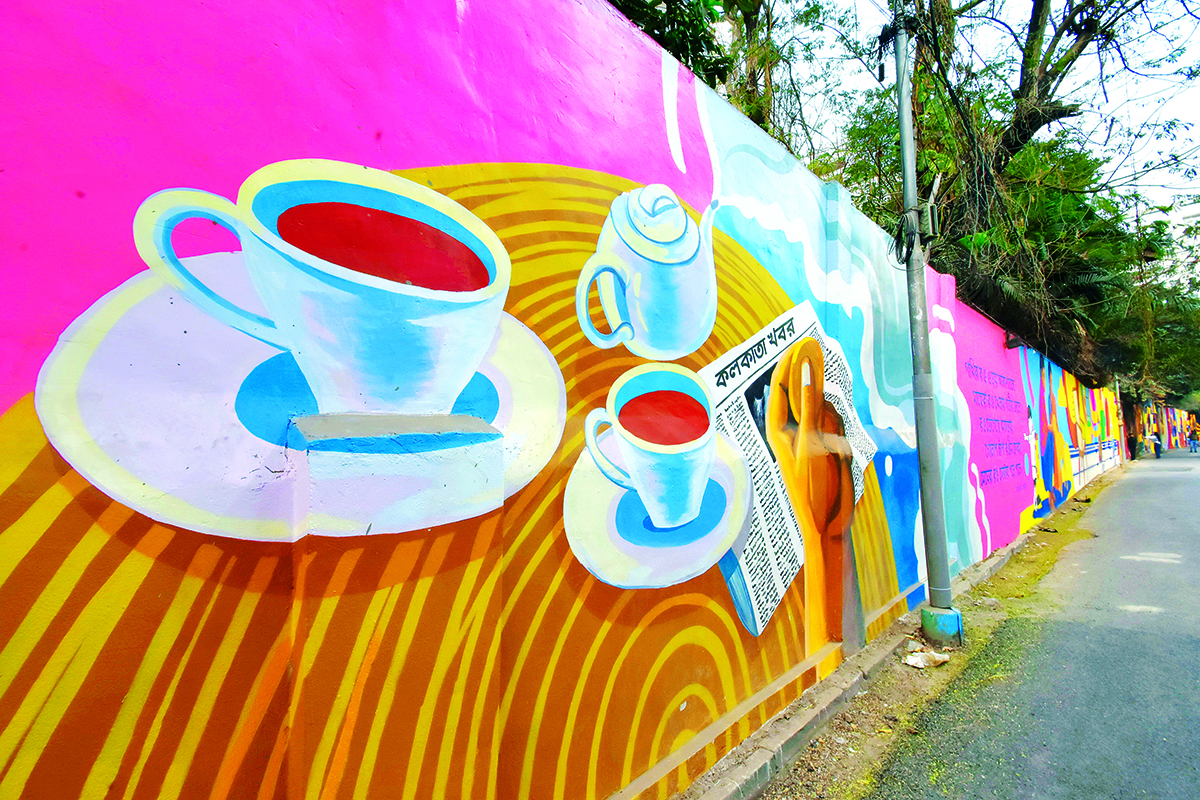
Cities begin to resemble one another, their buildings and public spaces become increasingly uniform. What gives a place its character, Mukherjee suggests, lies in the ordinary things that uniquely belong to it. The quotidian objects around which culture gathers and life unfolds. By bringing these onto a public wall, the mural becomes more than an artwork, it becomes a reminder.
In pausing before this spread of art, people are offered memories, and familiarity, and their roots. And in that moment of recognition, the city briefly remembers itself.
The team which worked with Sayan Mukherjee includes Prodip Sarkar, Tushar Adhikary, Palash Poddar, Sayandeep Roy, Subrata Sarkar, Rahul Jaiswal, Sandipan Paul, Supriyo Maity, Soumen Majhi, Bibhas Kotal, and Pabitra Patra.
Comments
Currently there are no Comments. Be first to write a comment!