




The Indian Ploggers Army. Runners collect waste and pack it neatly for disposal
Litterbugs in Bengaluru are held to account
Rashmi Gopal Rao, Bengaluru
How do you deal with litterbugs who throw bags of mixed garbage on the street, disfiguring the cityscape? It was the single biggest challenge civic agencies trying to clean up Bengaluru faced. Officials at Bengaluru Solid Waste Management Limited (BSWML), however, ideated a solution.
In every locality there were litterbugs infamous for stealthily throwing their garbage, all mixed up in a plastic bag, on vacant spots, under trees and even tied to electric poles. The BSWML decided to call them out. Citizens who reported such habitual offenders would be rewarded with Rs 250. The offender would be fined.
Eventually, the fine collected totalled Rs 5 lakh from 350 litterbugs. There were mixed feelings about BSWML’s creativity but, on the whole, most residents thought it was a good idea.
“Around the end of October, we also organized an initiative called Kasa Suriyuva Habba or Garbage Dumping Festival, where the garbage of such habitual offenders was dumped back in their very houses,” says Balakrishna N., junior health inspector, Basavanagudi ward in Bengaluru. “It was more of an awareness drive. We have imposed fines ranging from Rs 1,000 to Rs 10,000. The key takeaway is that such incidents have come down by about 30 to 40 percent and, more importantly, people have realized the importance of disposing their waste in a proper manner.”

Often considered the fastest growing city in Asia, Bengaluru, India’s IT capital, is witnessing rapid growth in population. It’s likely to rise from about 12.3 million to around 14.7 million by 2031.
The city’s stockpile of garbage will expand too. Currently, Bengaluru generates close to 6,500 metric tonnes of waste each day which is projected to double to 13,900 metric tonnes by 2031.
Unlike many apathetic cities, Bengaluru is trying to tackle the problem head-on. The civic administration, non-profits, resident welfare associations (RWAs) and private e-waste companies are working in step to reduce, recycle and reuse waste.
Agencies and citizens
The Bruhat Bengaluru Mahanagara Palike (BBMP) recently handed over the responsibility of the city’s waste management to BSWML which handles the collection, transportation and processing of waste across the city.
The biggest challenge the civic administration faces is that citizens do not segregate their waste. A directive has been issued stipulating that households and bulk waste generators need to segregate their waste into wet (biodegradable), dry (recyclable) as well as hazardous (sanitary waste, e-waste, batteries, diapers, etc) waste. Figures indicate that only 60 percent of the total waste generated is collected. Only 10-15 percent is recycled. The rest ends up in landfills.
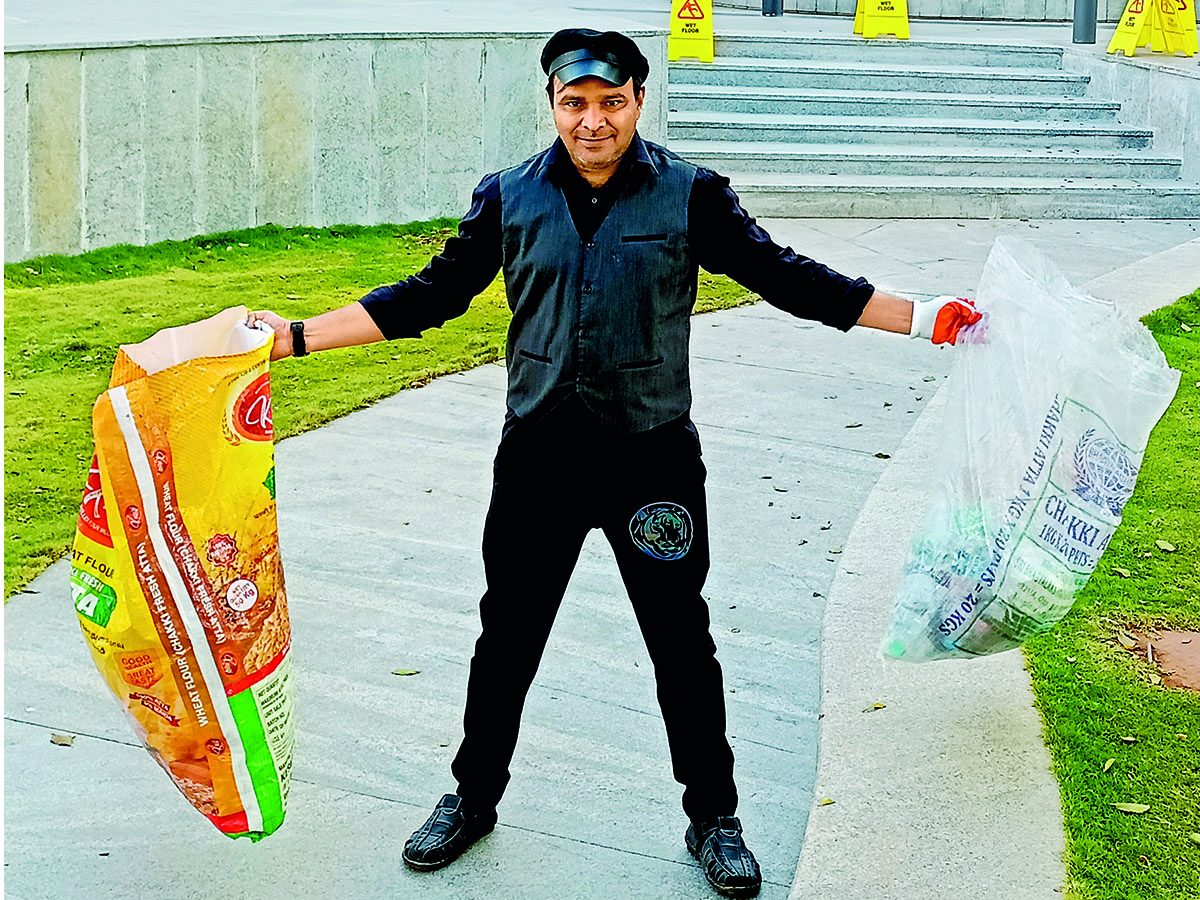 G. Nagaraj aka Plog Raja displaying the trash he has picked up | Photo: G. Nagaraj
Despite public education and awareness programmes, mixed waste is often found in plastic bags casually tossed under a tree — resulting in the birth of ‘black spots’ in the city. There is also construction and demolition debris, discarded furniture, and other bulky dry waste that cannot be picked up by regular garbage collectors. This too is left to accumulate in public spaces, leading to a huge quantum of unmanaged waste on the streets, footpaths, in public parks and even near lakes.
“There is pervasive littering and despite being aware, many citizens and street vendors continue to litter, creating ‘black spots’ or unofficially designated public dumping grounds,” says G. Nagaraj aka Plog Raja, a Bengaluru resident and founder of The Indian Ploggers Army. “The most common items we collect are single-use plastics (bags, bottles, packets, cups) which defy the official plastic ban. This plastic is often mixed with wet waste, making recycling impossible,” says Nagaraj who is an environmentalist and a runner.
Action and reaction
In all fairness the BBMP has upped its budget for solid waste management to Rs 1,400 crore, an increase of Rs 400 crore from last year. Further, citizens have been asked to pay a user fee for waste collection along with property tax, depending on the size of their property. Several advanced waste processing facilities including additional bio methanation plants, sanitary waste processing units and bio CNG units were planned apart from investments and upgrades to existing landfill sites.
Real-time monitoring systems to track waste collection have been put in place. In June this year dedicated WhatsApp numbers were introduced whereby citizens could report details of black spots, illegal dumping sites as well as incidents of uncollected waste.
 |
|
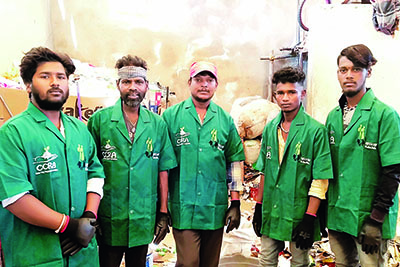
Hasiru Dala recently launched PPE kits for waste workers |
“For every area and, in fact, every street we have garnered the support of a few citizens and created self-help groups which makes the process more effective. We have a very active helpline. WhatsApp numbers have been provided to citizens who can alert us about garbage lying unattended. All they need to do is send us the picture and location and we then send a vehicle for the garbage to be cleared,” says Balakrishna.
As a result, almost 200 tonnes of segregated dry waste is being sent on a daily basis to the Bidadi Waste-to-Energy (WTE) plant. Built and funded by the Karnataka Power Corporation Ltd (KPCL) in collaboration with the BBMP in June 2024, the plant now generates 11.5 megawatts of electricity every day. According to reports, this venture has reduced the quantity of mixed waste being sent to landfills by 10 percent. The BBMP now plans to send 500 tonnes of segregated dry waste to the plant, instead of 200 tonnes.
Saving the planet
Joining hands with the civic administration are citizen groups, NGOs and private organizations who are leaving no stone unturned in managing the waste. All the golden rules are being followed from reducing to recycling to innovating strategies.
“We have been running awareness campaigns on waste, but currently we are focusing on reducing waste itself. For example, while shopping we advocate the use of reusable bags. If people are shopping online, we request them to use the package-free option which many don’t do. The paper bag seems eco-friendly, but ultimately paper comes from trees. There is a processing cost. So paper should be reused till it tears rather than be used to dump trash,” says Odette Katrak, founder of Beautiful Bharat, a volunteer group working to take sustainable practices to every home and event.
Katrak is also a firm believer in zero waste cooking. Whatever can be eaten should not be decomposed, she says. Think lemon peel pickle, orange peel juice and even pineapple peel beer. “I call it Treasures from Trash and I have also created a recipe bank. Even though these are small measures they definitely make that much-needed difference,” she emphasizes.
Reusable cutlery banks are also available across Bengaluru. People organizing events can rent cutlery for a small fee. The money is used for cleaning and maintenance. Some cutlery banks just charge a deposit which is fully refundable.
Such services decrease the huge quantity of waste generated by disposable plates and spoons which, most often, are made from materials like paper and Styrofoam.
“Ploggers Army has a preloved bank which can cater to the underprivileged by connecting all the green dots. Right from clothes to toys and stationery, everything which is reusable and in good condition is collected by us and routed to underprivileged families through our bank. Rehoming is a much-needed activity in sustainability,” says Nagaraj who has also been actively promoting the use of the menstrual cup as an effective alternative to single-use sanitary pads.
RWAs too are pitching in. Padmashree Balaram, president of the Koramangala 1st Block RWA, has coordinated the installation of about 50 leaf composting machines to tackle leaf litter piles across the city. “I floated the proposal with BSWML and also garnered the support of volunteers who will be responsible for each composting unit. We have the first batch ready from BSWML and we formally inaugurated our leaf composting machines on December 4,” says Balaram.
There’s also a proposal to instal around 1,000 composters in all city parks so that the compost generated can be used in-house for garden maintenance, true to the title of this initiative called ‘Namma Yele, Namma Gobra’ (Our Leaves, Our Compost).
E-waste too hasn’t been cast aside. Attero, India’s largest e-waste recycler, stepped into the D2C space in 2024 by launching Selsmart, its integrated e-waste consumer take-back platform.
Selsmart simplifies the entire process of recycling old electronics by enabling consumers to schedule doorstep pick-up and receive a fair market value for their devices. Attero currently processes 144,000 tonnes of e-waste annually, transforming it into green metals which are put back into the circular economy.
“The platform provides doorstep pick-up, instant digital payouts, and end-to-end traceability. We currently handle 150 orders per day from Bengaluru alone. Attero aims to scale up Selsmart to 5,000 daily orders by March 2026,” says Nitin Gupta, CEO and co-founder of Attero.
From the grassroots
Hasiru Dala, a trust established in 2013, is a frontrunner in the entire chain of waste management from segregation to waste picker rights to recycling.
It manages 33 dry waste collection centres (DWCCs) in Bengaluru, including segregation and recycling. As a result of its efforts, over 8,500 waste pickers have received official occupational identity cards, a symbol of recognition for their work. It has also empowered waste pickers with social security schemes.
A firm believer in the circular economy, Hasiru Dala launched Hasiru Batte, its textile waste management initiative, in 2018. Former waste workers give discarded clothes a new lease of life. Textile waste is collected from 16 DWCCs and sent to a textile recovery centre (TRC).
The initiative is run by a former waste picker, Indumathi, who has now become an entrepreneur. Clothes and fabric are sorted, processed, upcycled and sold at a thrift store. The daily procurement and processing of textile waste at the TRC is 1.5 tonnes.

The recycled clothes have been displayed in pop-ups in places like Lalbagh, prominent engineering colleges and many others. Hasiru Dala has trained waste pickers to sort fabric based on material, quality and so on before sending it to the TRC. About 13 women are upcycling these fabrics into bags, pouches and the like. The organization claims to have successfully diverted 498 tonnes of textile waste since 2022 from reaching landfills.
Hasiru Dala has recently launched Personal Protective Equipment (PPE) kits for waste workers which includes gloves, boots, aprons, masks, all of which are designed with durability and comfort in mind due to their long working hours.
Another frontrunner in waste management in partnership with the government is HSR Citizen Forum. Headed by Dr Shanthi Thummala, this NGO has managed to achieve a waste segregation level of 80 percent. It sends 35 tonnes of wet waste to composting centres daily along with five to six tonnes of dry waste for recycling. The organization conducts workshops on allied areas like composting, urban gardening, celebration of festivals in an eco-friendly manner, and so on. The area also houses the Swacha Graha Kalika Kendra (SGKK) or the Composting Learning Centre which is the first of its kind in India and educates visitors about kitchen and garden waste composting. It is a unique experience centre that houses 20 home and community composting models which help visitors learn the nitty-gritty of composting first-hand.
Bengaluru has not yet been crowned India’s cleanest city. It ranks a lowly 36 in the Swachh Survekshan audit of 2024-25. But with all hands on board it is perhaps making an effort to get there.
Comments
-

XnfrzDuoURPBqEXD - Jan. 21, 2026, 11:19 a.m.
DyBCqBJipeSrKNHuxbyj
-
Priya Shyam - Jan. 5, 2026, 7:15 a.m.
Hi, Feels good to read about various citizen groups and NGO s working towards a cleaner Bengaluru. There are lot of reels n short videos being circulated on whatsapp about proper waste segregation, composting and disposal of waste. But i think these messages can reach more people if they can be screened in movie halls.