



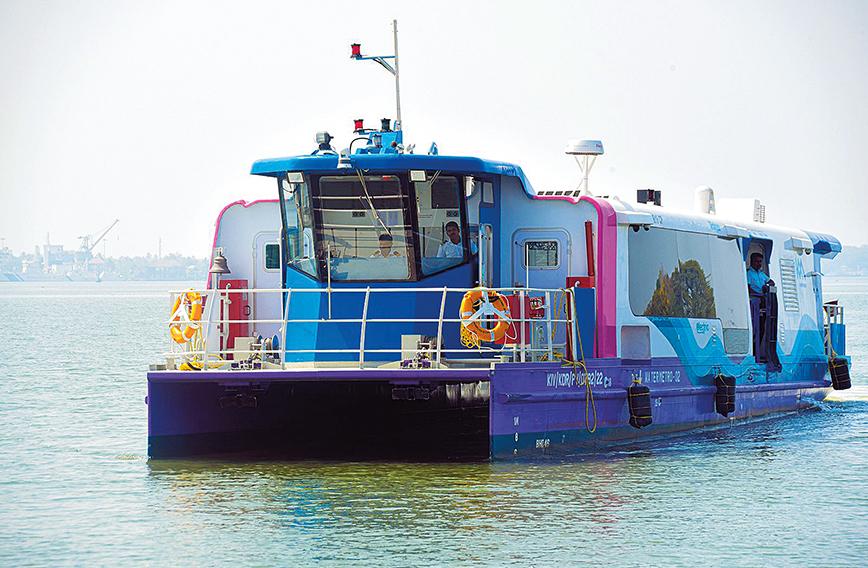
The Kochi water taxi (above) will be replicated on the Dal lake and the Jhelum
Srinagar to get a water metro
Jehangir Rashid, Srinagar
With cars crowding roads in Srinagar and traffic jams becoming routine, old-time residents recall how an alternative mode of commuting, through water transport, once helped people navigate the city. Shikaras and boats glided smoothly down the Jhelum river to reach different destinations. Most important areas, especially in downtown Srinagar, were located along the banks of the Jhelum.
“The boats not only ferried people from one place to the next, they also transported essential items. It was due to this that ration depots in the old city of Srinagar were placed along the banks of the Jhelum. Water transport was affordable and people would love using it once again,” says Ghulam Mohammad, a resident of Dalgate.
That wish is going to become a reality. On October 31, a Memorandum of Understanding (MoU) was signed between the Regional Transport Officer (RTO), Government of Jammu & Kashmir, and the Inland Waterways Authority of India (IWAI) to develop and operate an urban water transport system in Srinagar along the lines of the Kochi water metro.
“The initiative aims to ease traffic congestion, enhance intra-city connectivity and promote sustainable and eco-friendly mobility within Srinagar,” said an official of the Regional Transport Office.
The Kochi water metro, the first of its kind in India, was launched in December 2021. It consists of 23 battery-powered electric boats which ferry people on its numerous waterways to important destinations in the city. Eventually it will take people along 15 routes, connect 10 islands and traverse 75 km on 78 electrically propelled hybrid ferries.
The J&K MoU was formally presented to Chief Minister Omar Abdullah in the presence of Satish Sharma, Union minister for transport, Avny Lavasa, secretary, Transport Department, and Qazi Irfan, the RTO, Kashmir.
The proposed `900-crore project plans to begin water transport connectivity through electric-hybrid boats for local passenger movement. There will be five routes with 10 terminals on the Dal lake and two routes with eight terminals on the Jhelum. This network will complement existing road infrastructure and offer an alternative and green mode of urban transit.
“Both parties have agreed to work jointly to obtain statutory clearances and address environmental, forest and local considerations related to project execution. The funding structure will be finalized through mutual consultation, while a detailed implementation roadmap will be prepared in the coming months,” said the official of the Regional Transport Office.
The collaboration is being viewed as a major step in developing a reliable, efficient, and environmentally responsible public transport system in Srinagar. The project is expected to enhance urban mobility, boost tourism and create new livelihood opportunities by introducing a modern and sustainable mode of transport.
Under the agreement, the J&K government will provide administrative and logistical support, including clearances, land acquisition and the development of allied infrastructure. It will also ensure efficient first- and last-mile connectivity, integrating the water metro into the broader urban transport ecosystem of the Union Territory.
“The IWAI will provide technical expertise and guidance for the project, oversee maintenance of navigational channels and facilitate capacity-building programmes for inland water transport personnel. It will also ensure navigation safety and the adoption of modern operational systems,” said the official.
Residents of Srinagar hope the project will be completed in the set time frame so that there is some relief from traffic congestion. They point out that unnecessary delay would defeat the very purpose of the project and people would continue to suffer.
“Any project developed for easing our commuting problems is welcome. There has been very little development of roads in Srinagar over the past few decades while the number of vehicles has increased manifold. More and more cars are being put on the road,” said Rameez Ahmad, a resident of Sanat Nagar.
The RTO reassured people that both the state government and the IWAI will get all clearances for the project, address environment and forest issues, and tackle funding structures in the coming months.
“More than a decade ago the then government of J&K had drawn up a plan to introduce cruise rides on the Jhelum. Initially, it was to run the service in Srinagar and then extend it to other districts of the Kashmir Valley. The idea was dropped, much to the dismay of the common people,” remarked Abdul Razaq, a resident of Fateh Kadal.
According to officials, a similar inland water transport model is being explored for Jammu, reflecting the government’s broader vision to harness the potential of the region’s waterways for integrated urban transport development.
“Once urban water transport becomes a reality in Srinagar and Jammu, the people will find it easier to commute. But it is important that a timeline be set for completion of this prestigious project. The deadline should be met and there should not be any extension,” said Mohammad Younis, a resident of Abi Guzar.
People are keeping their fingers crossed. They are keen the government and the Centre keep their word and that the water metro becomes a reality within a stipulated time frame.
Comments
Currently there are no Comments. Be first to write a comment!