




Trams offer an invaluable advantage to Kolkata
TMC gone, tram hopes soar again in Kolkata
Aiema Tauheed, Kolkata
THE BJP’s victory in the recent state elections has kindled hope among tram supporters that the network will be restored and trams will trundle freely in Kolkata once again.
Urban Development Minister Agnimitra Paul and Transport Minister Arjun Singh have both spoken positively about restoring the tram system. Restoration and modernization of the tram network and its integration with the Metro are, it seems, on Arjun Singh's agenda.
“There are many positive signs. But unless it really happens, in reality, we will have doubts,” says Dr Debasish Bhattacharyya, founding president of the Calcutta Tram Users’ Association (CTUA) which has fought for the restoration of the tram network for many years. The ground floor of his home, which is over 100 years old, doubles as the CTUA office.
Surrounded by books on trams and framed by old-style windows, Dr Bhattacharyya says he is hopeful the tramways will spring back to life.
Global events have strengthened the argument for electric mass transport. Recently India faced fuel shortages due to geopolitical tensions. The city’s trams offer an invaluable advantage — a public transport system that does not depend on imported petroleum.

An added advantage is, unlike electric cars and buses which rely on batteries, trams depend on electricity drawn from overhead lines so they don’t leave behind a trail of toxic waste.
Once the backbone of the city’s public transport system, the tram network has shrunk to a shadow of its former self. Today, only two routes ply on the city’s streets.
“We are blessed that we never discontinued the tramways. All the depots, the infrastructure, tracks, traction poles, the workshop, everything is ready here. Due to the last government’s sabotage, the properties are in a shambles but the network can be revived within a short period if there is political will,” says Dr Bhattacharyya.
The CTUA is yet to formally approach the new government. Do they have a blueprint for revival?
“One after another, tram routes were closed. We want to reverse this declining trend by reviving one tram route in one month, maybe another tram route the second month, and continue like that,” he says.
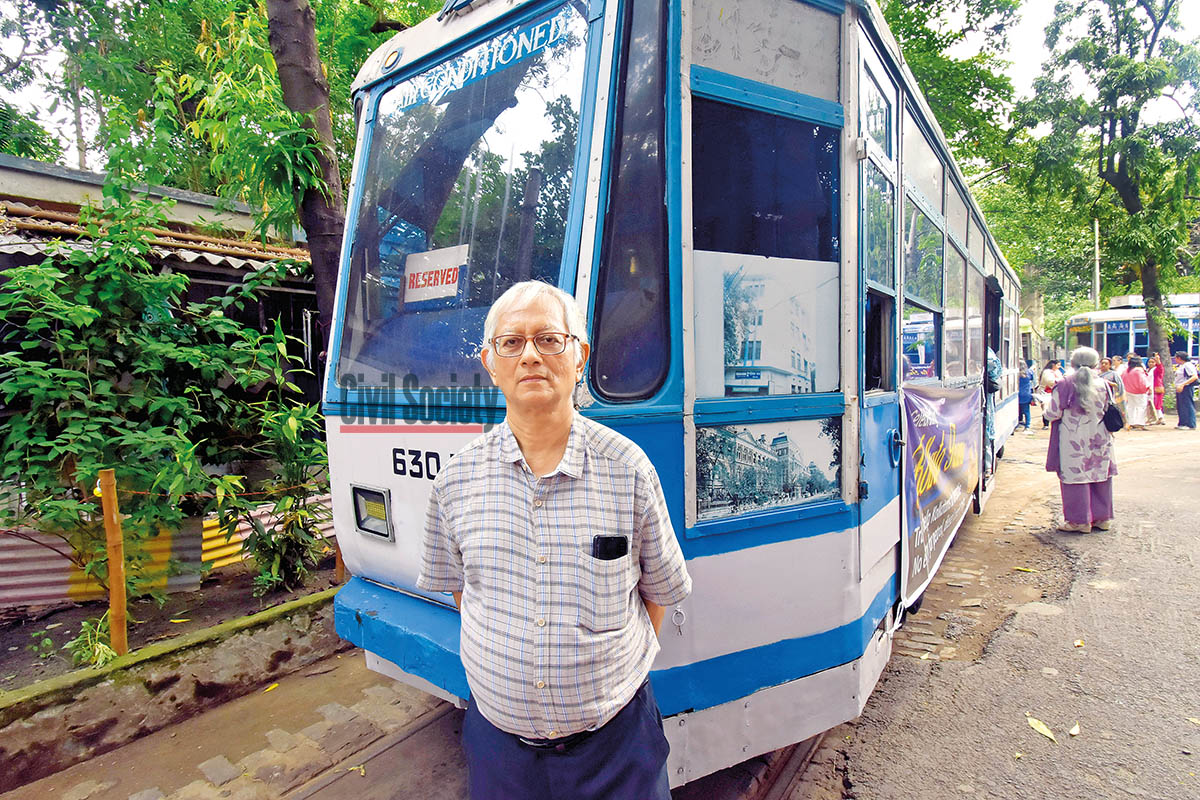 Dr Debasish Bhattacharyya: ‘We are blessed that we never discontinued the tramways’
The depots still have many serviceable tramcars, though no investment has been made. The few trams that run rely on poor quality spare parts from the local market.
At one time all these parts were manufactured in the Nonapukur Workshop — the only workshop where trams are completely overhauled and manufactured. “At present, if you visit the tram depots, they are like graveyards,” says Dr Bhattacharyya.
For 20 years no one has been recruited so there is a backlog of vacancies. People who retired were not replaced. Revival of the tram service will create jobs.
“Earlier we had up to 10,500 people employed in the tramways transport system,” recalls Dr Bhattacharyya.
“The Nonapukur Workshop has around eight different shops, including carpentry, welding, wheel, carriage and wagon sections. A few people remain there, sitting idle because there is no work. For many years, they have been coming to work, drawing their salaries, sitting idle for eight hours, and then going home.”
How long would a full-scale revival take? “It depends largely on funding. If sufficient money is provided, I guess within a year or two all the tram routes can be restarted,” says Dr Bhattacharyya.
His estimate is based on what he sees as the network’s biggest advantage: much of the underlying infrastructure still exists. In several parts of north Kolkata, tram tracks remain embedded in the roads, while depots, workshops and traction poles are still in place.
Dr Bhattacharyya also recalls what overseas friends and supporters of trams had told him. “Foreign tram drivers and the railway experts who visited said that the quality of the tracks is akin to those in Vienna and many other European cities, including in the Netherlands,” he says.
Even where services have ceased, the basic framework of the system survives. The infrastructure, including overhead poles, remains standing, although the copper traction wires have been removed. According to him, a large part of the fleet requires only minor repairs, oiling and cleaning to return to service.
“I can also tell you that, for Metro station construction, tram tracks were removed from BBD Bagh and Esplanade. As compensation, the West Bengal Transport Corporation (WBTC) received money from the Metro Railway. After that, they did nothing. I have all these RTI documents with me. They consumed the money. They used it somewhere else. It was not used for the benefit of the tramways,” he alleges.
If the new government seriously wants to revive the tramways, it can be done within two years, he believes.
However, ongoing infrastructure projects could slow the pace of revival. “For example, on Diamond Harbour Road, there is the Metro construction going on in Joka,” he points out.
Apart from being green and clean, trams will enhance the city’s image. “Tramways are a marker of urban development and confidence. They are safer for women and the fare is inexpensive,” says Dr Bhattacharyya.
Safety concerns and traffic-related objections cited previously by authorities were largely manufactured to justify the steady withdrawal of tram services and are unfounded, he believes.

“Because of very low running and operational cost and very high longevity, the tram fare is a minimal `6 or `7, wherever you travel. Whereas in a bus, especially an AC bus, the fare could be as high as `50.” For low-income commuters and daily wage earners, the difference is significant.
CTUA is also keen that Kolkata’s tramways receive recognition from UNESCO for their heritage value, similar to Durga Puja in Kolkata which now has a UNESCO tag. He argues that any such effort would require long-term commitment from WBTC to preserve and maintain the system.
“The city’s trams are a living industrial heritage. Just like the Darjeeling Himalayan Railway and the Kalka-Shimla Railway, Calcutta Tramways is equally eligible for the UNESCO tag. The only reason the tramways can’t apply is that the owner of the system has to provide a guarantee that the property will be maintained for 20 or 50 years.”
Trams also derive their heritage value from the historic neighbourhoods they connect, Dr Bhattacharyya points out. The Rabindra Sarani corridor, for example, runs through several of north Kolkata’s cultural landmarks, including Lalbazar, Nakhoda Mosque, Tagore’s house, and Bagbazar.
The future of Kolkata’s trams is also being fought in the courts. A Calcutta High Court order in 2023 called for the system to be “restored, maintained and preserved” and directed the state to examine ways of revitalizing the network. Time will tell whether Kolkata will see all its trams back on the tracks.
Comments
Currently there are no Comments. Be first to write a comment!