



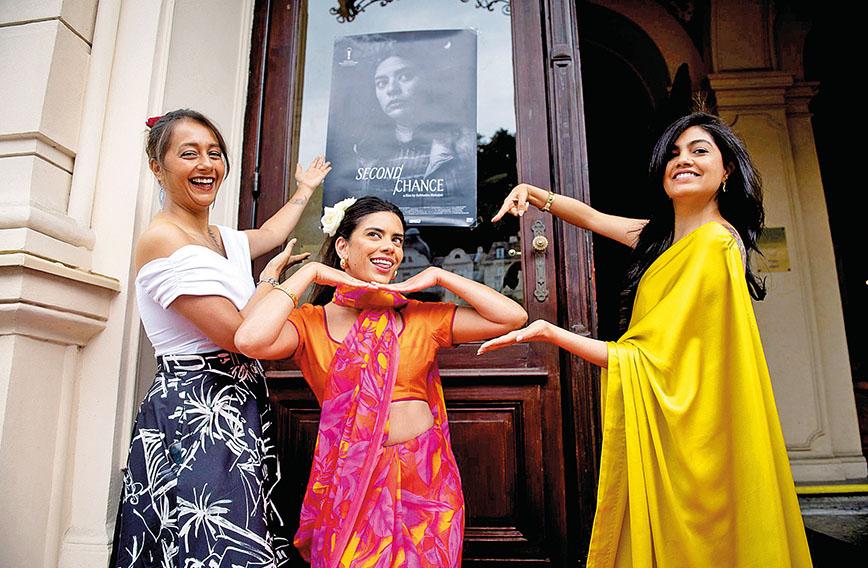
Subhadra Mahajan (right), director of 'Second Chance,' with actor Dheera Johnson (middle) and production designer Namra Parikh at the Karlovy Vary Film Festival
Breakout films make it big
Saibal Chatterjee
At the 77th Cannes Film Festival in 2024, Indian cinema ended a 30-year jinx. Payal Kapadia’s All We Imagine as Light broke into the Competition line-up, becoming the first film from India to do so since Shaji N. Karun’s 1994 Malayalam-language Swaham.
Kapadia was the first Indian woman filmmaker to compete for the Palme d’Or (Golden Palm). The prize eventually eluded her. The FTII (Film and Television Institute of India) alumna had to settle for the Grand Prix, the award for the second-best film. But that was no mean achievement. No Indian film had ever won the Cannes Grand Prix since the inception of the award in 1967.
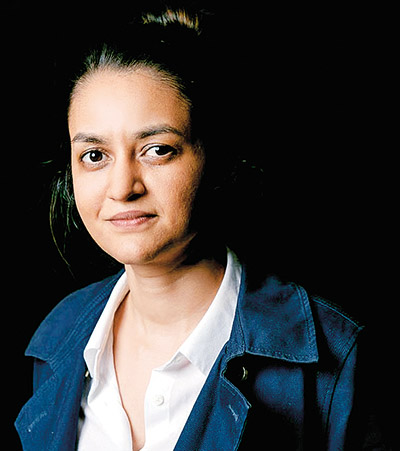 |
| Payal Kapadia |
As the festival unfolded, Kapadia’s impeccably crafted film, about two Malayali nurses in Mumbai balancing their troubling realities with their dreams, generated massive buzz and emerged among the front-runners for the top prize.
In the past, film critics would lament India’s continued absence at major festivals. The tide now seems to have turned decisively. Not only are the top festivals consistently picking Indian titles, they are also bestowing awards on them.
Significantly, most of these break-out films have been directed by women with unique voices and strikingly individualistic idioms. Many filmmakers are from small towns who work outside Mumbai, telling stories that are close to their roots. It is such films, on the Indian reality, that are attracting global appreciation.
The year was special also because Kapadia’s FTII classmate, Maisam Ali, raised in Ladakh, made history with a slot in the Cannes ACID sidebar. The Leh-set film, In Retreat, is about an unnamed prodigal who returns ‘home’ after a long absence. The film was the first-ever Indian entry in a section that was launched in 1992 to help independent films from across the world find distribution in France.

Equally significantly, 2024 saw a Kannada short film, Sunflowers Were the First Ones to Know, by another FTII alumnus, Shivamogga-born, Mysuru-based doctor-turned-filmmaker Chidananda S. Naik, winning the best film prize of the festival’s La Cinef competition for film school students.
India had never had it so good at Cannes, certainly not since Mira Nair’s Camera d’Or (Golden Camera) win for 1988’s Salaam Bombay!
The year of plenty wasn’t a flash in the pan. While Mumbai-based Kapadia has been leading the way — her first feature-length film, A Night of Knowing Nothing, won the L’Oeil d’or (Golden Eye) award for the best documentary in Cannes in 2021 — several Indian filmmakers with small-town roots and no formal training are powering a resurgence of Indian independent cinema on the global festival circuit.
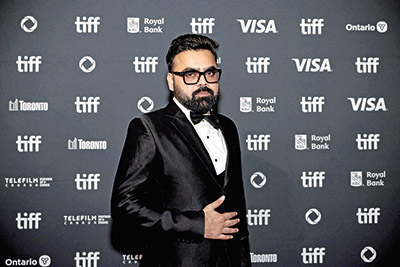 |
| Jitank Singh Gurjar |
Among these directors are Gwalior’s Jitank Singh Gurjar, whose maiden feature-length film Vimukt won the Netpac (Network for the Promotion of Asian Cinema) Prize at the 2025 Toronto International Film Festival, and Shillong-based Pradip Kurbah, who won a clutch of awards (Best Film, Best Director and Netpac Prize) at the Moscow International Film Festival this year for his fourth film, The Elysian Field (Khasi title: Ha Lyngkha Bneng).
Kurbah’s film is a tender, mildly droll portrait of six people who hold on to hope and humanity in a remote village that has dropped off the map in the 100th year of India’s independence. Its story of death, desolation and deprivation plays out over four different seasons during which the fate of the characters shows no signs of changing. The last inhabitants of the village frozen in time do not, however, give up on the land and the community.
“The audience in Moscow received The Elysian Field with great warmth,” says Kurbah. “Many elderly people came up to me after the screening and said the film reminded them of their villages, their people, their past. It showed that even though the story is from Meghalaya, emotions of loneliness, memory and hope are truly universal.”
It is noteworthy that the exciting efflorescence, probably still a work in progress, is being driven by directors who have consciously chosen to work outside Mumbai. Maisam Ali made In Retreat, a lyrical and languid film about home and belonging, about thriving on memories and living them down, in a style and space entirely his own.
 |
|
Anuparna Roy with the Orizzonti Best Director award |
That is the playbook many young Indian filmmakers are embracing. Anuparna Roy, first-ever winner of the Orizzonti Best Director award (Venice Film Festival 2025), was born and raised in West Bengal’s Purulia district. That is where her heart still lies.
Like many of her ilk, Roy is acutely conscious of the power of universal stories that are anchored in specific geographies and cultures, of the dynamic joys and misgivings of remembering and reinterpreting past experiences in the light of new ones.
Her feted debut film, Songs of Forgotten Trees, revolves around two young women, an aspiring actress who does sex work to pay her bills and an IT firm executive, who share an apartment in Mumbai, a city far removed from the places that they have arrived from. “I will always carry Purulia inside me,” says Roy. “I still talk in my own language, which is very different from the Bangla spoken by elite Bengalis.”
The response that Songs of Forgotten Trees received in Venice was overwhelming, the director says. “It was wonderful to see how it resonated with audiences beyond borders and cultures. It was enormously inspiring,” she adds.
With the Venice win, Roy has joined an elite club of award-winning Indian women that includes Payal Kapadia, Shuchi Talati (Sundance 2024 Audience Award for Girls Will Be Girls), Varsha Bharath (Rotterdam 2025 NETPAC Award for Bad Girl) and Diwa Shah (San Sebastián 2023 Kutxabank New Directors Award for Bahadur — The Brave).
Hill story
The latest to join the group of laurel earners is Sikkimese filmmaker and Satyajit Ray Film and Television Institute (SRFTI) alumna Tribeny Rai for the Nepali-language film Shape of Momo.
She won the Taipei Film Commission Award and the Songwon Vision Award at the Busan International Film Festival 2025.
 |
|
Nidhi Saxena, director of ‘Secret of a Mountain Serpent’ |
The sorority is steadily swelling. Among them is Nidhi Saxena, whose first two films — Sad Letters of an Imaginary Woman and Secret of a Mountain Serpent — premiered in Busan and Venice, respectively, in a span of less than a year. She says: “I don’t have a house in Mumbai. I go there to work but my base is Jaipur.”
“It is important,” she adds, “for artists to cling to their roots. Mumbai standardizes everything. It has become a factory and reduces us to factory workers and forces us to work within a set framework.”
Secret of a Mountain Serpent, featuring Trimala Adhikari as a schoolteacher and Adil Hussain as an enigmatic writer-engineer who comes visiting, is nothing like a Mumbai film. It explores the magic and boundaries of female desire in an Uttarakhand hill town devoid of its young menfolk who are all away fighting in the Kargil war.
Saxena’s two films make significant demands on the audience. “My inspirations are from Tarkovsky, Bresson, Mani Kaul and Kumar Shahani, besides Tsai-ming Liang and Apichatpong Weerasethakul,” she explains. “In my first film, time is seen metaphysically; in the second, existentially.”
“When we see time with the logic of poetry and not prose, we can be more experimental,” she elaborates. “It adds a dimension to the narrative. I feel that films that we do not understand fully have a lot of poetry in them. So, we go back to them again and again. Each time we revisit the film, we get something new from it.”
 |
|
Subhadra Mahajan at the Busan International Film Festival |
Stylistic individualism also drives Shimla’s Subhadra Mahajan, whose first film, Second Chance, was part of the Proxima Competition at the 2024 Karlovy Vary Film Festival. She swears by the creative sustenance that she draws from her hometown even though she now lives in faraway Mumbai.
Second Chance, a ruminative black and white film which also travelled to the American Film Institute Festival in Los Angeles and the Busan International Film Festival, is about a young woman who, after an enervating emotional setback, retreats to her family home in the hills to heal and regenerate. Talking of hills, Diwa Shah lives in Nainital and makes films for the world. “I find it difficult to make films from anywhere else. I like being in the mountains. They keep me rooted, calm and inspired,” says the writer-director of Bahadur — The Brave.
She thrives on “the feeling of community” that a hill town fosters. “Everybody knows everybody here. Yes, opportunities are limited in Nainital. In Mumbai, you can explore a lot more things. But the flip side is that you get caught in a rat race in the bargain. You have to survive and sustain a stable lifestyle. You are unable to take risks as a result,” she says.
Worm’s eye view
What is it that has changed and led to festivals increasingly throwing their doors open to films from a country that had long struggled to impress programmers?
Says Shah: “Apart from festivals looking at Indian cinema with greater intent, it is also us finally trying to find our own system, our own structure, to make the cinema that we want to make.”
Shah is doing just that. Bahadur — The Brave, about the plight of Nepali migrant porters stranded in her hometown during the Covid pandemic, fetched her the Kuxtabank New Directors Award at the 2023 San Sebastian International Film Festival.
 |
|
Diwa Shah (centre), director of ‘Bahadur—The Brave’, at the San Sebastian Film Festival |
She followed that up with a feat that holds even greater promise for her fledgling career. From October 1, 2024 to February 15, 2025, she was one of six selected filmmakers who participated in the 48th session of La Residence du Festival de Cannes in Paris.
At the session, she worked on developing the script of her second film, Kyab — Refuge, about third-generation Tibetan refugees in India. At the end of the four-and-a-half-month residency, Shah won the programme’s top scriptwriting fund.
With Kyab now a French co-production, her path forward would be expected to be easier than it was when she made Bahadur — The Brave entirely on her own steam. Her urge to tell stories of marginalized communities in her backyard, she says, “has a lot to do with my childhood and the place I belong to”.
“Growing up, I had many Tibetan friends in school. We also had a Tibetan market. Back in the day, there was social harmony and we did not even pause to think that these people belonged to a different community. When we were asked to write an essay on Nainital, we talked about a temple next to a mosque, next to a gurdwara, next to a church. Sadly, that is not the case anymore,” says Shah.
The Cannes residency, she says, has impacted her as a filmmaker and as a person. She adds: “Programmes like these make you braver with what you’re trying to do. The exposure gives you more confidence and creates newer avenues. I hope it shows in my work.”
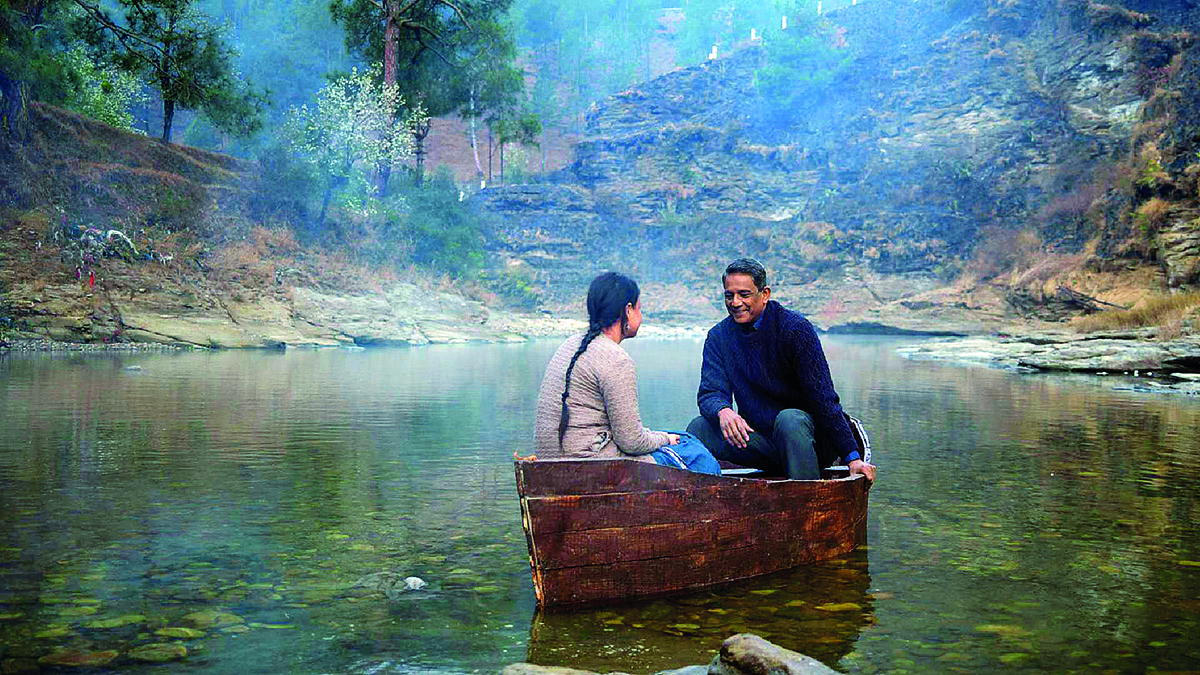 A scene from ‘Secret of a Mountain Serpent’
Saxena, as far from Bollywood in spirit as Nainital is from Mumbai, won the Asian Film Fund for post-production from the Busan International Film Festival last year for her debut film, Sad Letters of an Imaginary Woman, about a lonely 40-year-old woman who has a phone conversation with her younger self.
Soon thereafter, Saxena, who is a published author in Hindi and has a background in the fine arts, won the Biennale College Cinema grant for Secret of a Mountain Serpent, which was developed during the 13th edition of the Venice Film Festival’s programme for filmmakers making their first or second film. It premiered at the festival earlier this year.
Despite not adhering to Indian narrative cinema’s established norms, Saxena has made two films distinct from each other in double quick time. “In ten months, to be precise,” she quips. “My first film premiered in early October one year and the second one in early September the next.”
There is clearly no dearth of action in the Indian independent cinema scene. While Kurbah’s next film project, Moon, was selected by Busan’s Asian Project Market, Jitank Singh Gurjar is close to embarking on his next film.
Says Gurjar: “I am working on a film about child abuse and domestic violence. I will shoot it during winter early next year. Although the film is set in a city, the language will be Braj like it was in Vimukt, a purely rural story.”
 |
|
Pradip Kurbah won two awards for his film, 'The Elysian Field,' at the Moscow Film Festival |
Vimukt explores the family dynamic of an impoverished rural couple with a mentally challenged 26-year-old son. The three go on a pilgrimage to the Maha Kumbh Mela because the parents are led to believe that devotion could rid them of their misfortunes. Gurjar shot the film in 11 days, five of which were devoted to shooting pivotal sequences at the Maha Kumbh Mela.
“Vimukt is set in a village that is very close to mine. The physical texture and cultural nuance are the same,” says Gurjar, adding that he plans to continue making films in the Braj dialect. He says: “If I don’t, who will? The language has its own texture and rhythm but no films are made in the language. Because I do not work with big stakes, I have the freedom to choose what I want to do.”
Referring to the crowd scenes in Vimukt, he says: “I told the actors to stay in character and get into the crowd, we will shoot you. They merged with the flow of the pilgrims while we filmed them from specific angles. My film has more extras than Gandhi.”
Even as their determination to tell stories that no one else will and their guerilla-style filmmaking keep them afloat, their freedom ends when it is time to look for exhibition outlets. Says Kurbah: “You may travel far, your film may move audiences abroad but back home, or in the larger Indian scene, it can still feel invisible.”
He asserts: “Festival selections and awards open doors, give you confidence and credibility, besides connecting you to a wider world. But real change in distribution, support or recognition takes much longer when you come from a place that is still off the film map. Every festival journey is, therefore, a small victory. It reminds us that even from a small hill, our stories can echo across the world.”
He reveals that discussions are ongoing for the Indian distribution of The Elysian Field. “The process is always challenging for an independent film, especially one in a regional language like Khasi, but I’m hopeful things will move in a positive direction,” he adds.
Telling a story rooted in his own culture is what excites Kurbah the most because “you are opening a small window to your world, your people, your landscape, your emotions”.

That, he asserts, is honestly what touches others. “When they connect, it’s very special because it happens through feeling, not familiarity. A human story will always resonate no matter where it comes from. That is what keeps me going, knowing that emotions travel even when languages don’t,” he says.
Mahajan points out that the challenge of finding distribution is not bigger than convincing the public to come to the cinemas and buy tickets. “We did a limited five-city release of Second Chance in June 2025. I worked alongside the distribution team of Platoon Films with the limited resources we had for publicity. I learned that it is really a task to get people to go to the cinemas and buy tickets.”
What is needed, she says, is “a highly targeted approach and a correct understanding of the audience for independent films”. But one thing that she learnt from the experience, she adds, is that “nothing is impossible”.
“International acclaim is nice, but it also makes you sad,” says Shah. “Despite all the praise that you receive globally, there still are no avenues to get these films out to a wider domestic audience. People keep asking where they can get to see your film and you do not have an answer.”
But, all said and done, the light at the end of the tunnel of a dodgy distribution system is bright enough for these filmmakers and the admirers of the work that they do, not to abandon hope.
Comments
-

Surekha - Feb. 17, 2026, 9:35 p.m.
Very nice article. Had watched Second Chance and loved it.