



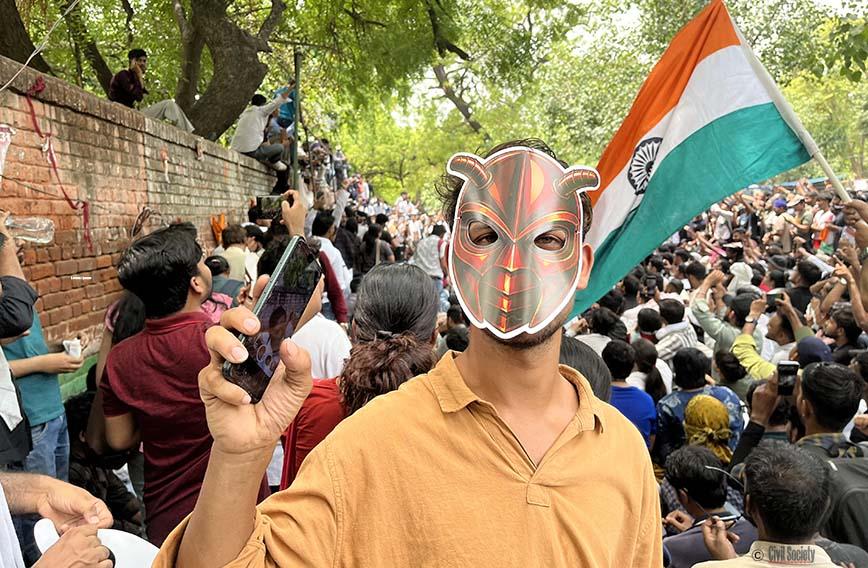
A young protester at Jantar Mantar in Delhi
Call of the Cockroach
Civil Society News, New Delhi
BEGINNING on June 6 in the blistering afternoon heat of Delhi, a series of protests over the education system have been held in cities across India under the banner of the internet-born Cockroach Janta Party (CJP).
The protests have drawn modest numbers of a few thousand each time, but they have been attended with enthusiasm by people from all walks of life, and ages too. Among the honorary cockroaches was Sonam Wangchuk, the respected climate activist who found in the CJP a “creative and peaceful expression of youth unhappiness”.
The demand has been for the resignation of the Union education minister, Dharmendra Pradhan, after repeated question paper leaks that have led to the cancellation of exams and upended the academic plans of millions of young people.
A large number of students have died by suicide because of the unbearable burdens that a centrallized examination system imposes on them. There is also the huge cost of coaching classes. Online marking systems have been found not to work.

The cockroach agitation has demanded accountability from the Narendra Modi government, beginning with the resignation of the education minister.
Till the July issue went to press, none of its demands had been met. A second protest at Jantar Mantar, which began on June 20, was continuing overnight, protesters having camped in the open, defying eviction by the police.
The CJP to us appeared to be driven by honesty by its founder, Abhijeet Dipke, 30, a communications professional based in the US, and a core bunch of young people.
By creatively taking on the privileged, the protest has touched a chord in millions of families fed up with the high cost and inefficiency of the education system imposed on them.
But opinions varied on the protest and Dipke. Among activist groups he was viewed with some amount of suspicion because he had popped up from nowhere, riding a social media tsunami.
The least charitable view was that he had been put up by the government to divert attention from the poor performance of the Modi government in running the exam system and education in general. The Congress and Rahul Gandhi in person were already successfully capitalizing on the issue.
Interestingly, the protest was given the miss by almost the entire mainstream media. It was left to small magazines like ours, websites, YouTube channels and so on to tell the story.
The story for us in this magazine was as much in the message as the messenger.
FIRST POST
When Dipke, sitting in Boston, launched the CJP with a post on X, he received a deluge of support online way beyond his expectations.
It was just a funky idea. A cheeky response, in the style of social media, to the Chief Justice of India, Surya Kant, remarking in court that unemployed and uneducated young people were like cockroaches infesting the system.
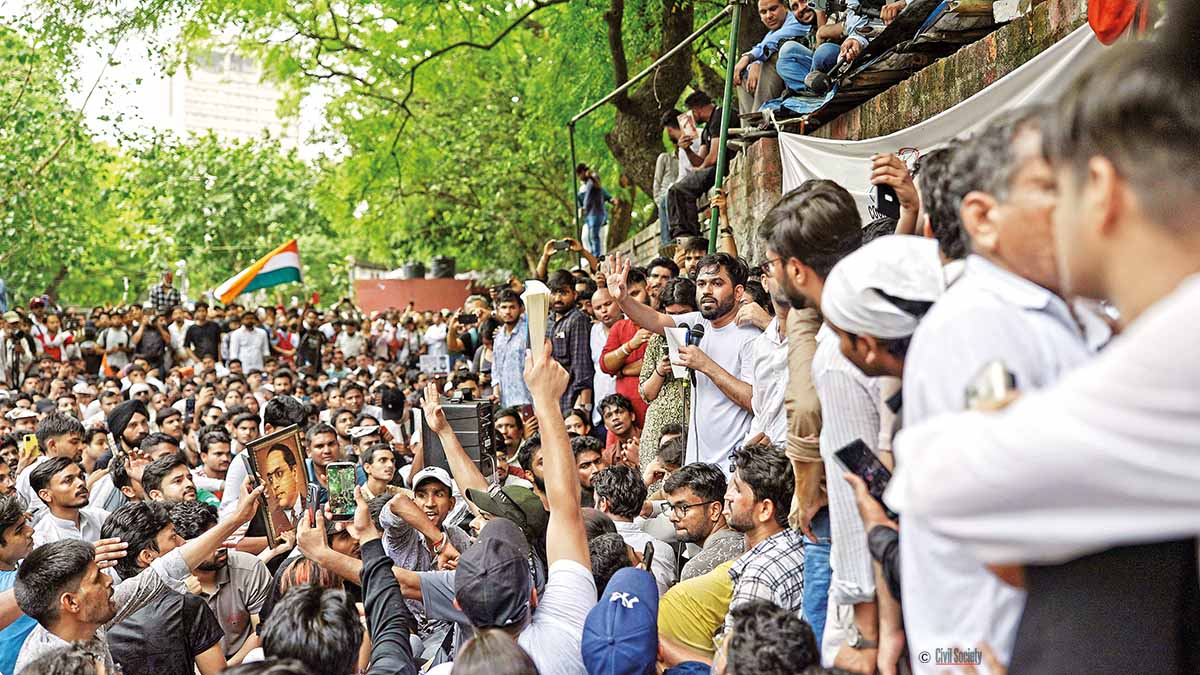 In searing heat on June 6, Abhijeet Dipke (right) addresses the first rally at Jantar Mantar
Thumbing his nose at the chief justice, Dipke spelt out the eligibility for joining the Cockroach Janta Party as: Unemployed, lazy, chronically online and having the ability to rant professionally.
If all such cockroaches could come together, how powerful they would be, said Dipke. In no time, on social media, there were 22 million young people signing up, happy to call themselves cockroaches.
Right on top of their list of concerns was the education system. Centrallized exams to enter colleges, as introduced by the Narendra Modi government, had become a burden. Such were the pressures that students had been dying by suicide. Families were going broke funding special coaching classes. Worst of all, since 2021 exam questions had leaked out repeatedly and no one in the government was ready to take responsibility.
The CJP decided to call for the resignation of Education Minister Dharmendra Pradhan. Emboldened by the online response, Dipke opted to come to India and organize protests on the ground.
Arriving in Delhi on June 6, Dipke went straight to Jantar Mantar where nearly 2,000 people gathered under a blistering sun to seek the resignation of the minister. June 20 was set as the date for the resignation.
A series of protests followed in Pune, Bengaluru, Jaipur, Patna and Ahmedabad — all drawing modest crowds.
People we spoke to at the first Jantar Mantar meeting came from all walks of life and were of different ages.
Renu, who works for a company, said: “I’m not a student but I am here for the future of my children. Just look at the state of the education system in India. What kind of opportunities are we giving India’s young. This is the time to speak up.”
Rajpal had come from Rajasthan. “People pass exams after studying hard and then the exams are cancelled later and no one is accountable. Look at the suicide rate among students. And it is not just education, but governance in general under Modi. Whether it is the foreign policy or the economic policy.”
Manav from JNU (Jawaharlal Nehru University) said he was doing a master’s in medieval history. He wasn’t directly affected but felt it was time to speak up and seek accountability. He carried a poster saying: “Plumbers of the country unite. Too many leaks in the education ministry to fix.”
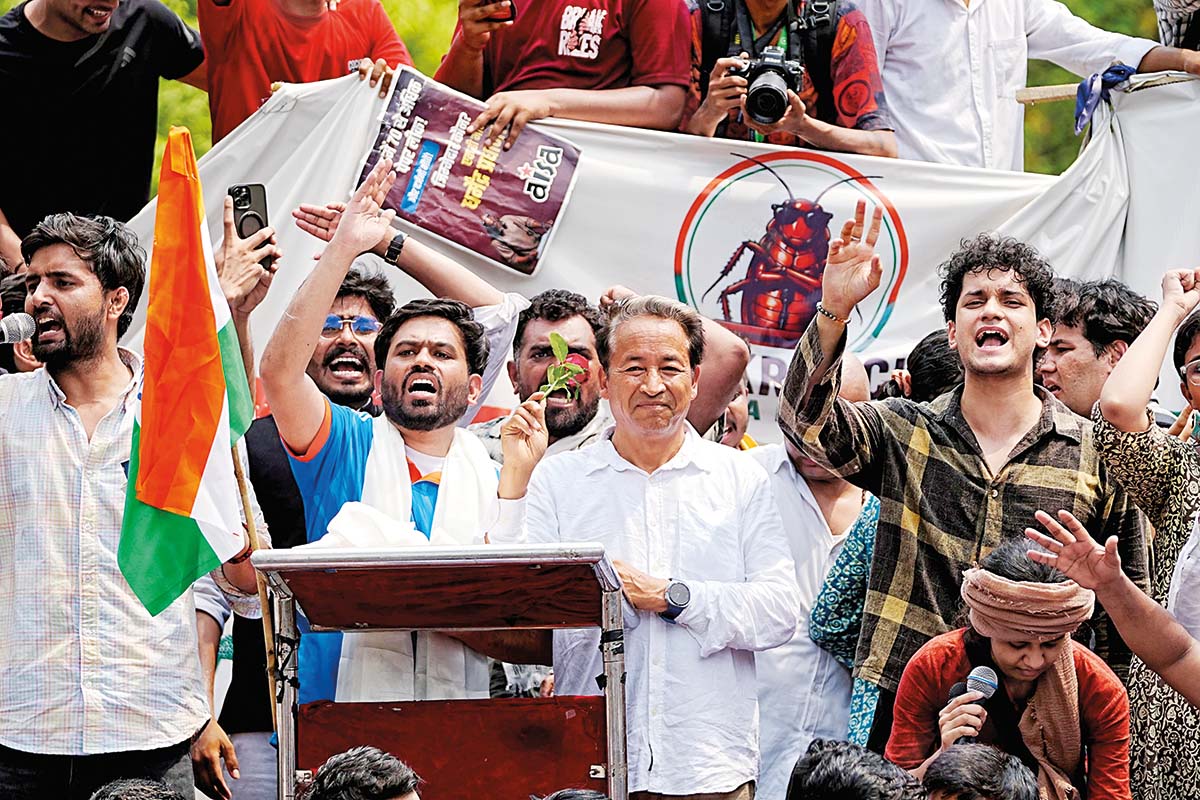 Climate activist Sonam Wangchuk came from Ladakh to be part of the cockroach protest
Sapna and Vishnu were a Malayali couple running a small wholesale business in food products from the southern states. They were there because education is an important issue.
Jitesh, in his twenties, was from Rohtak. “I am a graduate and so I am not directly impacted but this is an important issue and I support the demand for accountability.”
Over the past 14 years there has been little tolerance shown by the Modi government for protests. Jantar Mantar has been out of bounds for activists. Permission for the CJP protest comes as a surprise.
The BJP government, interestingly, seemed to give the CJP a long rope. Fears that Dipke would be arrested did not come true. Instead, police officers met him at the airport to hand over permission to use Jantar Mantar, which has for long been out of bounds for activists as a protest venue.
DEADLINE SET
With the deadline of June 20 for Pradhan to resign, a second event was planned at Jantar Mantar for which young people were to come from all over India.
As the big day arrived there was still no sign of Pradhan resigning. The crowd at Jantar Mantar this time was about the same as the first time. The only difference was that a significant number of leftist students were present. The stories were sadder too: a father whose son had died by suicide after the NEET leak, a woman from Odisha with kidney cancer accompanied by her 13-year-old son. She wanted him to become a doctor.
As the 5 pm limit for holding the protest came, Dipke said he would not leave Jantar Mantar till Pradhan resigned. The protest continued all night into the next day.
CORE GROUP
By all accounts, Dipke was juggling gaming and job hunting from his apartment in Boston when he accidentally gave birth to the CJP.
Dipke was born and raised in Maharashtra’s Chhatrapati Sambhajinagar (erstwhile Aurangabad). He studied journalism at the Symbiosis Institute in Pune and earned a postgraduate degree in Public Relations (PR) from Boston University.
Before moving to the US, he worked on digital campaigns of Arvind Kejriwal’s Aam Aadmi Party (AAP) between 2020 and 2023. Dipke has 245,000 followers on X, which he joined in 2014. In various social media posts, he has described himself as “a Dalit” and “a millennian” and consistently signs them off with “Jai Bhim”.
He comes across as someone deeply aligned with Ambedkarite thought and constitutional principles. This perception was reinforced when he displayed Dr B.R. Ambedkar’s My Autobiography upon landing at New Delhi's Indira Gandhi International Airport.
It was therefore not surprising that when the head of India’s judiciary casually referred to the country’s unemployed youth as “cockroaches”, Dipke decided to test the collective power of the disempowered. He created a platform for these “cockroaches” and invited people to join with a simple message: “What if all cockroaches came together?”
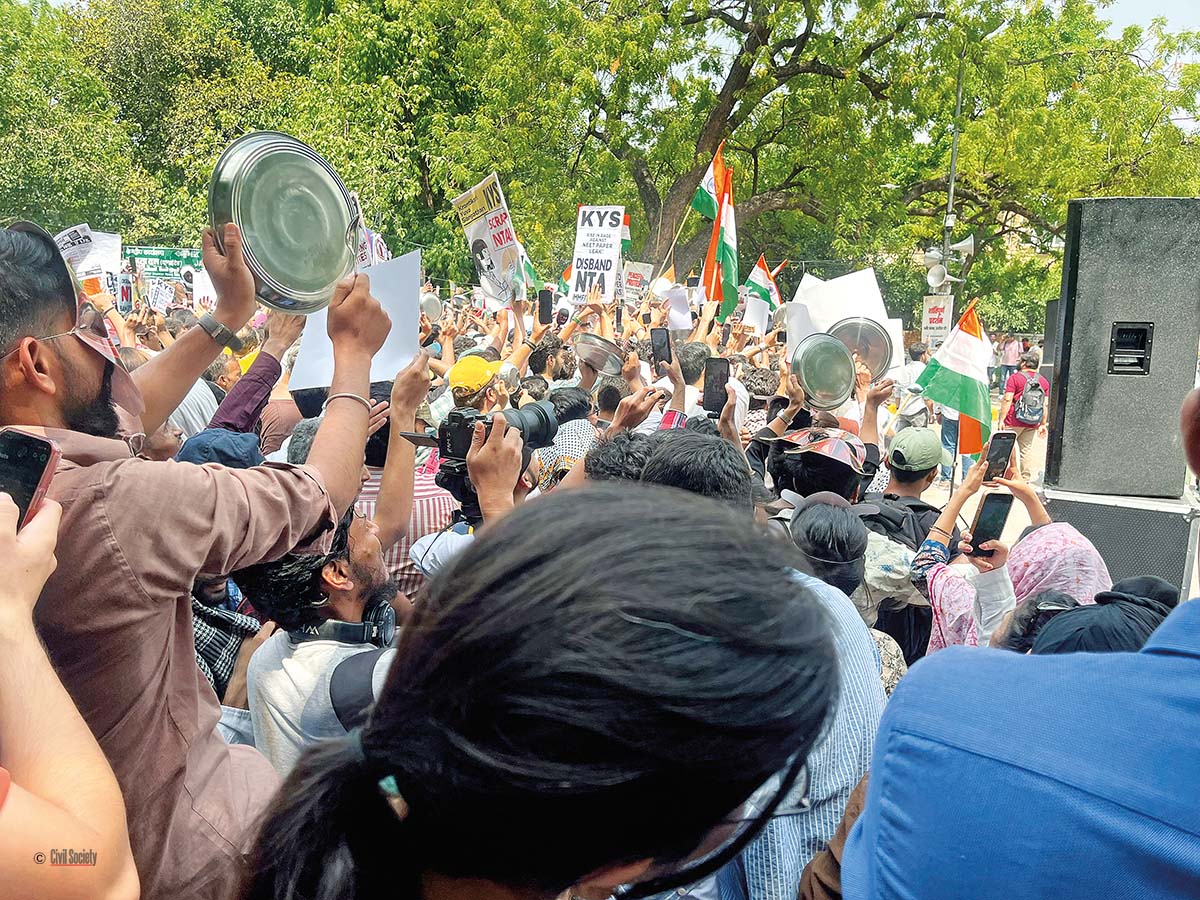 Protesters beat thalis with the chant, ‘Go Pradhan, go!’
Understandably, many people have questioned his past association with AAP. Much as he tries to distance himself from it, the label continues to follow him. As a digital media strategist and volunteer for AAP, he played a key role in driving the party’s meme-driven digital campaign during the 2020 Delhi Assembly elections.
For now, CJP continues to serve as a platform for expressing public angst against the government, complete with a political symbol and a manifesto, but without registration with the Election Commission of India (ECI).
“It doesn’t matter whether you belong to the Congress, AAP, the Samajwadi Party, the Trinamool Congress (TMC), or any other party. What matters is your commitment to safeguarding democracy and strengthening India,” has been Dipke’s refrain.
Walking alongside him as spokespersons are Ashutosh Ranka, a graduate of the Indian Institute of Technology (IIT), Kanpur; 26-year-old investigative journalist Saurav Das; and political researcher, author and filmmaker Vijeta Dahiya.
Ranka’s professional background is also linked to AAP, where he served as the party’s “unofficial” national spokesperson. A London School of Economics (LSE) graduate from Jaipur, he worked as a consultant with McKinsey & Company for nearly two years, from August 2017 to May 2019. Since August 2025, he has been employed as a senior associate at Global Health Vision.
In media interviews, he has denied having any recent association with AAP, stating: “I never actually held an official position in the party.” However, many online articles continue to describe him as “the national spokesperson of the Aam Aadmi Party”, while others identify him as “formerly an associate fellow with the AAP government”.
Das, who is from New Delhi, is an investigative journalist whose work has appeared in national and international publications such as The Caravan, Frontline, The Wire, The Hindu, Al Jazeera, and New Lines Magazine, among others. Along with CEO Shubham Thakur, he co-founded Climate Action Front, an environmental organization focused on climate research and net-zero policy.
Das has followed in the footsteps of his father, Shaikh Azizur Rahman, whose work has been published by The Guardian and Voice of America. He has carved out a niche for himself by leveraging the Right to Information (RTI) Act to produce credible and impactful investigative stories. He is also the author of the book, Complicit Silence: The Court’s Role in India’s Quiet Suffering.
Dahiya, who is from Sonepat in Haryana, is a political researcher, author, filmmaker and content creator who stirred controversy with his comment, “Lord Ram ate meat.” An engineer by qualification, he writes under the pen name of Gulfam and has served as a primary researcher and scriptwriter for YouTuber Dhruv Rathee. He has authored two books — Power of Universe and To Hell with That Job — and directed the Haryanvi films Darare and Opri Parai.
His professional experience includes stints at Ranbaxy Laboratories Limited and the Ministry of External Affairs. Dahiya’s social media posts reflect his deep concern about India’s political, social and governance issues. He has attributed the overwhelming response to CJP to the “collective resentment” felt by many people across India.
HIGH DRAMA
There was high drama the day Dipke arrived from Boston on June 6. In a reel he uploaded he said he feared arrest. It seemed almost certain that the CJP protest would be scuttled by the government.
In the event, Dipke was received at Terminal 3 by police officers who handed him permission for holding the protest at Jantar Mantar without even having applied for it. He was also escorted to Jantar Mantar.
If there were expectations that the venue would be swamped with supporters, they were not fully met. Nonetheless, nearly 2,000 people, carrying placards and flags and wearing cockroach masks, braved the capital’s oppressive heat to join the protest.
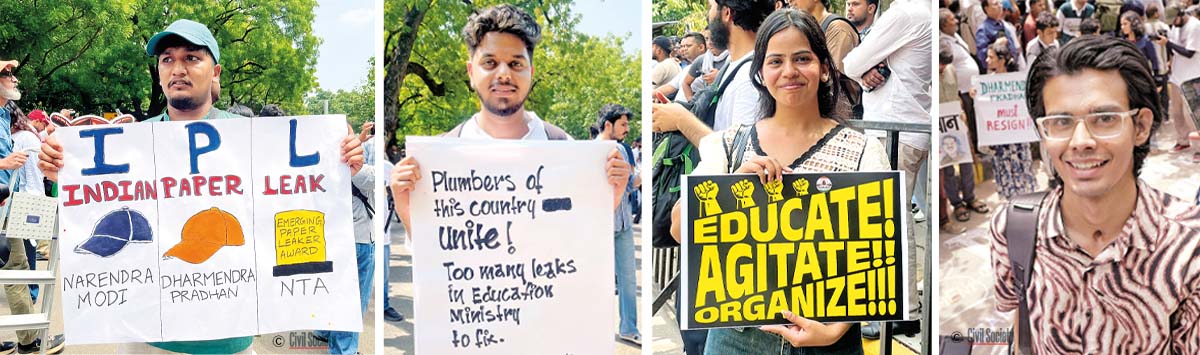 The protests drew enthusiastic demonstrators, many with innovative posters which they had brought along
Many believe that the turnout of nearly 2,000 protesters was impressive, given the lingering fear among people of being targeted or placed under government surveillance following the experience of participants at the last major demonstration over New Delhi’s poor air quality late last year.
Apart from Dipke, the protest was addressed by Wangchuk, who came especially for it from Ladakh. He also joined the protests in Pune and Bengaluru, saying he was happy to offer his guidance to young people.
When the movement reached Pune it gathered considerable momentum, with hundreds of students and young people assembling at Savitribai Phule Pune University, where the CJP unveiled its exam manifesto.
The charter’s key demands included Rs 10,000 in compensation for students affected by paper leaks, examination postponements or delays in declaration of results; alternative dates for re-examinations to be announced and concluded within 72 hours; the introduction of special trains to examination centres during recruitment drives; physical evaluation of answer sheets instead of online assessments; age relaxation for candidates affected by delays; mandatory audits of computer-based tests; and the awarding of examination contracts solely on the basis of merit.
Dipke said the release of the manifesto would be followed by aggressive lobbying with Members of Parliament (MPs) across party lines.
“The monsoon session is coming up, and we will be urging them (MPs) to raise the issue there (Parliament) and also hold discussions within their parties. That’s the kind of advocacy we want to pursue in the short term,” he said while addressing the crowd.
Quoting the popular Buddhist phrase ‘Tamso Ma Jyotir Gamaya’ (from darkness to light), Wangchuk urged the audience at the rally in Pune to “walk from darkness to light”. He stressed that education and environmental protection must become national priorities if the country is to secure a bright future. He also called on people to follow the guiding principles of truth and non-violence in their pursuit of justice.
The protest in Pune was followed by similar demonstrations in Lucknow at Eco Garden on June 12 and in Amritsar at Golden Gate on June 13. Uttar Pradesh had already witnessed a similar agitation on May 29 in Prayagraj, where students threatened to intensify their campaign against the sealing of three coaching institutes in June if their concerns remained unaddressed. The Prayagraj Development Authority (PDA) has maintained that the coaching centres were operating without the requisite approvals.
Addressing the sizeable march in Lucknow, Dipke declared, “If it becomes necessary to go to jail, I will be the first to go, but no one will back down.”

He reached Hyderabad and Bengaluru on June 14. Hundreds participated in rallies in both cities, and the issues raised expanded beyond examination irregularities to include concerns over what protesters described as growing curbs on civil liberties under the ruling regime. The Bengaluru protest was attended by actor Prakash Raj, who is known for expressing his views fearlessly on a range of public issues. Addressing the gathering at Freedom Park in India’s Silicon Valley, Dipke urged people to speak out without fear of arrest.
In Jaipur, the CJP was at first denied permission to convene its supporters at Shaheed Smarak with authorities citing “law and order” concerns. However, approval was later granted subject to certain conditions.
It was by all accounts a small gathering of no more than a thousand and it was marred by an assault on Dipke. He was slapped multiple times by two men who came up to him.
Will the movement gather momentum and catalyze change in the education system? Much will depend on strategy and people’s support.
Praveena Sharma contributed to this story.
Comments
Currently there are no Comments. Be first to write a comment!