



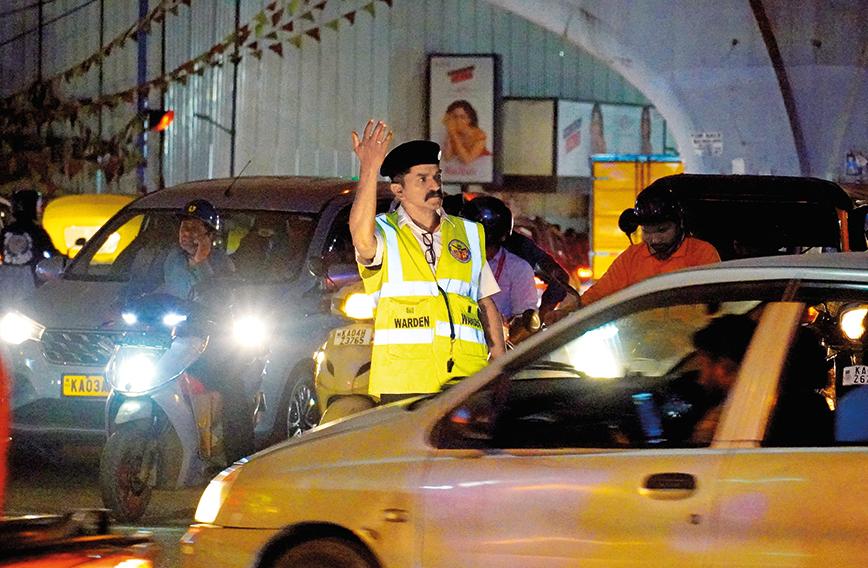
Chethan Elvis Das: ‘There is a lot of goodness left in the world’ | PICTURES BY: RICHA JOANITA DAS/Civil Society
When there are angels on the road
Rashmi Gopal Rao, Bengaluru
Most days of the week the Banaswadi intersection is clogged with dense traffic. Cars, buses and three-wheelers arrive in a torrent as they make their way to residential areas, a software park and the airport on Bengaluru’s northeastern fringes. During rush hour an unnavigable mess prevails.
On one such extremely chaotic evening, an ambulance ferrying a patient found itself stuck in the melee. Hemmed in from all sides, its siren yelping, the ambulance seemed to have little hope of getting through the traffic.
It was then that a wiry, youngish-looking man made his presence felt. He was wearing a white shirt and blue trousers and a reflective orange waistcoat with the words ‘Traffic Warden’ on it. Chethan Elvis Das purposefully walked into the thick of things, getting vehicles out of the way and opening up a path for the ambulance which then flew through.
There are in Bengaluru 740 traffic wardens like Das, of whom 75 are women. They help keep the city’s traffic moving. They serve voluntarily in their free time but have an official identity under the Traffic Wardens’ Organization or TWO, which falls under the police department.

Traffic wardens have a standard uniform and are trained in managing traffic. But they remain unpaid volunteers who are not on the police’s rolls and can’t issue tickets or take punitive action. Their enthusiasm, however, more than makes up for the lack of policing powers. They are buoyed by the spirit to serve society and tend to bring a gentler touch to policing.
Das vividly remembers getting the ambulance through as one of the high points of the 10 years he has spent being a warden. Episodes like this make the role rewarding. Indirectly, he helped save a life when otherwise he might have been doing something less socially valuable.
Das recalls: “That evening at Banaswadi was busier than usual. Traffic was streaming in from all sides. The sudden emergence of the ambulance added to the chaos. After some moments of great anxiety, we managed to successfully guide the ambulance out.”
But that wasn’t all. His effort didn’t go unnoticed. Someone from the family of the patient, who was following the ambulance in a car, made it a point to express his gratitude to Das.
 |
|
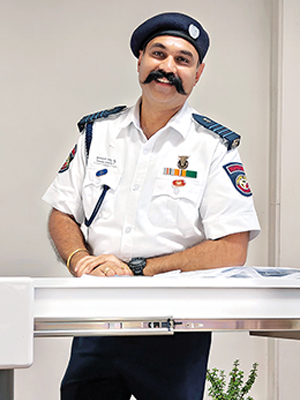
Srinivas Shenoy Y, CEO of a tech firm: ‘Volunteers are trained’ |
“Just as I stopped to catch my breath after the ambulance had passed, a gentleman made sure to stop and thank me, before rushing to the hospital,” says Das, for whom it made his effort doubly worth it.
Das, 50, is a software engineer now serving as a director in a tech enterprise. He is the Assistant Chief Traffic Warden of the Banaswadi zone of the East Division. He recalls helping people reach on time for prayers during Eid. Many came back to say thank you with soft drinks and sweets.
“Such incidents make me feel that there is still a whole lot of goodness left in the world and our efforts are worthwhile,” says Das.
“I joined TWO in 2016 after I met an acquaintance who was a traffic warden. He, incidentally, was an interior designer. I have always been inclined to do social work, so I was really excited when I got this chance. Apart from doing my bit to help people on the road, wearing the traffic warden’s uniform is a matter of great pride and privilege,” says Das.
Dr Omprakash S. has been a traffic warden since 2002. For him it is the next best thing to his dream of joining the police. He has degrees in management and law and works at Hindustan Aeronautics Ltd (HAL).
“I always wanted to join the police department, but fate had other plans. Being on the road gives me an immense sense of satisfaction as I help people get back home safe. People are very appreciative of our services and unknowingly this has really shaped my personality in a positive way. Apart from instilling a sense of discipline, I have improved my ability to resolve problems, my leadership and team building skills,” says Omprakash.
 |
|
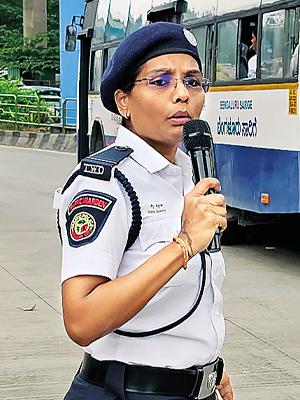
Shilpa Spoorthy, architect: ‘I look forward to my duties’ |
Yet another interesting perspective is put forth by architect Shilpa Spoorthy. “I do not drive and hence many of my friends and family would say that I did not have a holistic picture of the challenges faced by the people who actually drive. So, when I got a chance to join TWO, I took it up without hesitation. I am able to see what it is like to be in the midst of traffic and actually help ease congestion.”
Spoorthy has been a warden for three years. Even though wardens are not authorized to impose fines, most of the time riders hastily put on their helmets the moment they see her.
“Even on days I am really tired, I look forward to my duties as a warden because it makes me really happy,” says Spoorthy, who switches cheerfully from her day job of designing buildings to directing traffic.
Giving back to society and doing something socially useful is a sentiment that motivates most wardens. Traffic is a big problem in Bengaluru. To be out in the midst of vehicles and bringing some order to the streets gives wardens a sense of satisfaction.
Says Pradeep Devaraj, who is an IT professional and has been a traffic warden since 2010: “I always wanted to join the armed forces and so I like this role of warden. Along with helping people on the road, the experience of dealing with different kinds of people and situations is what makes the whole experience enriching.”
“I recently faced abuse from a couple when I tried to report them via a public app for not wearing helmets. To my utter shock and surprise, the lady started accusing me of clicking her picture without permission. Luckily, her face was not captured and they left without creating a major scene. When I recall the incident, it still makes me shudder, imagining what would have happened if the situation had spiralled out of control. This is just a one-off incident; most of the time we have people coming and expressing their gratitude which is enough to keep me going,” he says.
 |
|
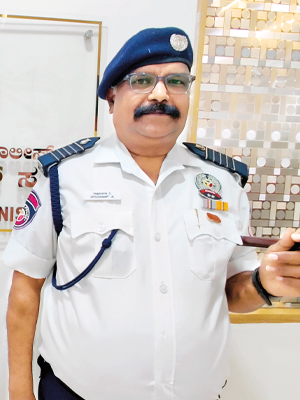
C. Sagayaraj, retired from BSNL: ‘Volunteering is needed’ |
Arun Das, who runs an interior decoration firm, has been a warden for the past five years in the J.P. Nagar zone. He remembers his first day of duty as being quite terrifying.
“It was a bit overwhelming to stand in the midst of a sea of vehicles and although my hand was making a stop signal, I found vehicles whizzing past right under my nose and hand! Later I learnt that my hand was positioned a bit low and that I had to develop a more authoritative body language,” he says.
“We get about two days of theoretical training after which we are given hands-on training on the road by a senior warden. After about three months, we are able to hold the show on our own. Also, it is in the initial days that many people try to ignore instructions but now most people are familiar and actually look out for me on days I am off duty!” adds Arun Das.
Volunteers are required to clock 16 hours of duty per month. Attendance is recorded through the WorkMate app and most traffic wardens do duty in a locality that is close to the place they live or work in. They also use tools like Google Maps to evaluate congestion which makes regulation more effective.
Bridge with citizens
With a population of over 14.5 million and counting, and close to a whopping 10.2 million vehicles, controlling traffic in Bengaluru is an overwhelming and daunting task. While the Bengaluru Traffic Police works tirelessly to regulate traffic, it is not enough and this is where the spirited wardens come in.
TWO was started in 1985 to serve as a bridge between the Bengaluru City Police and citizens. It is the country’s only voluntary organization committed to traffic engineering and management, says Pandurang H. Rane, IPS (Retired), Chief Traffic Warden who has been heading TWO for the past year. Citizens who join are highly motivated and want to do their bit by the city in their own way.
It is a firm commitment that the wardens make to the police department, says C. Sagayaraj, Additional Chief Traffic Warden. He recently retired as a senior accounts officer with BSNL, the government-run telecom company.
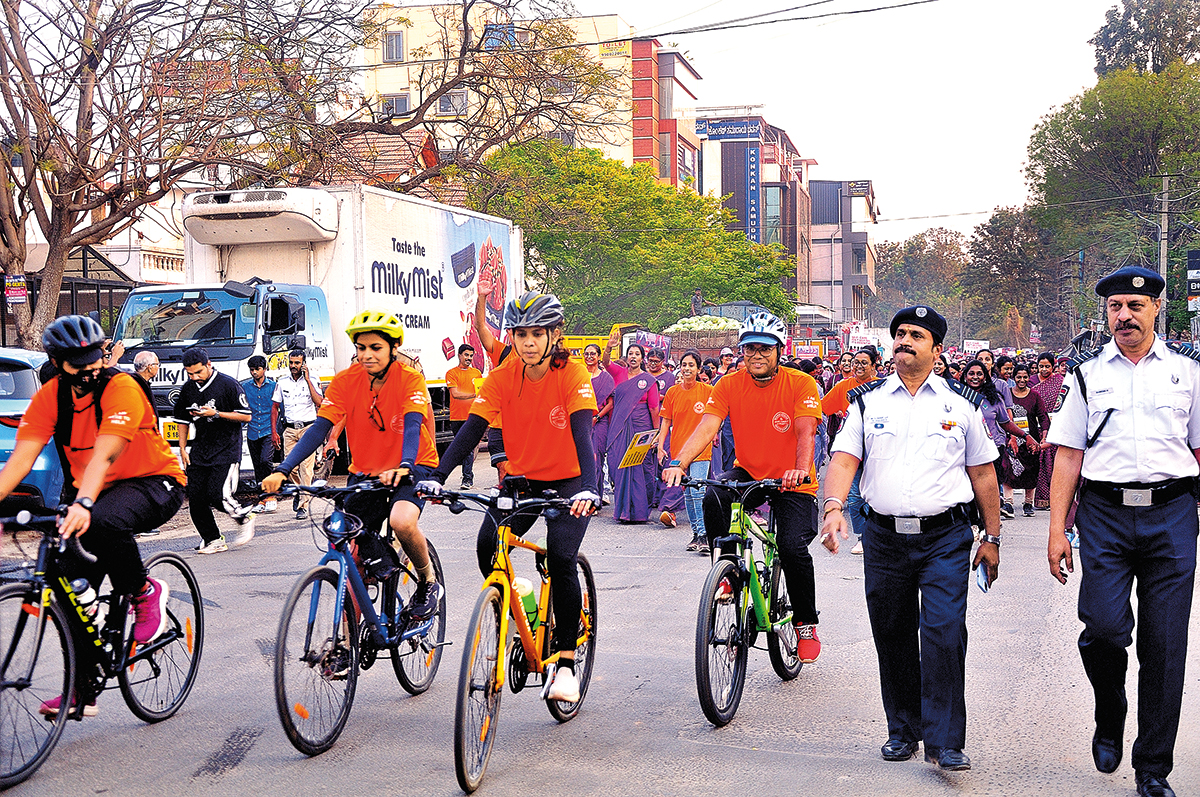 Traffic wardens help out on the road on special occasions like sports events and marathons
“While we sign up as volunteers, we also make a commitment from our end to discharge our duties to the best of our ability. Given the city’s growing population, volunteering is the need of the hour. It gives me happiness and pride since I help my co-citizens and also support police personnel. Also, our wardens have been able to develop an effortless rapport with citizens which augurs well for the whole cause of efficient and effective traffic management,” says Sagayaraj.
Vision and mission
TWO was conceived of by Dr Ajai Kumar Singh, an IPS officer, when he was Deputy Commissioner of Police (DCP) for Traffic. Its operations began in August 1985.
“The importance of public support and citizens’ participation in the smooth working of the police department cannot be underestimated,” he says.
“Irrespective of whether we are facing a problem of staff shortage or not, citizens’ cooperation is an invaluable asset and much required. And while it may not be suitable to have citizens directly involved in many areas of our operations, traffic is definitely an area where we can involve them,” says Dr Singh.
Recalling the conceptualization of TWO, Dr Singh says that when he took over as DCP Traffic, he happened to go through some old files in which there was reference to a similar organization in Kolkata and Coimbatore.
“This piqued my interest and I sought to find out more about the rules, set-up, roles and responsibilities of this organization. After extensive research, meetings and consultative sessions internally, we came up with a framework, guidelines and rules,” says Dr Singh.
 |
|
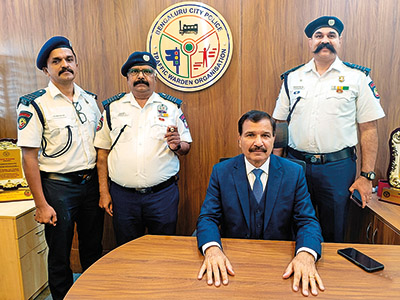
Pandurang H. Rane (seated) with, from left, Chethan Elvis Das, C. Sagayaraj, Srinivas Shenoy Y. ‘Our wardens did a commendable job on New Year’s Eve,’ says Rane. |
“TWO was established through a Gazette Order by the state government of Karnataka. We appointed the highly capable Prof. C.E. Jesto as the first Chief Traffic Warden and since then the organization has grown from strength to strength. No funds were allocated for this endeavour and citizen volunteers wore only badges and caps at that time,” he recollects.
Headquartered at the Traffic Management Centre on Infantry Road in Bengaluru, TWO works in tandem with the Police Department, with the Commissioner of Police being its chief patron. The Chief Traffic Warden heads TWO and reports to the Joint Commissioner of Police (JCP) acting as per guidelines and protocols prescribed by the department.
The Chief Traffic Warden is supported by the Additional Chief Traffic Warden, Joint Chief Traffic Wardens and the Deputy Chief Traffic Wardens.
The scope of TWO is the entire city which, in turn, is divided into 10 divisions. It includes the East Division, West Division, North Division, South Division, Northeast Division, Southeast Division, Central Division, Whitefield Division, Vijayanagar Division, and HSR Division. Each division is further divided based on zones which are determined by the distribution of traffic police stations within the respective divisions.
TWO operates within this hierarchy with each division being headed by the Deputy Chief Traffic Warden. Each zone has a Zonal In-charge (ZI) who holds the rank of Assistant Chief Traffic Warden. All traffic wardens of a zone report to the latter.
For citizens, by citizens
Bengaluru is the city of gardens. But to get to the Lalbagh Botanical Gardens for an early morning walk one needs to cross a busy traffic junction where five roads converge.
While there are traffic signals, the complexity comes from the fact that several roads face the West Gate. A particularly large central junction makes it difficult for pedestrians to cross with ease.
Says Bindu Rao, a morning walker: “Personally, I have seen several senior citizens struggle to cross the road, since they are unable to judge where the traffic is coming from. However, their woes were mitigated when a traffic warden was stationed at the junction. The gentleman is not just friendly but also keeps nudging people to observe where the traffic is coming from. I find him very helpful. He uses a small handheld speaker to give instructions to pedestrians and ensure they cross the road safely.”
Traffic wardens are not paid. So, to qualify one has to have a stable income. It is a volunteering opportunity, not a career.
TWO invites applications and citizens of Bengaluru can apply online or offline as long as they meet the eligibility criteria.
“Specifically, people between 25 and 55 years of age can apply. The minimum qualification is a Class 12 or Pre-University Course certificate. Applications are screened and shortlisted candidates are called in for an interview after which there is a background check for successful applicants. The next step is a comprehensive two-day training where candidates are taught the nitty-gritty of traffic management and their roles and responsibilities explained. Finally, candidates procure their uniforms and are administered the Oath of Allegiance by the Commissioner of Police after which they are assigned their new orders,” says Srinivas Shenoy Y., Deputy Chief Traffic Warden & Head of Administration at TWO. Shenoy is the CEO at Credo Infotech and has been with TWO for two decades.
Apart from regular traffic control, wardens help out as and when required by the area police station. This includes managing traffic for VIP visits, religious processions, marathons, walkathons, cricket matches and so on.
“Our wardens did a commendable job on New Year’s Eve and even the recent IISc open day which attracted close to 100,000 people,” says Rane. During the pandemic, traffic wardens were exemplary: involved in ration distribution, vaccination drives and the like.
Traffic wardens visit schools and colleges and educate youngsters about traffic rules, road safety, the importance of using safety gear and so on. There are similar educative sessions for employees of companies.
TWO also has an engineering wing where wardens give feedback on issues like unscientifically designed humps, accident-prone zones, faulty signals, unsafe pedestrian patches or even bottleneck spots that lead to congestion.
 |
|
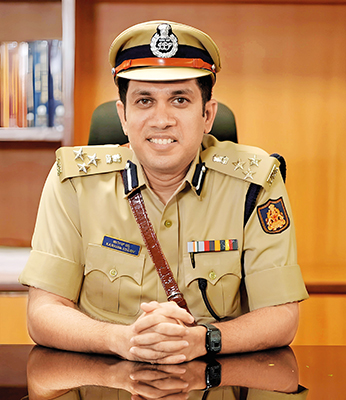
Karthik Reddy, Joint Commissioner of Police |
“We have several wardens who are road engineering and logistics experts due to their education and profession. After continuous study and evaluation of local spots, they have the expertise to identify the issues facing a particular road, the root cause and potential solutions which can help resolve the problem,” says Shenoy.
Given that the backbone of TWO and its success is entirely dependent on the service of selfless citizens it is important to keep them motivated.
“While on most days, it is really fulfilling, sometimes there are people who question our authority. This happens more frequently if they see a lady regulating the traffic,” says Spoorthy.
It is not easy to be standing for long hours, sometimes in bad weather, and to have to also control instances of road rage.
“There are times when people run out of patience and threaten to report you but at the same time many people do come up and acknowledge the service we do. We take safety precautions like avoiding standing in the middle of the road, and we wear reflective jackets after dark, etc, ” explains Das.
So, it is not surprising that one of the main challenges TWO faces is a high rate of attrition which is over 30 percent.
“There are several reasons people become inactive; they become busy with their jobs, travel out of the city for work for long periods, get busy with family responsibilities and so on. And when priorities shift over time, we have people opting out on a regular basis,” adds Shenoy.
Therefore, the importance of having wardens motivated cannot be overemphasised. There is a points-based system accorded to wardens. High-performing wardens are awarded certificates and the names of star performers are mentioned on the TWO website.

There is also a system of promotion whereby Wardens can become Senior Wardens, Assistant Chief Traffic Wardens, and so on. They participate in the Independence Day and Republic Day parades.
The wardens band together as a cadre would. There are parades, a sports day and get-togethers. A spirit of being a force serving the city prevails among them.
The Bengaluru Police ascribes value to their contribution. Karthik Reddy, Joint Commissioner of Police for Traffic, says: “Apart from traffic regulation, they communicate effectively with the public, help us during special events and are also able to bring a holistic perspective regarding issues reported on the road. This is mainly due to the fact that they are well versed with ground realities and do not have a myopic view of the overall situation.”
“They also support us immensely with our Student Association for Road Safety (SARS) programmes where we educate schoolchildren on traffic and road safety. Their unstinting cooperation is a strength not just for us but for Bengaluru city as a whole,” says Reddy, a 2009-batch IPS officer.
Comments
-

Sampreeti Purohit - May 11, 2026, 1:32 p.m.
What a wonderful and structured initiative to keep the tech city moving in the fast pace that it's very lifestyle is! As a former resident of Bengaluru, I have experience the densely jammed roads and frequent melee, which are frankly very frustrating. Grateful for the Traffic wardens who voluntarily show up alongside their usual occupations. What's remarkably sweet is that a warden's response to our gratitude as "a whole lot of goodness left in the world" whereas, they are the ones who initiate this goodness trail.