



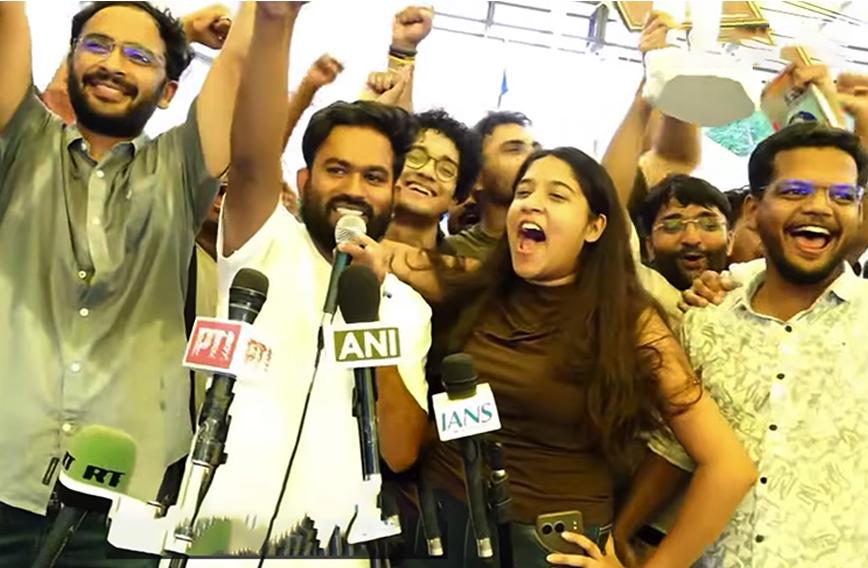
The Cockroach Janta Party core team celebrates
A cockroach victory, Pradhan goes
Umesh Anand, New Delhi
A 49-day student agitation which galvanized India with its call for education reforms and shook the Narendra Modi government came to an end on July 25 with the government conceding the demands made by the students.
The education minister, Dharmendra Pradhan, was compelled to resign over the repeated leaking out of questions and general corruption in the examination system.
The students also got an assurance that no cases would be filed against protesters anywhere in the country and that families of children who had taken their lives because of examination stress would be given financial compensation.
The agitation has left in tatters the strongman image of Narendra Modi who was ridiculed by young protesters on the streets and internet.
The announcement of an agreement came at a joint press conference addressed by Saurav Das and Ashutosh Ranka for the students and Ministers Jitendra Singh and J.P. Nadda.
There were exultant scenes at Jantar Mantar, the epicentre of the agitation in central Delhi. Protesters in huge numbers gathered around the stage to celebrate.
The agitation began on June 6 at Jantar Mantar shortly after Abhijeet Dipke created the Cockroach Janta Party (CJP) on the internet.
Dipke was poking the Chief Justice of India in the eye for a courtroom remark that unemployed young Indians were not better than cockroaches.
The response to Dipke’s funky idea was overwhelming. There were 20 million followers in no time. He then decided to test this support on the ground and raised the issue of question paper leaks which had upended the lives of students. In a matter of months there had been 20 suicides. He was joined by Das and Ranka.
The June 6 protest drew no more than about 2,000 people. The numbers, however, kept growing and falling organically.
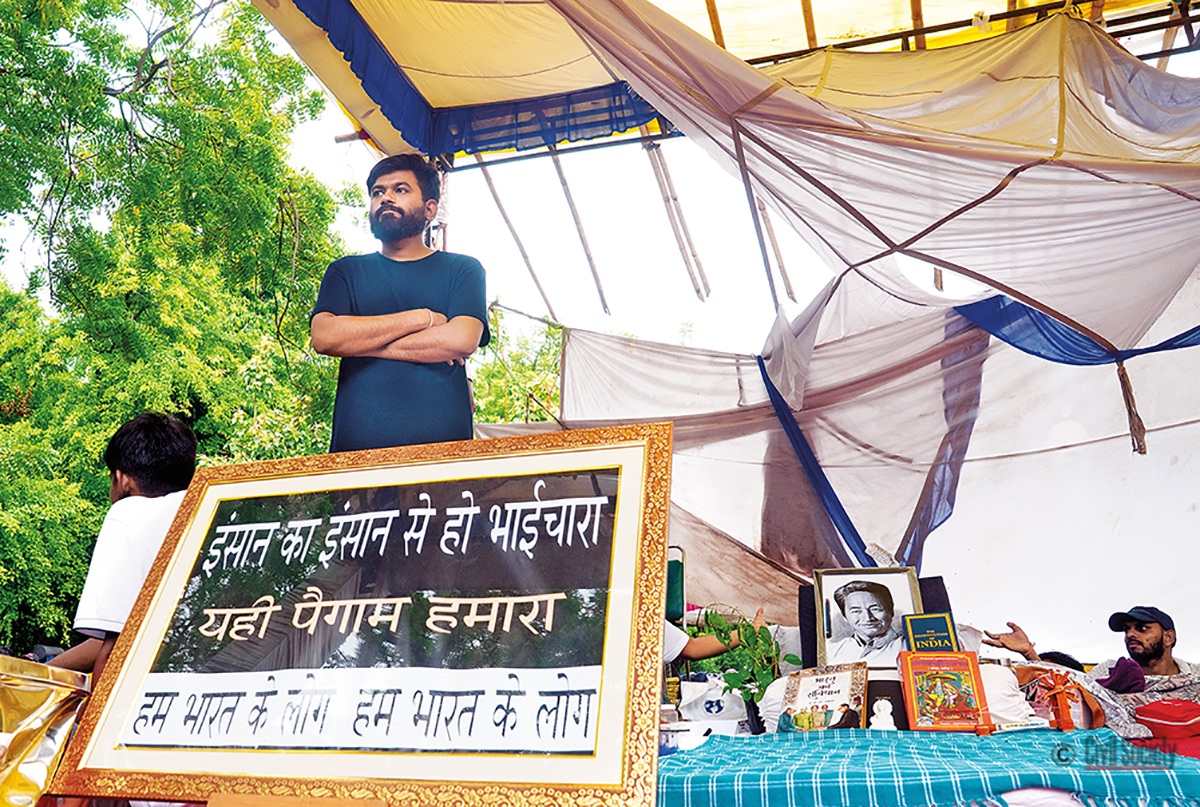 Abhijeet Dipke of the Cockroach Janta Party spends a pensive moment after the dais was restored at Jantar Mantar | Civil Society picture/Lakshman Anand
For more than a month, the government did not respond to the students’ request for talks and tried to stare them down. But a call to march to Parliament on July 20 drew an overwhelming response with protesters turning up in Delhi in tens of thousands.
The brutal picking up of Sonam Wangchuk, the climate activist and educationist, also angered people. Wangchuk was on a fast in support of the students. The crude way in which he was, in his frail condition, bundled into white sheets and dumped in hospital brought out yet more protesters determined to march to Parliament.
The government blinked at this point and sought talks which ended finally in conceding all the students demands.
Even as talks were offered on July 20 police brutally cracked down on peaceful supporters, setting off a wave of anger against the Modi government.
Using teargas and canes, the police kept protesters away from the gates of Parliament House which had to be hurriedly drawn shut.
They also barricaded and beat up people at Jantar Mantar and Connaught Place. Women and even children who had come with families were beaten up by the police in an action which seemed intended to prevent others from showing up for the agitation. Far from deterring people, the police action had the opposite effect. By evening thousands of more protesters poured into Jantar Mantar.
The numbers continued to grow overnight into July 21 and 22 creating an explosive situation in the capital. In cities across the country, too, protests erupted with the call for Modi to resign.
On July 20, Jantar Mantar was barricaded in layers on either side of a central space where people had gathered in front of a stage.
As more protesters arrived, the spaces between barricades filled up packing people in tightly together. A stampede-like situation was developing in full view of the police which then beat up people. Teargas was fired.
Among the injured were very young girls who came with their parents to Jantar Mantar. Students were picked up and taken to police stations though protesting peacefully. Many students were grievously injured and bewildered at the violence unleashed on them.
A truck which had been boarded by leaders of the agitation was not allowed to leave Jantar Mantar to lead the march. Police finally clambered onto the truck to pull off the occupants.
The CJP agitation has struck a chord in millions of middle-class homes where families have been fed up with a dysfunctional education system. Increasing privatization has made education expensive and inaccessible. Additionally, a failing economy has not been able to provide jobs even as it has made some people very rich.
Ordinary people have made up the vast body of protesters raising slogans in the name of Mahatma Gandhi and B.R. Ambedkar and demanding their rights under the Constitution.
The CJP leadership of Dipke, Ranka and Das — with no previous experience of running protests — showed uncommon energy and courage in growing the agitation. They brought out peaceful, educated middle-class people, mostly young but also of all ages and from different walks of life.
That such an agitation managed to continue was itself surprising. The Modi government stares down all opposition and has been known to deal harshly with activists. Students have been jailed on questionable charges.
WANGCHUK’S FAST
The day of the march was preceded by high tension and outrage when Sonam Wangchuk was picked up by a Delhi Police team and dumped in hospital.
Click to read Sonam Wangchuk's Interview
Wangchuk’s support for the CJP has been a game changer. He called off his fast on July 24 when an agreement seemed at hand. He is known for his environmental concerns and is deeply interested in meaningful education. The institution he runs in Ladakh is globally known. Wangchuk has led the demand for Ladakh to be given self-governing institutions. He is a much-loved public figure in India whose remarkable life story inspired the blockbuster movie, Three Idiots.
Wangchuk told Civil Society that he got involved because he didn’t want the wrong people to hijack the movement and misuse it. His was a moderating influence. He wanted the government to address the concerns of the youth. Wangchuk, who insisted that the agitation be peaceful, was humbly persuasive in tone. He was joined in his hunger strike by 25 university students, belonging to the Left.
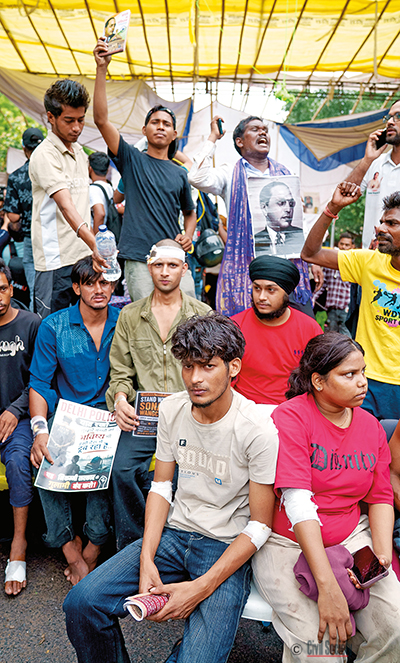 |
| Some of the protesters injured in police action | Civil Society picture/Lakshman Anand |
Wangchuk had been fasting for 21 days on the dais at Jantar Mantar when, early in the morning on July 18, a team of burly policemen crudely picked him up in white sheets and carried him away to be hospitalized.
Anger over the way Wangchuk was treated led to a nationwide demand for the resignation of Narendra Modi as prime minister. Earlier the students had only wanted the education minister, Dharmendra Pradhan, to go.
The CJP is seeking an overhaul of education with better public schools and colleges. They want an end to the centrallized examination system which has been badly managed.
In recent years scores of students have taken their own lives because of multiple pressures heaped on them by centrallized examinations such as NEET and many others. The exam’s questions have been leaked repeatedly owing to corruption, upending the careers of students.
Taking the NEET exam is also expensive. Families are forced to borrow to send their children to coaching centres.
Instead of good government schools and colleges, private coaching institutions and private universities, which are costly and don't really guarantee jobs have flourished.
After the first protest on June 6, protests also began taking place in cities across the country. The agitation found resonance in millions of homes in India where families are fed up with high costs and poor standards and the complete lack of accountability in government for the mess in education.
The rise of the CJP and the agitation are a sign of our times. They have been making news without being in the news — the major newspapers and TV channels having apparently been persuaded by the government not to cover the agitation. In guerrilla fashion, the CJP spread its message through social media.
We, in this magazine, tracked the CJP agitation from the first protest. Jantar Mantar was a hotspot of stress and tension for the young organizers of the agitation. Support poured in from well-meaning quarters. Celebraties filmstars and MPs showed up. Leftist students were consistent in their support and presence. Farmer unions joined in.
But this has been a lonely path to walk with the BJP government and its entire administrative apparatus ranged against the agitation. Jantar Mantar overflowed with policemen, many of them armed. Police cameramen recorded those who came and went.
Yet people came out of choice, drawn to the cause of improving the education system. These are ordinary people who see the protest as an act of heroism. Crowds swelled and ebbed. The CJP hasn’t had the wherewithal to drum them up.
Over the days we witnessed scenes which gave an idea of the intense character of the CJP and the agitation, and the enormous meaning it has for people.
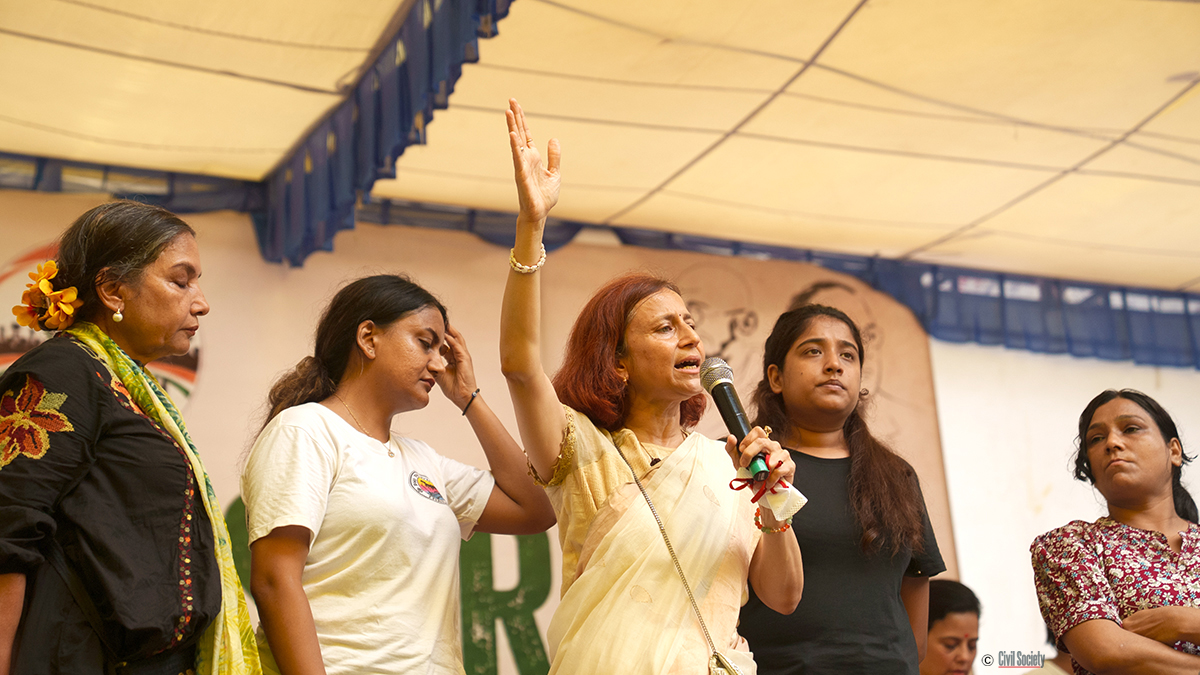 Shabana Azmi ( extreme left) looks on as Gitanjali Angmo, wife of Sonam Wangchuk, addresses the protest | Civil Society picture/Lakshman Anand
One afternoon at 1.30, not the time to be out in Delhi in July when it is hot and crushingly humid, we found Ashutosh Ranka addressing about 150 people under a tarpaulin, pedestal fans providing some relief.
It was an engaged audience which cheered when he said the reason government schools don’t function is because politicians don’t want people to be educated and question them. Ranka disarmingly told his audience that he hadn’t ever set foot in Jantar Mantar before June 6 and nor had the other key people in the CJP. Everyone should similarly come forward to be counted on an issue as important as education, he said. When Ranka asked how many had come to the CJP protest for the first time, a majority of hands went up. He asked if they would be there for the July 20 march to Parliament, and all hands went up.
PERSONAL STORIES
While prime movers of the CJP have worked tirelessly for the protest, it is ordinary people who have taken it forward and spread the word.
Gautam was on fast because he has experienced first-hand that privatization in education is not working. He goes to a private university in Greater Noida, paying fees his family can hardly afford.
“Over the course of my four-year degree, I’ve paid a fine of Rs 2,000 for late fees twice,” he said. “The name of my university is Galgotias University. Every year on April 7, they take the full fees at once. It is not possible for a middle-class person to make the entire payment at once. It was not done in the first year, but they have done it in the second year. And because of this, two of my papers were barred.”
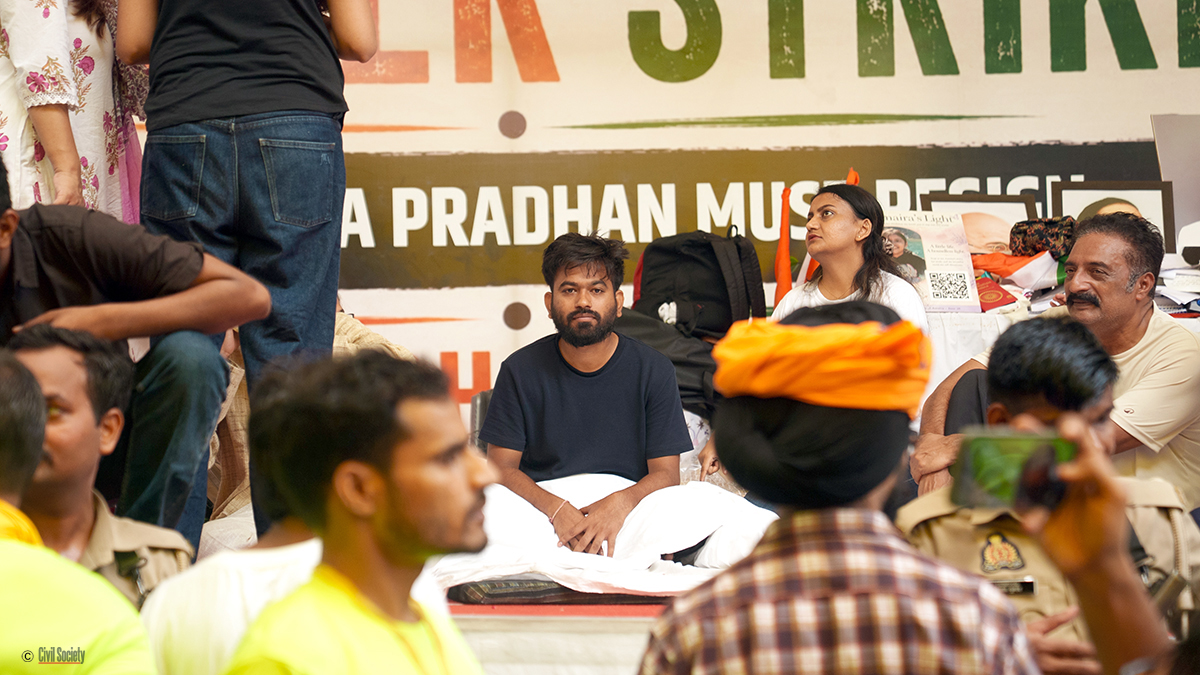 Abhijeet Dipke, who was fasting, and actor Prakash Raj (right) | Civil Society picture/Lakshman Anand
Manish comes from UP and belongs to AISA (All India Students Association), the leftist student union. He says: “I come from UP. If I tell you about my university, there has been a huge fee hike. It is a very socio-economically backward area. The fees of the courses have been increased by 400 percent. Dharmendra Pradhan is responsible for that. The funds of our campuses have been cut. Dharmendra Pradhan is responsible for that too. The democratic spaces in the universities are being cut. He’s responsible for that too. A policy like the National Education Policy (NEP) is being used to commercialize, decentrallize and saffronise education. Dharmendra Pradhan is responsible for that as well. That is probably why in the last three years, over six million students in Uttar Pradesh have left their studies. We are supposedly going to have a $5 trillion economy, but our students are not even able to study.”
It is not just the young who have felt the need to protest. Dilraj was there with his teenaged granddaughter. We ask him if she brought him to the protest and he says it is he who came and brought her along.
One of his granddaughters is studying to be a doctor. The one with him has appeared for NEET, also hoping to study medicine.
But Dilraj is worried that the way the education system is being managed, future generations will not be able to compete globally. His is a rural family in Uttar Pradesh with a base in Delhi. There is nothing for his grandchildren in agriculture and if they can’t get an education at an affordable cost what future can they have?
Madhu is also elderly. She decries elitism in the country. The rich get an education, go abroad, but what about the others, she asks.
She says it is revealing that the Chief Justice of India could see unemployed young people as cockroaches. How does his mind work, she wonders.
Politicians need to be much more open to change and the needs of people, she says. The country needs to evolve.
“Someone like Sonam Wangchuk, an engineer, he has done such wonders in Ladakh. He turned the failures of this education system into successes. We should adopt his model of real education in our schools. We should work for this model,” Madhu says.
“Why is the education system of Finland considered the best? People may say that it is a small country. It is not a matter of small or big. In Finland, education is given so much importance, teachers get the most respect. In our country, teaching is a time-pass, easy, suitable for women, they can work for a few hours and then they can take care of their household. This is how it is,” she says.
Comments
-

Suresh Babu - Aug. 14, 2026, 6:40 p.m.
Dear Editor, What a foolish title saying Call across India to sack Modi. Sir there is some nuisance in Delhi by a handful of unemployed, Ganja batch students who do not have any motive except creating some disturbances. In a population of around 150 crores some hundreds is trivial and negligible.
-
Usha Rai - Aug. 6, 2026, 6:19 p.m.
Loved your August issue of Civil Society. Apart from your bold stories and editorial on the CJP movement, I thought both stories of Praveen Sharma on Mahrashtra and Margao were excellent. Shree Padre is always good, but I enjoyed reading his story on bringing life back into tanks. I also liked Rashmi Gopal Rao's stories on Bhoomija's architecture and Amritsar's heritage architecture. It's refreshing reading Civil Society after looking at the screaming stories in newspapers. Great going. Keep it up.
-
Dr. Naresh Shetty - Aug. 6, 2026, 6:12 p.m.
Civil Society Is No Longer Civil We often demand our right to protest, but conveniently forget that every right comes with an equal responsibility. Public discourse has increasingly become confrontational rather than constructive. The debate surrounding NEET is a classic example. What began as a genuine concern over irregularities has, in many instances, evolved into a political battle rather than a serious discussion on policy reforms. If our objective is to improve the system, then our focus must be on solutions, not on scoring political points. The responsibility does not rest with one institution alone. Some teachers, who are expected to uphold the highest ethical standards, have unfortunately become aligned with coaching centres, creating conflicts of interest and fuelling a commercialised education system. Many parents, driven by the desire to secure a medical seat for their children, are willing to participate in unethical practices. Equally, many students pursue medicine not because it is their passion, but because it is their parents’ dream. Perhaps it is time for parents to give their children the freedom to choose careers based on their interests and abilities rather than societal expectations. A motivated professional is always a greater asset to society than a reluctant one. When irregularities were identified, the government ordered a re-test for those affected. While no corrective measure is perfect, taking decisive action to protect the integrity of the examination was an important step. The larger challenge, however, lies beyond any single examination. The uncomfortable truth is that corruption remains one of the greatest diseases affecting our society. It is not confined to governments or institutions; it exists wherever individuals compromise their moral and ethical values for personal gain. We are all part of this system, and therefore we all share responsibility for reforming it. A system cannot be transformed merely by passing the blame or searching for scapegoats. Real change begins with introspection, accountability, and the courage to uphold integrity, even when it is inconvenient. Democracy thrives on diverse opinions and healthy debate. Differences of opinion are its strength. But above all, the nation and its long-term interests must come first. Only when we place ethics above expediency and responsibility alongside rights can we build a stronger, fairer, and more civil society.