



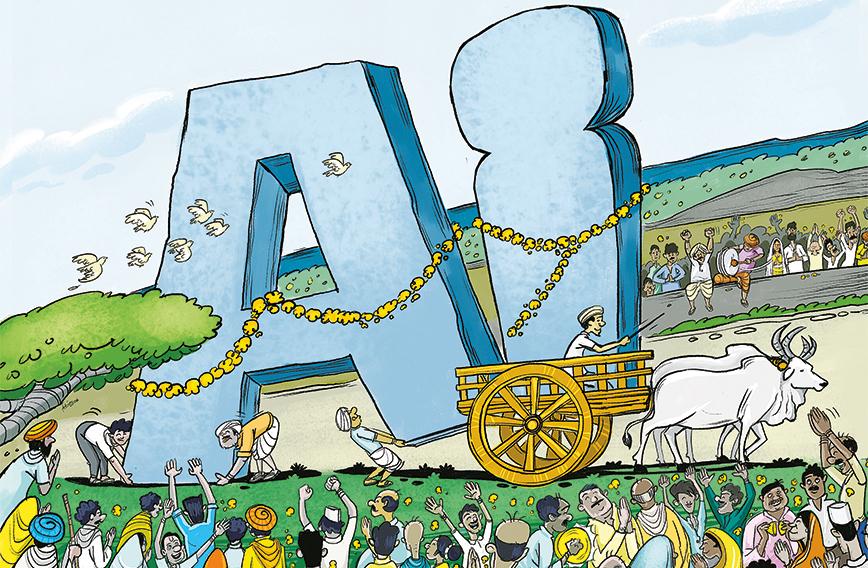
What is India’s AI future?
By Kiran Karnik
The abbreviation for artificial intelligence, AI, is now as commonly used as TV. And like television, artificial intelligence has permeated everyday life. It became even more ubiquitous when the AI Impact Summit was held in Delhi in February. A media barrage amplified AI’s visibility for the government-led event which heads of state and globally renowned industry figures attended. AI models on display drew such large crowds to the exhibition section that the event had to be extended by a day.
The New Delhi Declaration, finalized at the summit and endorsed by over 80 countries, was well-crafted and said all the right things, in keeping with its theme of ‘Sarvajan Hitaya, Sarvajan Sukhaya’ (welfare and happiness for all). It positions AI as a global public good that must be democratized, not monopolized, and emphasizes collaborative, trusted, inclusive AI development. One would assume that these motherhood statements would be universally acceptable; yet, the Declaration is voluntary and non-binding, with no enforcement mechanism. Further, in keeping with its general disdain for any multilateral agreements, the US explicitly stated it “rejects global governance of AI”.
The mega-event, including showcasing of indigenous capability at the exhibition, made it seem like a coming-of-age ball for Indian AI. The presence of so many heads of state, public statements by global tech leaders lauding India’s tech capabilities and prospects in AI, and self-congratulatory statements by India’s leaders made a heady amalgam. On this count, hype overtook reality by a fair margin.

GETTING DOWN TO IT
Now that all the hoopla is over, it is a good time to look dispassionately at the AI Impact Summit, its outcome, and the broader arena of AI. While the summit addressed many areas, some vital issues were swept under the carpet, glossed over, or otherwise neglected. These have deep consequences, calling for serious attention. Amongst them:
- Fostering industry-government and cross-country collaboration on using AI for social development (focussing on the UN Social Development Goals, SDGs), along with financing for such an effort.
- Using AI to create new jobs/livelihoods and to supplement rather than supplant humans.
- Mechanisms to protect individual privacy as a part of basic human rights amidst the frenzy to capture data and the ubiquitous surveillance via satellite, aircraft, drones, and CCTV cameras.
- Data sovereignty, responsibility for protecting confidential data (of individuals or entities), and not capturing or using/exporting personal and non-personal individual data or community data without explicit informed consent.
- Safeguards and guard rails against AI’s runaway development or uses, especially in autonomous, human-independent modes.
- Protecting countries against exploitation by a few country-company tech monopolies.
- Weaponization of AI, in war and in trade.
- Other dangers posed by AI, including deepfakes, biased training models, hallucinations, and the development of artificial super intelligence (ASI).
As a major new and disruptive technology, AI has multifarious impacts. Many of these evoke considerable concern and the road ahead, with even more sophisticated AI, seems full of possible dangers. At the same time, AI also opens up immense new opportunities, leading technophiles and most tech experts to argue that advancing technology in this field will be good for all humans.
Without getting overly carried away by all the hype, or by apocalyptic doomsday scenarios, here we focus on a few selected issues from the eight listed above.
SOCIAL GOALS
While AI’s relationship with weapons and coercion is strong, as already visible in the war against Iran and the earlier abduction of President Maduro from Venezuela, its most promising and exciting uses are in the arena of social development. The possibilities, especially in health and education, are so immense that the only immediate constraint may be our imagination.
This is an area of critical relevance for India, since it is the health, education and general well-being of citizens that should most concern us; yet, India’s record here has been dismal, as reflected in the United Nations Development Program (UNDP)’s Human Development Report (HDR). This uses a composite index to measure a country’s progress, its overall performance and its relative standing vis-à-vis other nations. Despite having the fourth largest economy (amongst the fastest growing), and superpower aspirations, India is ranked 130 (out of 193 countries) in the 2025 HDR (marginally up from133 in 2022), on a par with Bangladesh and far below China (78) and Sri Lanka (89).
HEALTHCARE
The health of an organization can be quickly gauged by the cleanliness of its toilets. Similarly, the true wealth of a nation is reflected in the well-being, health, and wellness of its people. Though progress has undoubtedly been made, India yet compares badly on the health front, even amongst countries with similar per capita incomes. Despite a few world-class hospitals and its emergence as an aspiring “medical tourism” hub, the public health infrastructure is generally poor, especially in rural areas and more so in the East and many states in the North. Budget allocations for health — in the states and at the Centre — are small and grossly inadequate, reflecting low political priority. Meanwhile, the sorry state of government healthcare facilities is pushing people to private clinics and hospitals — a backdoor method of privatization of public health which is impoverishing many of the poor.
 AI can address the backlog in healthcare | Civil Society picture/Ajit Krishna
Amidst this, there are signs of hope, with tech and AI giving glimpses of what might be feasible. New AI-linked devices and methods of diagnosis — often non-invasive and simple, involving minimally-skilled paramedics and low costs — are being invented. These also make possible remote diagnosis and can be implemented at scale, extending the reach to rural and remote areas with poor health infrastructure. Leveraging this and the growing communication infrastructure, AI will hugely enhance the possibilities of healthcare through automated diagnostics and remote expert consultation. Sophisticated but simple and inexpensive devices are making possible home/self-diagnosis (going beyond infrared thermometers, oximeters, blood tests, and self-administered Covid tests). Some examples are mentioned in the excerpts from More from Less for More (Mashelkar and Borde), in Civil Society (February 2026).
At hospitals, AI can facilitate better healthcare. This begins with the simple (but forbidding for so many) task of navigating one’s way through the hospital rigmarole of registering, seeking an appointment, booking time for any required tests, etc. Other hospital administration tasks can be automated, freeing up the doctors’ time for their core task of patient consultation, thereby improving quality and efficiency. At the medical level, AI is driving big improvements, from better diagnostics to facilitating robotic surgeries. It is making possible a move towards personalized medicine, with patients getting the most appropriate medicines in the dosages optimized for their individual situations.
Wearables are transforming healthcare through continuous monitoring of key parameters, making possible early warnings and action, even pre-emptively through AI at the back-end. They are also prompting greater health consciousness and will contribute to a healthier and fitter population. AI is helping researchers discover new medicines or treatment routines, and speeding up not only this process but also the validation tests that are required before these reach patients. At the same time, AI is facilitating work on organ replacement. A combination of health science, electronics and AI may, in years to come, make it possible to replace almost any organ of the body.
For India, which functions in different centuries at the same time, the grassroots, bottom-of-the-pyramid problems are of great importance, more than state-of-the-art tertiary care hospitals. What has been only cursorily outlined above indicates that it is precisely in this most-needy segment that AI can make the biggest impact.
EDUCATION AND SKILLING
Like healthcare, education and skilling are areas of vital importance. These have inherent value and are key elements in helping individuals attain their full potential. They also enable better livelihoods for individuals, and social and economic development of the nation. AI is already facilitating this and can be a major contributor in scaling and universalizing quality education.
AI can help to design modules for education or training, and re-design them to adjust content, its pace, language, and examples to suit the intended audience. This can be done for in-person courses as also for online ones. In fact, such learner-responsive programmes can be crafted in a manner that suits the level, understanding, and grasping power of each individual. These personalized programmes will not only make education and skilling available to persons anywhere, at any time, and on any device — all at an affordable cost — but will raise the quality of education by using the best teachers and ensuring comprehension.
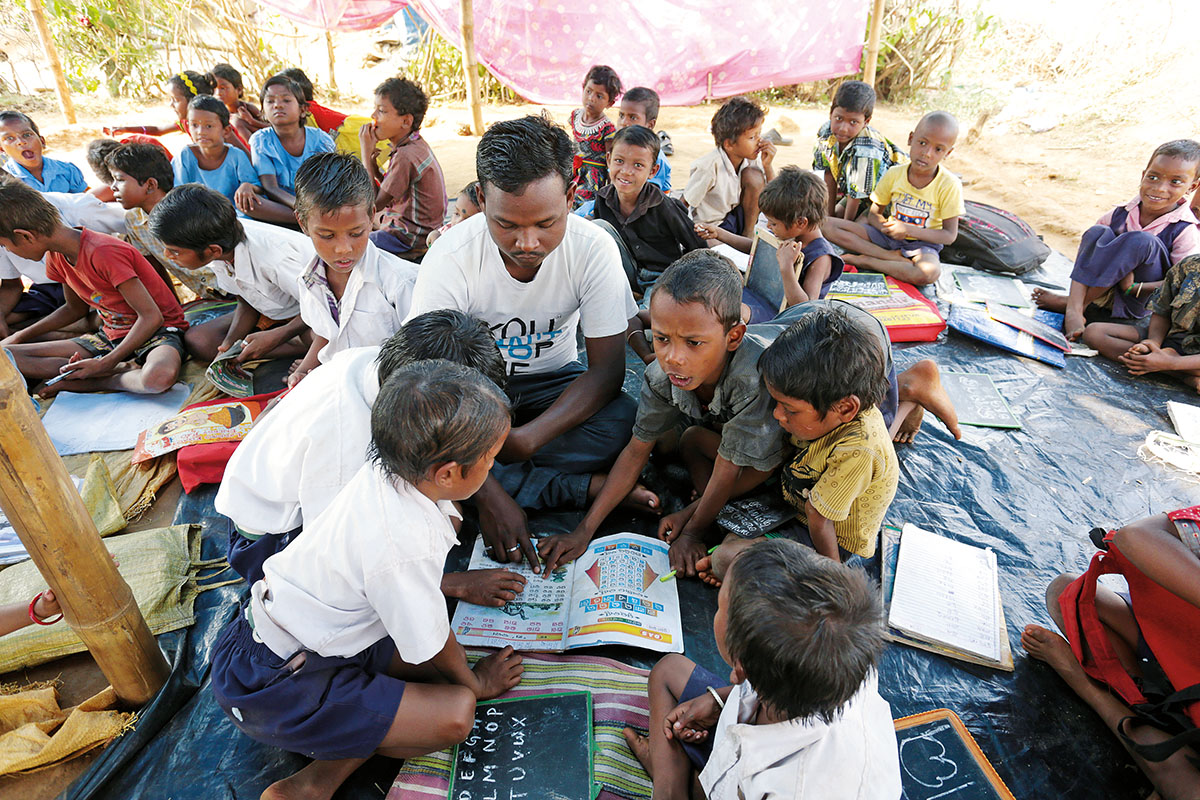 Learner specific models are required to suit the intended audience | Civil Society picture/Ajit Krishna
This can be further enhanced by using a virtual online tutor, who/which can help clarify any doubts and questions: a guide, constantly at your side, to make sure you understand all the material. The immense possibilities that this opens up were covered in an earlier column (see “Your AI Guru”, Civil Society, July 2025).
In the emerging and rapidly-changing world, continuous re-skilling and upskilling will be required, and AI-aided virtual learning will be the quickest, easiest, and cheapest way of doing this. Such education/skilling will also enable one-step-up work, facilitated by AI at the back-end. Thus, a villager provided basic education and skills (via an online programme) could become a nurse at a PHC, with AI aiding her as a virtual (remote) guide or coach. In other fields too, such a human-plus-AI approach would ensure jobs, even as lowest-level bottom-of-pyramid tasks get automated. Continuous and rapid upgrading of skills will ensure that humans stay one step ahead of automation, with abilities which AI cannot immediately replicate. Also, higher productivity will lead to higher wages. Thus, AI would complement or supplement, rather than supplant humans.
These opportunities in health, education and many other social development areas — so important for all of the Global South — need development of specific AI models. One would have liked to hear more discussion about this, and the formulation of an action plan at the AI Summit. Nationally, too, we see so little attention paid to this, in contrast to big plans and claims about basic foundational models (like Large Language Models or LLMs), compute facilities, data centres, etc. Yet, this was a chance for India to take the lead, to initiate the creation of something that the 100-plus developing countries could use. As one of the very few countries where social need meets tech capability, India should have been at the forefront. Maybe, though the Summit is over, it can yet be.
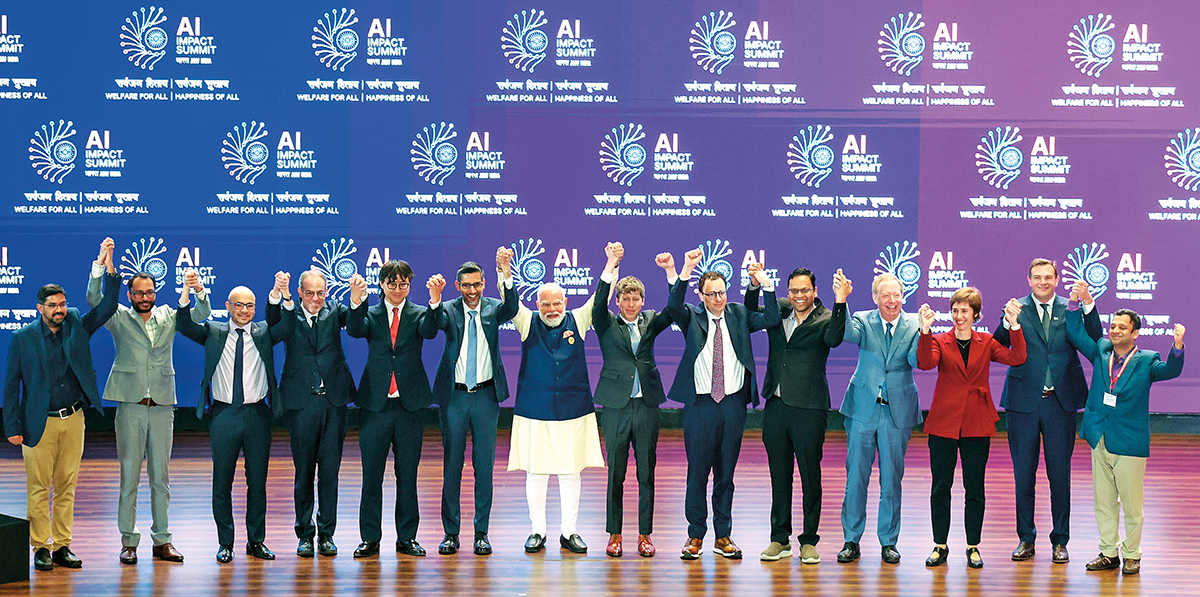 The summit was a heady event
AUTONOMOUS WEAPONS
As with most technologies, the real driving force behind AI’s development is its military use. In conjunction with existing tech, AI acts as a big force multiplier, taking capability to a new level. Smart bombs and precision strikes are made smarter and more precise; surveillance can be at higher resolution, and troop or weapons movement analyzed instantly to decipher enemy plans, with super-fast simulations suggesting alternative deployments to counter these. Many such uses will give a huge advantage to those who possess greater AI capability.
These, however, mark incremental — though sometimes large — changes. Of greater concern is a more fundamental change: the move to autonomous weapons. These — AI embedded in devices or platforms (drones, planes, boats, submersibles, or even robot-soldiers) — can be trained to find, identify, and neutralize any given target without human intervention.
Once programmed, autonomous weapons will make their own decisions about whom (or what) to attack and the best time to do so. Meanwhile, with hypersonic missiles and neighbours as possible enemies, the reaction times have reduced vastly. Therefore, any anticipated attack necessitates a superfast creation and evaluation of options, choosing the best one, and taking immediate action: steps done quickest through full automation, without the slowness of humans-in-the-loop.
While there are moral or philosophical issues around autonomous weapons, a more practical concern is whether this will promote wars, as the threshold for mounting a war is likely to be far lower. The more cynical may argue that automated weapons, particularly robot-soldiers, are fine: after all, human lives are not being lost and “body bags” are not coming back. The worry, consequently, is the casualness with which nations may get into wars, as these begin to resemble video games (with little actual bloodshed for tech-capable nations); it is also possible that at some point, agency may shift from humans to AI. When, against whom, and with what intensity to wage war may then be determined by AI and not by humans. It is for this reason that many thinking people are urging a moratorium or outright ban on the development of autonomous weapons.
Historically, in two other areas of advanced and dual-purpose tech, nuclear and space, India was at the forefront in trying to promote their use for development — through both example and advocacy for global agreements. The recent summit was an ideal platform for India to have done this with regard to AI and its off-shoot, autonomous weapons. We would have had the strong support of the Global South, and of many thinking people in the developed world. It was a chance missed to do some global good and once again position India as the moral voice and conscience of people everywhere.
MICROCHIP ELITES
Technology has always been used to create weapons, and it has often determined who wins a war. Now, technology has itself become a weapon used in global trade. The ubiquitousness of tech and its use for critical applications in all areas has made vital sectors of the economy in all countries dependent on it. As AI gets embedded in everything, one has to depend on readymade solutions from a very limited number of vendors. Trying to develop apps will require access to the underlying models (LLMs). These are owned today by very few companies, almost all only from one country (the US).
Components like microchips are now the building blocks for all possible systems and products. Advanced microchips are available from only a handful of countries, and the graphic processing units (GPUs) — essential for large and fast computing facilities needed for AI — are available from even fewer sources. More basic, and as necessary, are minerals like rare earth elements; rare earth magnets are vital for many applications, including electric motors and vehicles. On these, one country (China) has a virtual monopoly.
This has led to a few select countries (the US and China, in particular) beginning to use this, not only as leverage in trade negotiation but also by imposing selective restrictions on exports of certain products, technologies, and essential elements, to some countries: sanctions that prevent access. Given the dependence of countries on these technologies, this has become a new coercive weapon, a new form of gunboat diplomacy of yore, almost like a military threat.
Such weaponization is used through companies too. For example, in July 2025, sanctions by the European Union against Russia were cited by a US megacorp (Microsoft) as the reason to cut off critical software (cloud services, Outlook, and Teams) being used by a major Indian oil refinery (Nayara, partly owned by Russian firm Rosneft). This tech-coercion now supplements — almost supplants — the use of the global payment system (the US-controlled SWIFT for inter-bank transfers) as a lever to enforce sanctions.
With such controls, Gen AI may no longer be an abbreviation only for Generative AI, but also for (army) General AI.
Given the global spread of supply chains and the need for continuous tech support and devices, there is need for an international agreement on free trade for civilian use. The summit would have been a good forum to raise this and initiate some negotiations. Similarly, some regulations are required to counter global monopolies.
DATA PROTECTION
AI is built on data, which is the raw material that helps create and train the LLMs, the backbone of all AI. It is also used to target individuals as consumers, since extensive data about an individual can now be gleaned from a very wide variety of sources — from payment data (credit cards, UPI) to medical tests and hospital records. Countries are now increasingly aware about both the value and the privacy issues around this data, leading to calls for data sovereignty (no export of data) and no collection and use without consent. While India is yet mulling over the regulations and export restrictions, the European Union is greatly concerned (especially about US MNCs) and already has tough laws (like the General Data Protection Regulation) regarding its data. On the other hand, in a recent (February 18, 2026) cable, US Secretary of State Marc Rubio has asked that diplomats follow “a more assertive international data policy” and that diplomats “counter …. data localization mandates”. Clearly, there is need to balance data flows, data sovereignty, and privacy: an issue that called for the summit’s attention and requires global agreements.

The growing danger of deepfakes, created through the use of AI, of intentional or hallucinatory misinformation, of AI-induced mental health problems (sometimes ending in suicides), and of cybercrime are widely recognized, even experienced. These global problems could have been addressed at the summit and action sought.
LOOKING AHEAD
Apart from the dangers of AI-controlled autonomous weapons, there are concerns about the rapid development of AI, including its self-learning. Looking ahead, there are many — including sci-tech leaders — who are greatly worried about the emergence of superintelligence (ASI), the final step after Gen AI and artificial general intelligence (AGI). ASI marks the point at which AI is superior to the human brain. This is not sci-fi from some vague and far future, but may be closer than we imagine. For example, Sam Altman, founder and CEO of OpenAI (arguably the world leader in developing and mass-marketing AI to hundreds of millions), said at the AI Summit: “On our current trajectory, we may only be two years away from early visions of true superintelligence.” This writer too has pointed to the possibility of humans losing their pole position as the dominant species and becoming subservient to AI.
Tackling this existential danger may require a global agreement on a moratorium on AI development: another issue that was ripe for discussion at a global forum. Though lacking teeth without any enforcement mechanism, even resolutions, guidelines and guard rails have value as normative documents that may nudge behaviour and action.
These are issues yet on the table. They merit dialogue and debate: domestically and globally. India must play a major role in this.
Kiran Karnik is a public policy analyst, author, and columnist. His most recent book is ‘Decisive Decade: India 2030, Gazelle or Hippo’.
Comments
-

Paridhi - May 8, 2026, 11:50 a.m.
The article was insightful, bringing together both the potential dangers and opportunities of AI with admirable clarity. Its emphasis on social sectors like healthcare and education is especially important, where AI can expand access, improve quality, and bridge long-standing gaps. At the same time, the concerns around autonomous weapons, data control, and inequality are timely reminders of the risks. Since AI is clearly here to stay, the need of the hour is not resistance but mindful adoption and democratisation. Its call for public awareness, ethical frameworks, and inclusive policies is crucial to ensuring 'AI supplements humans and not supplants'.