




The flight of a Generation
Sanjaya Baru
 IN 2024 India overtook China as the biggest source of tuition paying students with 3,31,602 students securing visas to study in the US, representing a 23 percent increase over the previous year. Indian enrolments increased primarily at the graduate level, reported The Times of India, accounting for 19 percent of the total student emigrants that year. Interestingly, those who had completed some course of education and stayed on for Optional Practical Training (OPT) accounted for as much as 41 percent of tuition paying Indian students. Taken together Indian students reportedly spent up to US$ 11.8 billion in 2023.
“You did it, India!”, declared US ambassador Eric Garcetti, welcoming this enthusiasm in India for overseas education in the US. “The decision to study abroad, and your choice of the United States, represents a valuable investment by you and your families. ..... We celebrate the strength of the Indian educational system that prepares students to compete globally and look forward to seeing India continue to lead.”
Overseas students constituted a fifth of all students enrolled in colleges across Britain in 2022. With a decline in the numbers coming from China, due to political restrictions, and Europe, after Brexit, India has emerged a major source of fee-paying students with annual fees in the range of GBP10,000 to GBP38,000, among the highest in the world. Thanks to a differential fee structure, overseas students are effectively subsidising the education of British nationals. While US, UK, Canada and Australia remain the ‘big four’ destinations, the craze to go overseas and the search for lower cost options is taking Indian students to new destinations such as Chile, Estonia, Ireland, Korea, Kyrghzstan, Lithuania, Malta, Russia, Taiwan, Turkey, Ukraine and so on.

According to Rajiv Ganjoo, founder CEO of LilacBuds, a consulting outfit facilitating overseas admissions for Indian students, “Tuition fee in the US ranges from $20,000 to $100,000 depending on the programme and university in comparison to tuition fee range of $3,500 to $15,000 per year for other emerging student destinations. Additionally, these countries need skilled professionals, providing increased opportunities for students from Bharat and all these courses are also recognised back in India.”
 Consider the fairly typical example of Council for American Education, a private consulting firm run by two US-educated Indians, Rajesh and Sudhir Arya, out of New Delhi’s Defence Colony. Their website studyingoverseas.com claims, “Our mission is to provide assistance to the students seeking guidance or mentorship for education in the United States. We aim to establish Council for American Education as the educational consultancy of choice for the test-preparation and advising needs of students planning to study in the US. As a team, we are committed to set the academic objectives for ambitious and driven students and help them reach out to the stars.”
There is a phenomenal growth in such consulting organizations that help Indian students prepare for overseas education. These outfits help aspiring students train for the admission process and assist them in going through the process. While no guarantees are offered, a hefty fee is extracted. This is a phenomenon that has come to stay — families paying hefty sums at home for the education of their children to help them go overseas where they end up paying even more for higher education. Such investment makes sense only if at the end of the process overseas employment and then citizenship is secured, especially in a developed country. That is the way the economics of high cost education, at home and overseas, works. The numbers are there to see.
Liberalising the foreign exchange management policy, the Government of India introduced a new scheme in February 2004 that permitted Indian citizens to remit overseas an annual sum of $25,000 for a range of personal purposes. These included (1) Private visits to any country (except to Nepal and Bhutan where the Indian Rupee is legal tender); (2) as gift or donation; (3) for going abroad for employment; (4) to facilitate legal emigration; (5) for maintenance of close relatives abroad; (6) for overseas travel for business, or attending a conference or specialised training or for meeting medical expenses, including a check-up abroad, or for accompanying a patient going abroad for medical treatment/check-up as an attendant; (7) to meet expenses in connection with medical treatment abroad; and (8) for overseas education. In May 2015 the ceiling for annual remittance overseas under these heads was increased to $250,000. This has meant that over a four- year period an individual can remit a million dollars overseas and that in any given year a family of four can also remit a million dollars. Consequently, there has been a sharp increase in annual remittances overseas since 2015.
Data provided by the Reserve Bank of India show that of the total funds remitted overseas each year, under the LRS (Liberalised Remittance Scheme), travel overseas accounts for the largest amount followed by studies abroad. Together the two heads of remittance account for over 50 percent of funds remitted. While funds remitted for travel abroad would cover business travel and tourism, this head would also include travel for studies overseas. Further, one could suggest that funds remitted under two other heads could also be paying for overseas education, namely, ‘maintenance of close relatives abroad’ and the ‘others’ category that includes educational loan repayment and payment for overseas journals.
While RBI offers official estimates of funds remitted overseas for education, there are other estimates in the public domain. Overseas education consultants OneStep and University Living claim that Indian students could spend up to $70 billion by 2025 for overseas education, mainly in the four English-speaking countries of US, UK, Canada and Australia. This compares with $47 billion estimated to have been spent in 2022, the academic year after Covid. The number of Indian students overseas is expected to double from one million in 2019 to two million in 2025. In a tweet last year on X the former CEO of India's NITI Aayog and the Prime Minister’s G-20 Sherpa, Amitabh Kant, claimed, "Indian students opting for higher education abroad would rise to 1.8 million with their overseas spending rising to $80 billion by 2024."
Few, of course, believe that this clamour for overseas education is only in search of knowledge and the experience of living abroad. Most see it as one step closer to emigration, overseas employment and eventual citizenship of a developed country. Indians, who have recently overtaken China as the most numerous migrants entering OECD countries, are more likely than Chinese to stay back in the country they go for higher studies, according to the OECD’s International Migration Outlook 2002.
The OECD report concludes, “Indians are the most likely among all foreign students to stay back in their host country and join the local workforce.” Indeed, most observers of the overseas education scene as well as private sector consultants believe that Indians are willing to spend liberally on overseas education because they view this as an investment in ultimately seeking employment, even citizenship, overseas. Thus the actual spending on overseas education may well be far higher than what the LRS data suggests if funds are provided through unrecorded channels.
Such forecasts also suggest that this phenomenon is not only expected to persist but that it would become bigger as middle class and upper class Indians become wealthier and are willing to spend more on overseas education. Finally, they also suggest that a large part of what India gets as inward remittances from ‘skilled and knowledge workers’ — Gulf labour and H1-B visa holders in US — would increasingly go to balance the external account as outward remittances increase. There was a time when Indians went overseas to study. Today they study in order to go overseas.
The problem with out-migration of students is not just about numbers, nor even about the flight of talent, as a problem in itself. Indeed, it is not even about the foreign exchange outgo on account of the cost of education and stay overseas. It is all these but equally also about the social signals it sends at home and overseas. When the children of a country’s power elite — its political, bureaucratic and diplomatic leadership, its scientists and intellectuals, its business leaders and the leadership of its armed forces and such like go overseas to study and work in large numbers they reinforce the view across society that migration is an aspect of upward social mobility. Elite migration raises concern among the vast majority whether they would also not be better off making their future overseas.
What message does a nation send out when the children of all those who have occupied high offices like national security advisor, foreign secretary, central bank governor, cabinet secretary, armed forces leadership, national intelligence agencies and so on opt to study and be gainfully employed overseas. What stake do the parents have in this country when their children’s future is no longer linked to that of the country? When the policies they pursue bear no consequence for the next generation in their families who have opted to hitch their wagon to distant nations? In the social circles of India’s power elite families take pride in the fact that the next generation has seceded from the country of their birth.
Every year when graduation day arrives at American university campuses it is interesting to see how many senior officials of the Indian state fix meetings overseas to be able to travel and be present at the ceremony as proud parents, knowing full well that their child will settle down to a good job on the East Coast or the West. The social consequences of such elite migration are, therefore, long-term and serious. They damage a nation's image. Indeed, this preference for migration for education and employment among the elites can also be very corrupting. Multinational corporations and consultancy firms are happy to offer jobs overseas to children of the power elite. An insidious nexus gets embedded between the power brokers of the world. While economists calculate the fiscal and foreign exchange impact of overseas education, political scientists and sociologists must focus on the implications for politics and policies, national security and foreign policy and, indeed, national image and power.
***************
Indian contribution to MAGA
Defending a liberal immigration policy, President Joe Biden told an election fund raising event in May 2024 that while ‘xenophobia’ and a lack of openness to immigrants was hobbling the economic growth of countries like China, India and Japan, the United States had in fact been a beneficiary of its openness to talented immigrants. “One of the reasons why our economy is growing is because of you and many others,” Biden told a gathering of Asian Americans. “Why? Because we welcome immigrants.” Addressing members of the Global Organization of People of Indian Origin-Connecticut Chapter (GOPIO-CT), US Congressman Jim Himes called Indian Americans “a secret weapon for economic growth ... the future of US innovations.” “The brains of tech innovations are here... We have so much to do on immigration to enable the tech-savvy and entrepreneurial Indian-American community to have a smoother and faster way to have Green Cards and job visas.”
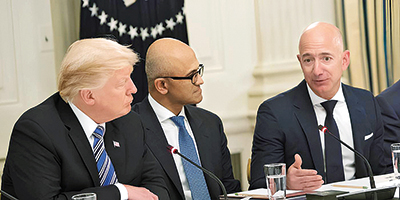
Microsoft’s Satya Nadella with Donald Trump and Jeff Bezos |
Not to be left behind in attracting the Indian American vote Donald Trump announced automatic green cards for bright young Indian immigrant graduates coming out of US colleges and intending to remain in the US. “What I want to do and what I will do is — you graduate from a college, I think you should get a Green Card automatically as part of your diploma, a Green Card to be able to stay in this country.” Trump said he was sad to hear “stories where people graduated from a top college or from a college, and they desperately wanted to stay here, they had a plan for a company, a concept, and they can’t — they go back to India, they go back to China, they do the same basic company in those places.” Educated Asian immigrants, Trump was telling his voters, would also help MAGA — Make America Great Again — his campaign slogan.
Indian Americans have contributed to US global leadership in a large number of fields ranging from medicine and healthcare to information technology and finance. President Biden’s acknowledgement, however, was probably the most public and bold statement by a senior political leader. East and South Asian immigrants — Japanese, Koreans, Chinese and Indians — have powered the post-War dynamism of the US economy. Chinese and Indian immigrants, who have arrived on American coasts in their thousands over the past quarter-century, have contributed handsomely to the continued global dominance of the United States as a premier Knowledge-based Super Power. Much is often made of the US contribution to China’s and India’s rise. Surprisingly, few have tried to quantify the Asian contribution to US global dominance as a technological power.
It is true that demographic shifts have hurt the growth prospects of many ageing developed economies. Biden was right to point to the economic cost imposed by the inward orientation of many developed economies. The US, however, has benefitted not just from her openness to immigration but in fact, and more so, by attracting highly talented immigrants, especially from Asia. Gone are the days when the typical immigrant landing on the shores of Manhattan was a desperate European. Of course, many of the world’s impoverished, persecuted and desperate still enter the US. They too provide fuel to the engine of US growth and the comfort of American lifestyle. However, it is the ‘best and brightest’ from Asia that illuminate the top of the pyramid of power and knowledge in the US.
The realisation that innovation and the powering of the knowledge economy in the US requires a more liberal policy towards immigration of Indian American talent has had to contend with the more familiar and generalised opposition to immigration. Responding to such opinion Ignatius Chithelen published a study of Indian American contribution to business and innovation in the US provocatively titled Passage from India to America: Billionaire Engineers, Extremist Politics and Advantage to Canada and China. If President Trump restricts visas to Indians, Chithelen argued, there would be flight of talent to Canada and in the end China rather than the US would benefit. Chithelen pointed to the contribution that ‘billionaire engineers’ like Satya Nadella, Sundar Pichai, Shantanu Narayen and several other CEOs and persons of eminence have made and continue to make to powering US business and the knowledge economy. Biden has certainly got that message.
China and India have exported large numbers of highly educated professionals as well as skilled labour to the US over the past half- century. Their contribution to a wide range of fields including computer science and information technology, basic and natural sciences, medicine, nuclear and space technology, finance and business, government and public affairs has been considerable and highly visible. In an aptly titled study published two decades ago, Give us Your Best and Brightest: The Global Hunt for Talent and the Impact on the Developing World, Devesh Kapur and John McHale drew attention to this American search for talent from developing countries. A developed West was siphoning off talent from a developing South, their study warned, enabling the former to remain globally competitive and dominant. Better compensation, living and working conditions drew such human capital away from developing economies to the developed.
 The Pravasi Bharatiya Divas organized by the government in India
Post-War development economics did focus on the possibility of developed economies in fact continuing to benefit from their relations with developing countries even in the post-colonial era. Beginning with the early work of Hans Singer, Raul Prebisch and Celso Furtado in the 1950s an entire body of literature emerged in the 1960s and 1970s that questioned the hypothesis that developing economies could benefit from foreign trade, investment and aid. The Dependency School led by Andre Gunder Frank and Samir Amin and the World Systems school led by Emanuel Wallerstein went further to suggest that the ‘centre’ of the world economy, namely, developed industrial economies, were in fact contributing to the ‘under-development’ of the ‘periphery’, while the periphery was feeding the continued global dominance of the centre.
Teresa Hayter’s classic expose of development aid showed how even aid money was not serving the goals of development but was in fact promoting the business interests of developed economies. This development economics literature viewed ‘brain drain’ from developing to developed economies within this dependency framework. What few foresaw in the 1960s and 1970s was the role that developing country talent would play in the early 21st century by contributing to the technological progress of the world's biggest economy through the continued augmentation of its ‘knowledge power.’
Surprisingly though, there is no significant study of this phenomenon despite the fact that many Indian professionals are based in US universities, institutions and think tanks. As many as 22,000 persons of Indian origin are employed as full-time faculty across all US universities and 16 Fortune 500 companies are headed by Indian Americans. A recently published report on the contribution of the Indian diaspora to the United States merely skims the surface. Even so, it presents some startling facts. A low middle income economy, that India is classified as by international financial institutions, has invested up to $40 billion in the world’s biggest economy since 2008, while total US FDI into India since 2000 has been estimated to be $64 billion. The irony underlying these numbers seems lost on the authors of the report, titled The Indian Diaspora in the United States: Recognising Impact and Celebrating Contribution. If these numbers are correct it could be claimed that on a per capita national income basis less developed India invests more in developed United States, than the other way round.
The contribution of Indian Americans and NRIs to the economic growth, technological development and global dominance of the United States remains to be properly quantified and documented. Economists have studied how global trade and investment flows in the post-War, post-colonial era have continued to benefit developed economies more than the newly industrialising economies of the Third World. The literature on brain drain, as we saw earlier, also examined the flow of human capital from developing to developed economies. In dozens of US institutions, in multilateral economic institutions and in private investment and financial research organisations scores of Indian economists and statisticians, including a couple of Nobel Prize winners, continue to devote a greater part of their time to studying India from afar. They publish copiously on issues pertaining to the Indian economy and on Indo-US economic relations. Yet, none has attempted to quantify the contribution of Indian Americans to sustaining the global dominance of the United States as a Knowledge Super Power.
In an early study of the economic impact of Indian and Chinese skilled immigrants, AnnaLee Saxenian observed, “when local technologists claim that Silicon Valley is built on ICs, they refer not to integrated circuits but to Indians and Chinese engineers.” Of the 11,443 high-tech firms that Saxenian found operating in the region in 1998, 774 firms (7 percent) were run by Indians and 2001 (17 percent) were run by Chinese and they collectively accounted for over $16.8 billion in sales and 58,282 jobs. Saxenian's study concluded, “Skilled immigrants contribute to the dynamism of the Silicon Valley economy, both directly, as engineers and entrepreneurs, and indirectly, as traders and middlemen linking California to technologically advanced regions in Asia.”

In a paper I wrote for the East West Center, Hawaii, in June 2000, on IT and the e-economy: "The Ballast for India-US Relations," I concluded, “The essential importance of the e-economy in Indo-US bilateral relations is that this is one sector in which the two countries are able to relate as equals with a spirit of give-and-take establishing a win-win relationship. The old paradigm of a one way dependence and a relationship of unequals is giving way to a new paradigm in which Indians see themselves as making a contribution of their own to the bilateral relationship and not merely being recipients of aid and largesse.” I observed at the time that not only had US companies benefitted from trade and investment in the IT sector, but that the US economy had also benefitted by securing access to India’s low cost but good quality skilled IT professionals. In the year 2000, when this paper was written, most viewed the US-India relationship as one that benefitted India. Few saw the Indian contribution to the US as a game changer for the latter.
A more recent study of Indian American contribution to the US knowledge economy, conducted in the states of New York, New Jersey and Pennsylvania, observed that “Chinese and Indian knowledge workers are good for the regional economy. Industries that face competition from firms in other parts of the country benefit from having more of the available knowledge workers locate in this region, rather than elsewhere —most notably California.” The study concluded that if the US government were to restrict ‘knowledge workers allowed to enter the country’, the jobs they currently fill would more than likely migrate to where those workers are — places like Shanghai and Bangalore. “Outsourcing would benefit fewer people in the region than the kind of “insourcing” these knowledge workers represent. Evidence suggests that the cost to native-born workers who are in the same fields as the migrants is probably small, relative to the overall benefit to other workers, employers, stockholders, and taxpayers in the region.”
While there have been many such micro studies of Indian American and NRI contribution to specific firms, industries and regions in the US, there is no macro study that quantifies the national and global impact of their contribution to the US economy as a whole. Biden's recent remark, therefore, should prompt us to try and estimate the Indian contribution to the US economy and its geo-economic dominance. Indian contribution to the US economy has been at three different levels. First, the contribution of highly qualified Indian professionals to US knowledge power; second, contribution of H1-B professionals and skilled workers to competitiveness of US firms; and, third, the contribution of Indian American business leaders to the global success of US corporations.
Comments
Currently there are no Comments. Be first to write a comment!