



MASTER OF THE MUSEUM PIECE
Umesh Anand, Benaulim
Far away from casinos, beaches and other touristy attractions, three homegrown museums, nestling in paddy fields on an organic farm, document the history of Goa going back several generations, recreating what life used to be like in this beautiful coastal paradise.
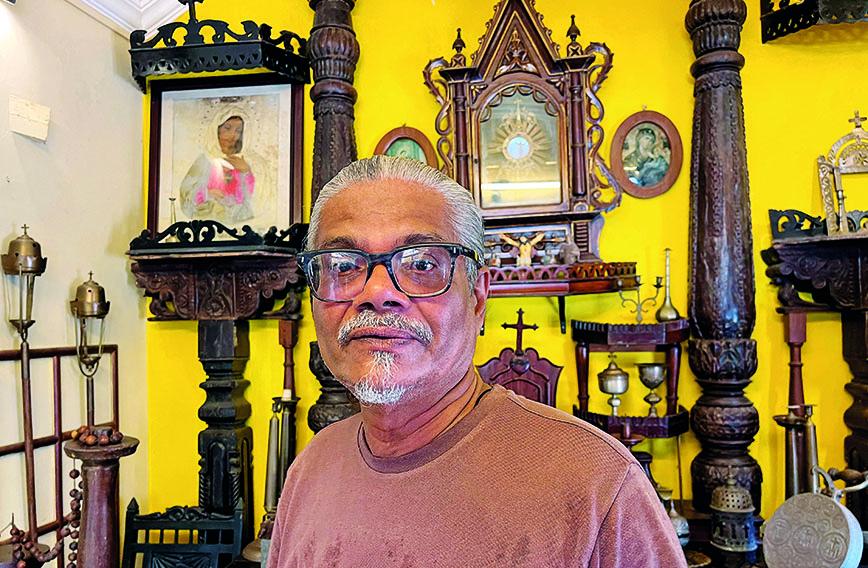
The Goa Chitra Museums in Benaulim in South Goa are the creation of Victor Hugo Gomes, restorer, conservator and free spirit. For three decades he has been scouring villages and towns to collect artefacts and recording the way ordinary people once went about their lives.
Gomes, 55, has made it his mission to preserve for posterity the practices, beliefs, values and traditions that existed lest they be lost forever amid rapid and irreversible change as Goa becomes a playground for people on holiday and a second home for the well-off from all over India and the world.
What emerges as a result of Gomes’s efforts to recreate the past is a picture of an inclusive and evolved society governed through collectives, respectful of nature and appreciative of beauty and nuance. There is both innocence and sophistication and a deep sense of community.
It was far different from the Goa of today where common lands, orchards and even paddy fields vanish in the clutches of builders and politicians. An environmental crisis looms with the loss of water bodies and green cover. Gone also are the traditional occupations with little to replace them except beach shacks, restaurants and taxis.

Gomes seeks to restore pride in the past. He thinks locals are directionless and losing out by not being rooted in their culture. With the museums, the hope is that there will be awareness. What is intuitively Goan will linger and be remembered even if it doesn’t make a full-blown return.
Ecology is high on the list. The museum highlights practices that once prevailed. Could they perhaps set people thinking and bring back ways of living that are wholesome and in harmony with nature instead of being consumerist and destructive?
 |
|
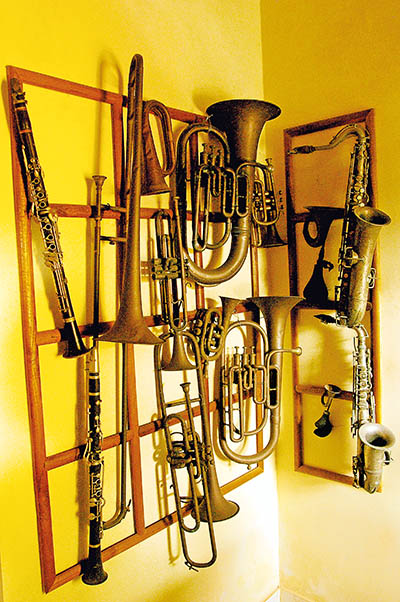
Musical instruments |
Gomes seeks to dispel the notion that people from Goa were up only for menial jobs as cooks, butlers, drivers and so on. He would like the Goa of the past to be seen as thriving and globalized long before it came to lurching from one tourism season to the next as it now does. He would like it to be known that it had a forward-looking middle class and a stable agrarian economy. It had India’s first medical college and its courts dispensed justice. There were good levels of literacy that came on top of traditional knowledge.
The Goa Chitra Museums have some 40,000 artefacts that tell this story vividly. They are housed separately in three collections. Goa Chitra is the flagship collection which focusses on village life and farming. Goa Cruti documents colonial influences going back to the 16th century. It was a time foreigners would live and work in Goa and the people of Goa would go out into the world. The third collection, Goa Chakra, is about the wheel and transportation with carts, rickshaws, palanquins and innumerable other non-motorized vehicles from all over India. To be accurate, this is really a national collection, the carts having come from all over India. Goa is represented in the palanquins and the hearses.
GRANDMOTHER’S WISDOM
Ordinary people have been the source for the artefacts. Extensive fieldwork has taken Gomes to corners of Goa. He was deeply influenced by his grandmother who brought him up. She was blind but could remember facets of life in Goa in vivid detail.
“She told me about some of the things they used. For example, you know, every village used to have a lake, a water reservoir which was used for the summer crop. They trapped water there and slowly, plank by plank, they’d release the water into the fields. Today if I ask people, no one knows that. So, I grew up seeing Goa through her eyes though she herself was blind,” he says.
 |
|
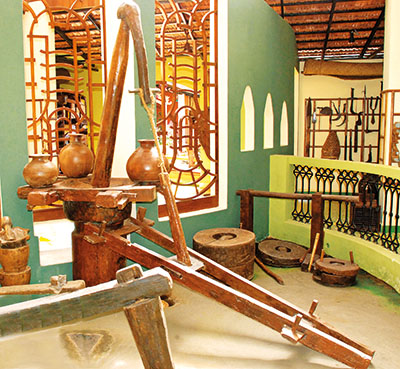
Coconut oil extractor restored by Gomes. It started him thinking about setting up a museum |
“Yeah. In fact, I recall her wisdom. I remember her telling me, son, don’t throw anything in the waterways, it is the pathway Rakhandar, the spirit who guards the land. The water is his pathway, so don’t disturb it by throwing anything,” he recalls.
“Basically, the museums are the story of the land. Everything my grandmother had told me had disappeared. Goa was changing very fast. I realized it was time for me to record what was being lost,” he says.
“I’ve connected with people from across Goa in the remotest of areas for literally 30 years of my life. I’ve slept on cow dung floors, with cows next to me to observe life as it really was. I can identify things that are still being discarded,” he says.
FISHING NETS
Benaulim being a coastal village, he began by documenting the fishing community. He learnt how canoes were made and the kind of wood used for them. He found that fishing nets used to be made from sunn, a grass that used to be grown to a height of three or four feet and harvested.
The football fields that are now found all over Goa were originally open spaces used by fishermen to grow sunn for their nets. Later they used cotton. Both were biodegradable and didn’t clutter the beaches unlike the plastic nets that are now used and are difficult to dispose of.
 |
|
The discarded door from the chapel at St John the Baptist Church in Benaulim |
“I documented the entire process of making nets. Now, sadly, you can’t even get one seed of sunn. We can’t reintroduce it. Go to that same coastline and it’s full of discarded nets. It’s sickening. These kinds of changes made me search for more practices from the past,” he says.
After documenting fishing, he began documenting agriculture. He also found it useful to create a glossary of Konkani words going back to 1887 that had been forgotten and were no longer in use. Bringing back the old words was important because they were more specific to implements and practices and brought him closer to the intricacies of local knowledge.
“My own glossary became my Bible. I started going around Goa meeting village elders and trying to find out what is that tool, what is this tool. They told me this tool was used on that terrain. Then I documented the different types of land that were used for cultivation. I didn’t just collect objects. I was fascinated with in-depth information. It became an obsession for me,” says Gomes.
FAMILY LAND
The Goa Chitra opened in 2009. It has taken shape in phases over the past 15 years or so. The three collections of Chitra, Cruti and Chakra sit on some 100,000 sq. m. It is farmland belonging to Gomes and his family. His father was one of the earliest settlers in Benaulim.
Though connected by highways and dotted with hotels big and small, Benaulim, being in South Goa, is still not a tourist hotspot. It is not isolated, but at least for now it is not a big draw in the way some of the better-known beaches in North Goa are magnets for crowds.
The vast collection of artefacts is housed in three unique structures which have their own special character. Being a restorer, Gomes has used windows and doors as he found them. He has preserved shapes and sizes to build large halls around them. He has retained texture. Noticeably, there are no air-conditioners, just fans whirring, with climate control coming from the architecture.
“Every time a house was being demolished, I would buy their discarded windows, doors, columns, balconies. Goa Chitra, you’ll notice, is built almost entirely with castaways. Almost every window is different. I built around what I had collected. I prefer using old wood, old doors, windows, when I restore houses,” he says.
The first museum that Gomes set up was the Christian Art Museum in Old Goa which he worked on between 1992 and 1994 at the invitation of famous artist Mario Miranda. It was the job that brought him back to Goa after a sojourn he had undertaken in other parts of India.
“The first museum I saw is the one I set up,” says Gomes jokingly. Basically a painter, Gomes had won a Lalit Kala Akademi award and spent time in Lucknow, among other cities, before deciding to go back to his roots.
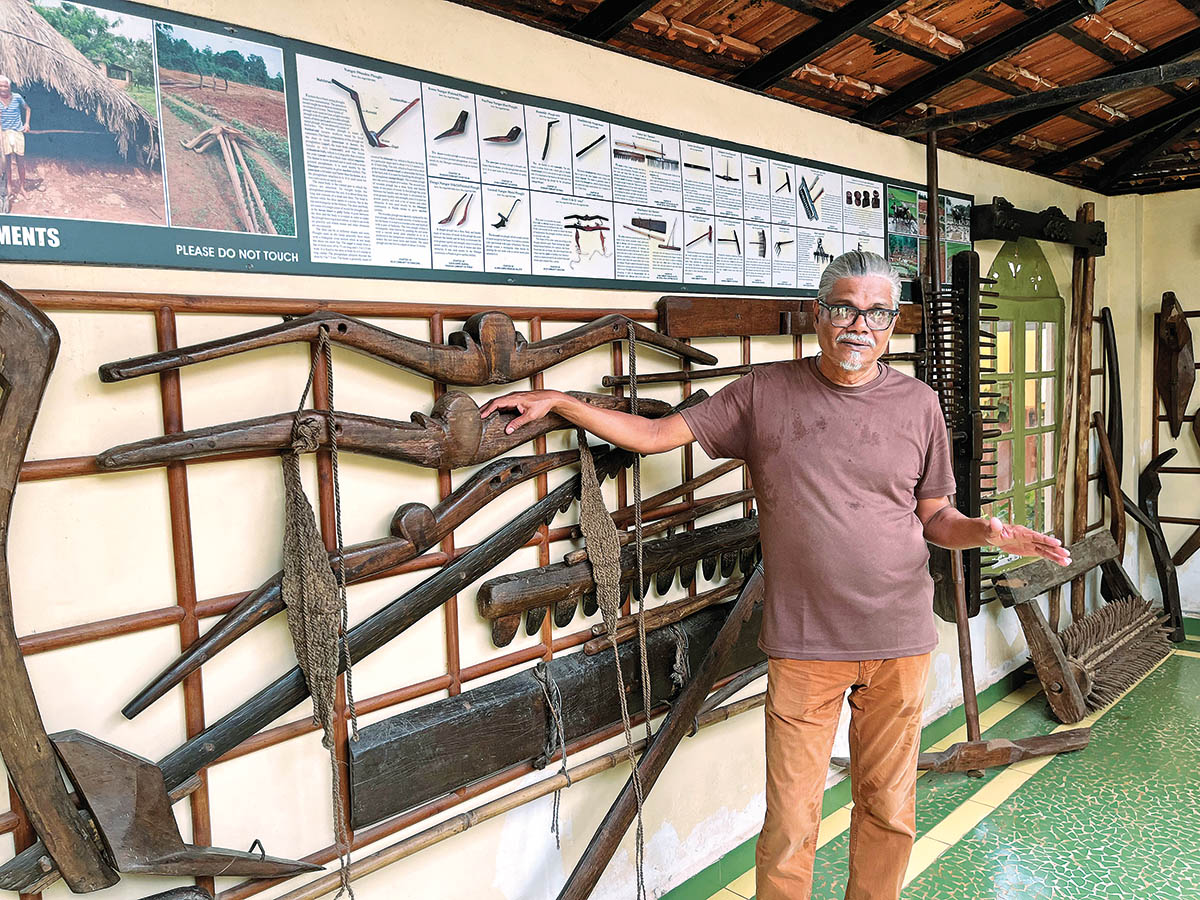 Different kinds of ploughs were used depending on the soil type | Civil Society picture/Umesh Anand
“When I was in Lucknow, I looked at Nawabi antiques every week. Twice a week there used to be markets in Hazratganj where such antiquities were being sold. The sad part is they were being bought by strangers for whom those things were not relevant. This was actually destroying the story of the land,” he recalls.
“You must have noticed how in the houses of the who’s who antiquities are used as showpieces, but the relevance is missing. What I saw in Lucknow was a wake-up call that made me come back to Goa.”
DOOR WITH A STORY
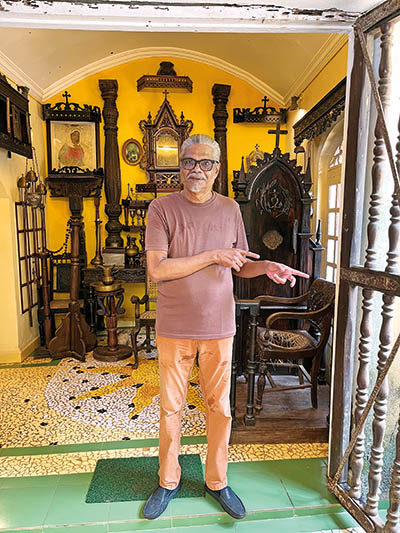
How can restoration be meaningful and not mere ornamentation? At the entry to the Goa Chitra stands a door that you might easily pass through without noticing. It is made from teak but it is unremarkable to the average eye. Its balusters are held together with a mundane frame and a couple of metal strips have been thrown in for support. Nothing has been done to pretty it up, just to preserve it the way it once was. It was in pieces when it was discovered by Gomes some years ago with an antique dealer and he restored it. The Church which could have saved and restored it had thrown it away.
So, this is a door with a story to tell. The door once belonged to the chapel at St John the Baptist Church in Benaulim where St Joseph Vaz (1651-1711) was baptized. Born to a Catholic family in Benaulim, St Joseph Vaz became a missionary in Sri Lanka where he is venerated. He was canonized by Pope Francis in 2015 when he was on a papal visit to the island.
The door, with its unique church past, makes the perfect point of entry to the museum’s first gallery dedicated to Christian art. It is an immersive installation that recreates the setting of a traditional altar in historic Goan churches. On display are many liturgical and devotional objects. From altar columns to chalices to an offertory box to candle stands to a baptismal basin and jug, they are all there. You will also find some elements of a confessional booth, a bishop’s cathedra and celebrants’ chairs.
Also on display are a Host mould and Host cutter. These were machines used in church to cut circular wafers used as the Holy Eucharist for communion. The wafers were cut from large, baked, uneven sheets of altar bread. The mould and cutter were made from iron and manually operated. Religious symbols were embossed. Size was important with the large Hosts being for the celebrant and the small ones for the congregation.
“The sacred art installation not only preserves these ecclesiastical treasures but also evokes the devotional and architectural character of Goa’s Christian heritage,” explains Gomes.
ENCOUNTERS AND LEADS
Valuable additions to the museum have often come from chance conversations with people in different walks of life. There have been families with traditional occupations that have been eager to have machines they once used preserved. Tracking these artefacts down hasn’t been easy for Gomes, but he couldn’t possibly have done it without collaborative efforts from ordinary folk who began by being inquisitive about his work and ended up enthusiastically chasing community history with him.
A nurse, by the name of Priya, told him about a wooden sugarcane crusher which bulls used to turn. All that he had seen till then were iron crushers attached to engines. With her help he tracked down one of the few surviving crushers in the Banda region near the Goa border. It had been abandoned after mechanized crushers took over. He took it to his organic farm and it is today in the Goa Chitra.
“We brought it back, a giant weather-beaten structure soaked in memories. With some effort and care we restored it. Today the Ushicho Ghanno, as it is traditionally known, stands proudly in Goa Chitra alongside other tools used in making jaggery — all generously donated by the same family,” says Gomes.
But it was his discovery of a bull-driven coconut oil mill, also known as a Ghanno, that really got him thinking about setting up a museum. Coconut oil is intrinsic to traditions of people in Goa and it meets a myriad of daily needs. The Ghanno had long gone out of use as coconut oil extraction became industrialized and no longer family- and village-based.
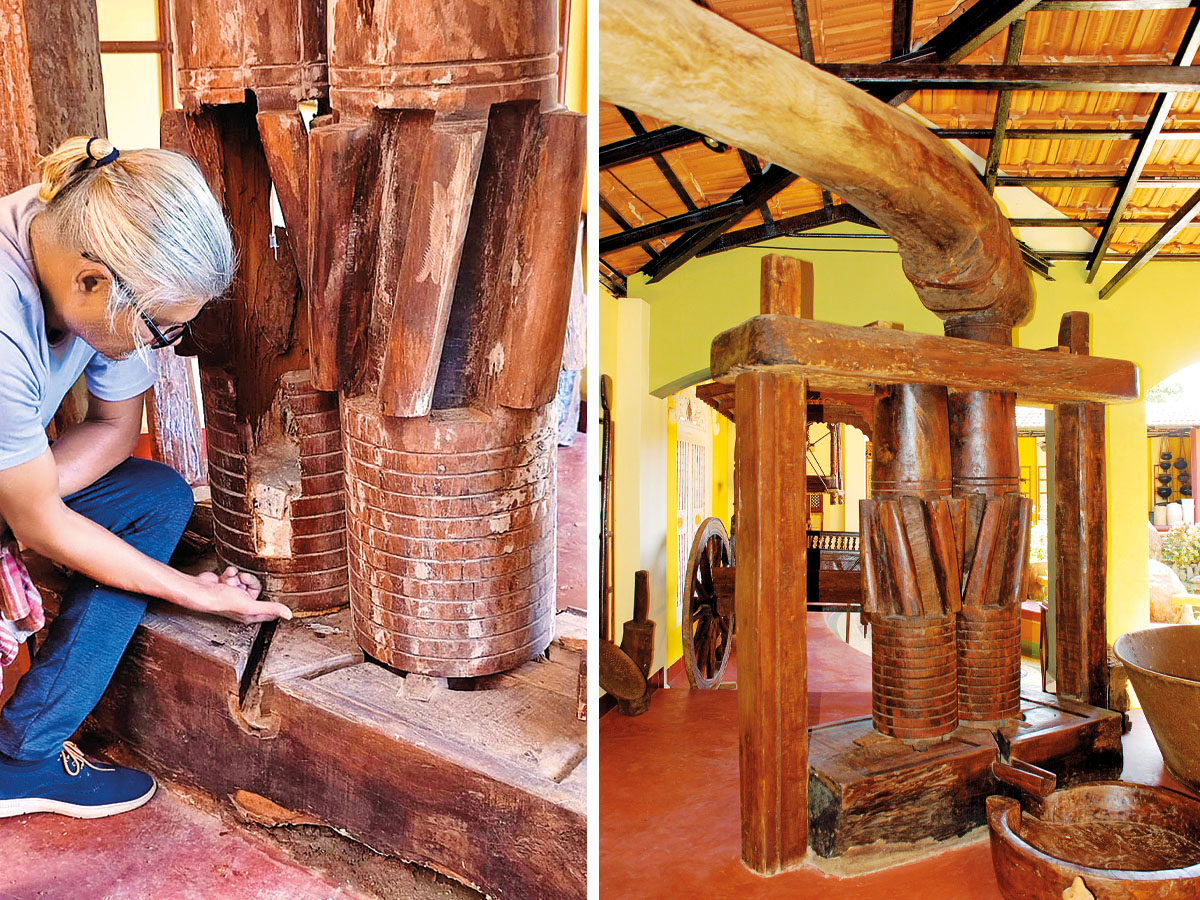 A file picture of Gomes restoring the sugarcane ghanno and (right) the restored version as it now is in the museum
The search for a coconut oil Ghanno took all of 14 years and the one he finally chanced upon was being attacked by termites and generally in need of rescue and restoration. Once he took it to his farm Gomes realized that many of the objects he had collected now needed to be taken care of and formally housed. A proper repository in a sizeable space with adequate protection for artefacts was what he needed and so the Goa Chitra was set up. The coconut oil mill remains the logo of the Goa Chitra Museums.
It was also from Priya the nurse that he got an entire kit of traditional tools for making jewellery. It so happened that her father was a goldsmith in Belgaum. Long after he passed away, she had retained the tools with which he made jewellery.
Among the tools were moulds which depicted local flowers. He realized that traditional jewellery designs were in fact inspired by local flowers — another example of how people drew inspiration from nature. Thanks to Priya passing on her family’s legacy, the Goa Chitra now has the only complete set of tools for the making of jewellery the traditional way.
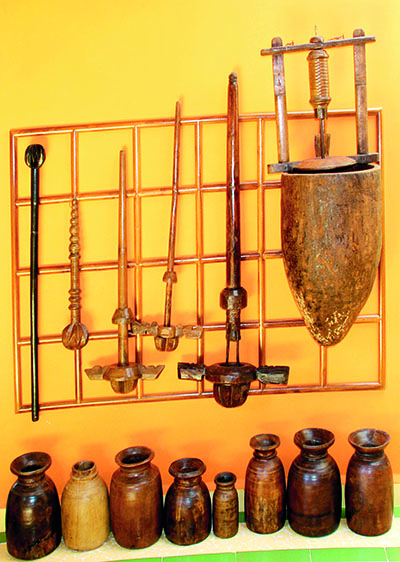 |
|
Butter-churning utensils |
“This isn’t just a collection, it is a story of a daughter’s devotion, a family’s legacy and a living memory preserved for generations to come,” says Gomes emotionally.
It is the serial collector in him that brings to the museum a bewildering variety of valuable things that might have escaped the notice of someone else.
The Goa Chakra is entirely about the wheel. On display there are carts, carriages, buggies, rickshaws, prams and palanquins. They have come from all over the country and there is a spinning wheel too.
This collection is a salutation to non-motorized transport. Carts and carriages get banned and ruled off the road. In the museum they can be seen differently as beautifully crafted vehicles, each distinct in its own way.
The Goa Cruti deals with the colonial past. There are items of daily living, from hat racks and umbrella stands to tables and chairs and crockery. There are clothes and needlework on display. Typewriters and work desks too.
Gomes points to a shelf of bound gazettes that were being dumped by the local courts and were taken over by him. It is the only extant record of many ancient judgements. Rows of index cards have survived.
A section with medical equipment from that time is particularly interesting. Goa has India’s first medical college and western medicine style surgeries were first performed here. There are pedal-operated basins that were used by doctors to keep their hands infection-free after they saw patients and before they went in for surgeries. A hospital bed, nursing pans and a range of surgical instruments, particularly for gynaecological procedures, are on display. In terms of
public healthcare Goa of those colonial times had made many advances.

In a dematerialized world where everything goes into the cloud with a click, how impactful is a museum that must be physically visited with patience and a lot of time to spare? During several hours spent with Victor Hugo Gomes we found visitors coming forward to congratulate him on his efforts. The museum had clearly made a lasting impression on them. There are also school and college students who come by on organized tours. Chances are that they too will be influenced and be inclined to respect Goan heritage.
Mesmeric as technology might be, there is no equivalent to seeing things in their physical form. Gomes’s efforts at restoration aren’t wasted. He faithfully and usefully brings the past alive. But after all the effort, the question is how to ensure that the collection survives. It is complicated because passion and intent are not enough. Funds are needed and organization too. Gomes himself should find a successor. He is getting on in years and his historic collection is experiencing the ravages of time.
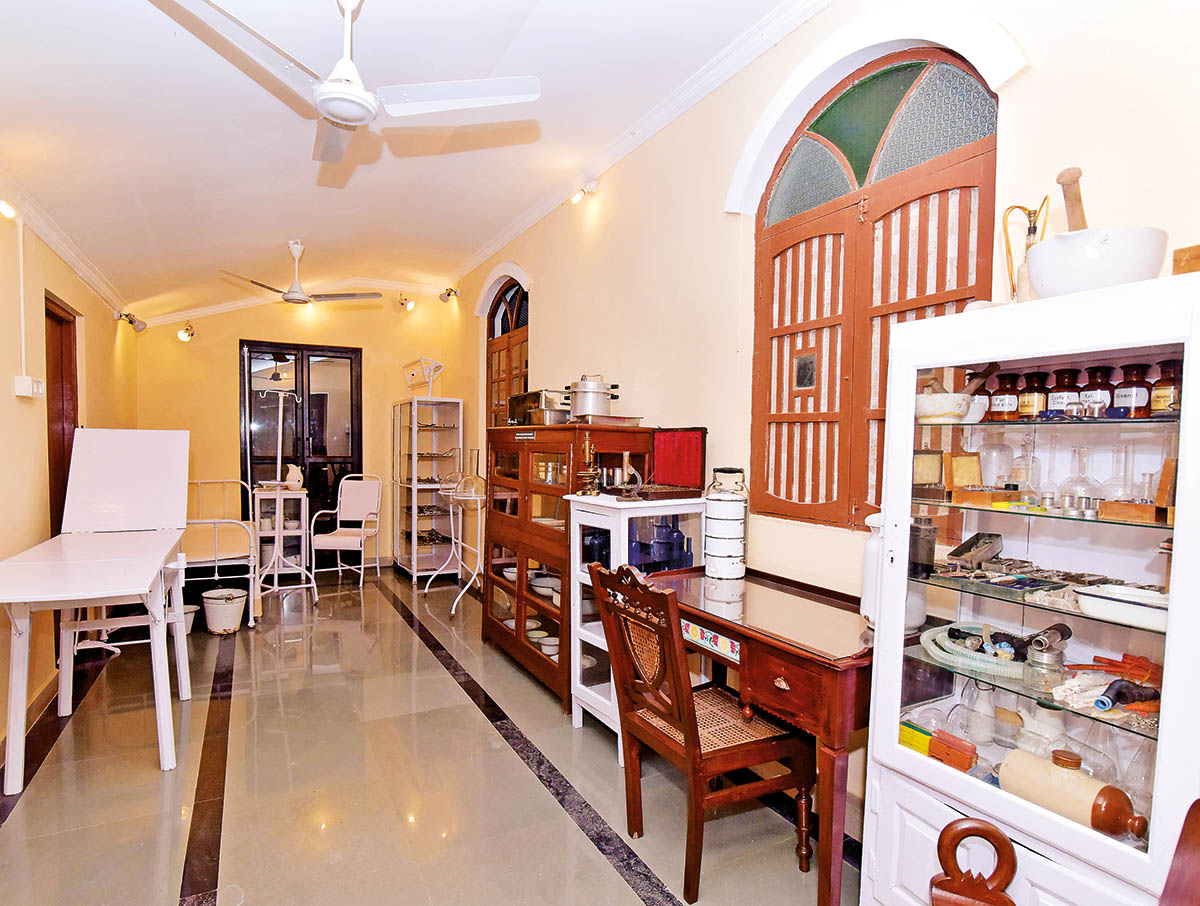 Medical equipment. Goa had India's first medical college
“It is an old age home that I am running for all these things,” he says wistfully, observing a pest burrowing into a wooden cart on display in the Goa Chakra. “You can hear it inside. Even if I deal with it here it will move somewhere else. I am merely looking after these things till they die.”
But for now, they are well cared for. Gomes is a ball of intense creative energy, zipping around in his pick-up. His hair is in a ponytail even though he has lost quite a bit of it. In style and presence, he is a younger version of his chronological self. But at his core he is a pragmatist in search of real solutions. Otherwise, he wouldn’t have been able to singlehandedly put three museums together.
Comments
-

Maria Gomes Fernandes - Aug. 3, 2025, 11:51 p.m.
Thank you dear Victor Hugo Gomes for your passionate saving and display of all these wonderful local treasures but most of all for this article and all the information it brings to each of us who take time to read it and hopefully visit the museums too! Dev Borem Korum!