



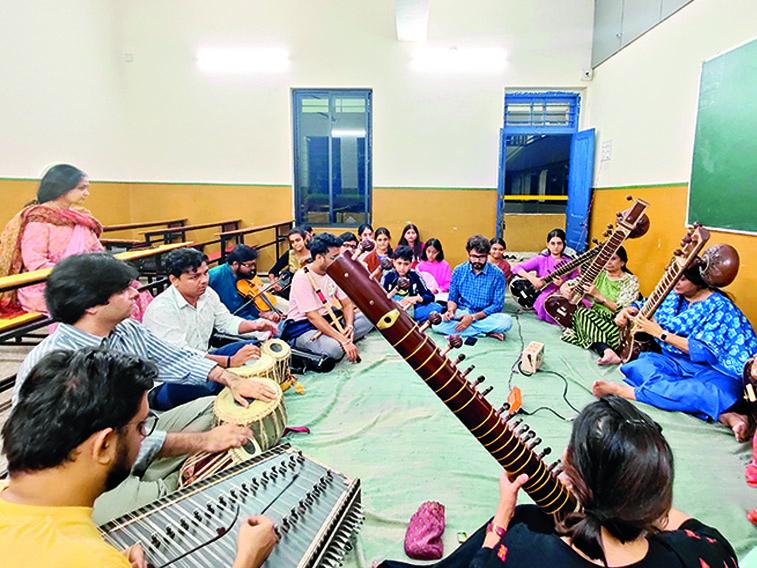
Classes are held in the evenings, sitting on the floor in regular classrooms with desks pushed to the wall
School and festival
Rashmi Gopal Rao, Ahmedabad
If you happen to be in the Usmanpura locality of Ahmedabad as evening sets in, chances are you will hear classical music emanating from an ordinary-looking school building in the area. It has been so on most days for 46 long years as accomplished musicians nurture new talent in a passionate attempt to keep classical traditions alive.
Saptak, a music school, was set up in 1980 with the high ideal of giving Ahmedabad a culture of classical music. Three musicians who would regularly perform at the Darpana Academy of Performing Arts felt the need for a school devoted to classical music.
The Darpana Academy was an established institution for the performing arts at the time and had been set up by Mrinalini and Vikram Sarabhai who were socially entrenched and resourceful.
The founders of Saptak, however, were artistes on an idealistic mission. They were recognized as talents in their own right, but lacked the wherewithal for creating an organization and were starting out from scratch. Nandan Mehta played the tabla, his wife, Manju Nandan Mehta, was a sitarist and Rupande Shah was a dancer and vocalist.

What the three lacked by way of material resources they made up for with their enthusiasm for the idea of a music school. Their inventiveness opened doors for them, bringing in well-wishers.
For instance, while looking for space for the school they arrived at an arrangement with the Shree Vidyanagar School to use its classrooms in the evenings. It is from here that the music school continues to function. Music lessons are imparted sitting on the floor, desks parted, blackboard in the background. Modest fees are charged and those with talent who can’t pay are given free lessons. The teachers are performers themselves who take small honorariums.
Saptak is not commercially driven and has no signboard — it can’t have one because it convenes on the premises of the Shree Vidyanagar School only during afterhours. Saptak is immersed in music beginning with the name which stands for the seven musical notes: Sa, Re, Ga, Ma, Pa, Dha, Ni.
The school was meant to take classical music from its esoteric perch and make it a part of everyday life in Ahmedabad. Classical music, the founders felt, needed to be widely savoured and enjoyed. It needed to be introduced to people who hadn’t been given a chance to understand it. Most importantly, it needed to be passed from one generation to the next.
 |
|
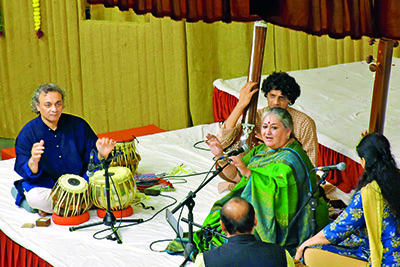
At this year’s festival: Vocalist Shubha Mudgal with Aneesh Pradhan on the tabla |
 |
|
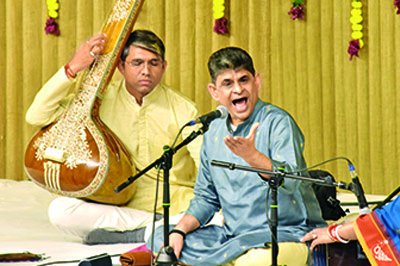
Vocalist Sanjoy Banerjee |
 |
|
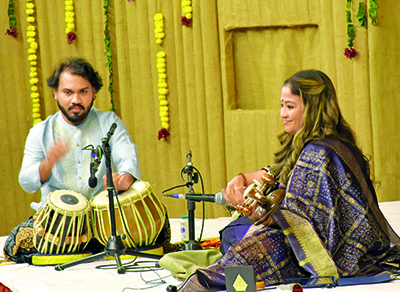
Debasmita Bhattacharya on the sarod with tabla player Yashwant Vaishnav |
 |
|
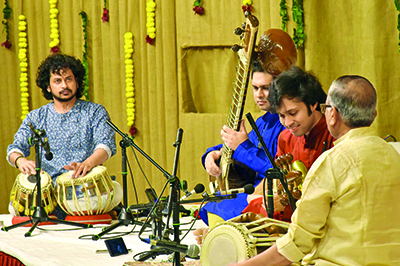
Shubh Maharaj on the tabla accompanies sarodist Aayush Mohan |
These are aspirations that have been wholesomely met. Saptak’s students are of all ages and from different walks of life — from very young children to professionals and homemakers. The musical notes that emanate from the Shree Vidyanagar School have serendipitously touched many lives.
For 13 days, from January 1 each year, the school organizes the Saptak music festival which attracts maestros from across the country. While the school provides access to classical music, the festival brings leading musicians to people. They perform and mingle with the audience, leaving behind a lasting experience. The festival is imbued with the same purity of purpose as the school is run with. No tickets are sold, entry being by invitation. There is community ownership of the event with volunteers doing much of the heavy lifting.
First concert
The Saptak festival, in fact, preceded the setting up of the school. Back in 1980, in need of funds, the three founders came up with the idea of organizing a concert. They invited Pandit Ravi Shankar and Pandit Kishan Maharaj to perform and both these great musicians agreed, thereby bringing the school a step closer to being a reality.
Since that first concert, legends of Indian classical music have continued to perform at the festival, charging a mere fraction of the fees they do for commercial events.
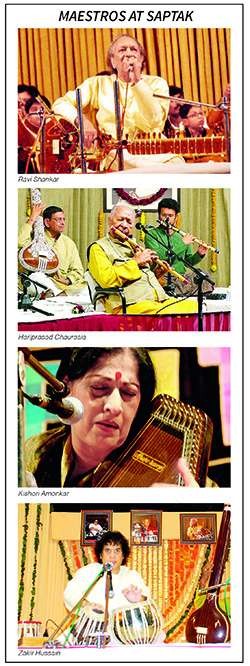
It is a long list of great performers who have been happy to show up: Pandit Jasraj, Kishori Amonkar, Ustad Ali Akbar Khan, Birju Maharaj, Ustad Amjad Ali Khan, Pandit Hariprasad Chaurasia, Pandit Shivkumar Sharma and Umayalpuram K. Sivaraman.
Says Rupande Shah, now 85: “That first concert was hugely successful and much appreciated. We were also able to save a sizeable amount from the proceeds of the programme. It was Nandan bhai’s idea to form a trust with this corpus and this was the genesis of the Saptak music school.”
In 1980, Saptak’s founders were frontrunners because Ahmedabad had few musical performances and opportunities for students to learn. Now both school and festival are institutions in their own right.
This year, in keeping with its reputation, the festival had many memorable performances. It attracted a galaxy of celebrated musicians like Amaan Ali Bangash, Aneesh Pradhan, Ashwini Bhide Deshpande, Fazal Qureshi, Kumar Bose, Parveen Sultana, Rahul Sharma, Rakesh Chaurasia, Shahid Parvez, Shubh Maharaj, Shubha Mudgal, Shujaat Khan, Suresh Talwalkar, Ulhas Kashalkar, Umakant Gundecha and Yogesh Samsi.
A hallmark of the festival is that maestros perform alongside emerging artistes and young talent. This year 10 performances had members from the same family performing together — bringing alive the guru-shishya and gharana traditions.
There was also an all-women Indian classical instrumental ensemble featuring talented female musicians led by the famous Shruti Adhikari, a disciple of Pandit Shivkumar Sharma. Titled Panchnaad, it showcased the collective artistry, talent and excellence of women musicians.
Further, an exclusive violin-saraswati veena duet was presented as an ode to the late Ustad Zakir Hussain who originally envisioned this concept. As in every year, Dhrupad, the very root of Indian classical music, continued to hold a timeless place at the festival. This year, it featured Uday Bhavalkar and the Gundecha brothers.
The festival’s 43 sessions featured over 150 musicians. The stage setting was simple and elegant which allowed everyone to focus on the music. Every night saw the crowds swell as people tiptoed their way to sit crosslegged on the pristine-white mattresses right in front of the artistes.
The school idea
Rupande Shah recalls how the idea of a school took shape: “I have been associated closely with the Darpana Academy of Performing Arts since I learnt dance from there. Nandan Mehta, who was an outstanding tabla exponent of the Banaras Baaj and also my childhood friend, taught at Darpana along with his wife, Manju Mehta, a renowned female sitarist.”
“We interacted regularly and Nandan bhai often expressed a desire to start something that would promote the rich legacy of Indian classical music,” she recalls.
“He wanted people to come forward and learn classical music. Just like how the Darpana Academy was a institution for dance, he desired something exclusively for Indian classical music.”
Shah recently retired as a trustee. Her place in the trust has been taken by Bijal Shah, her son, who plays the flute. Nandan Mehta passed away in 2010, and Manju Mehta died in 2024. Their daughters, Poorvi, a sitarist, and Hetal, a tabla player, (pictured) are now trustees.
Finding support
 |
|
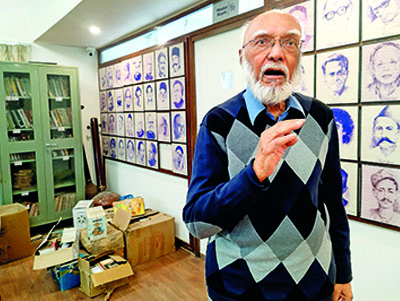
Prafull Anubhai, with his connections in the corporate world, has kept Saptak going |
Prafull Anubhai, 87, is Shah’s husband and has played a key role in keeping Saptak going. While Anubhai has a deep interest in music, he also has extensive experience in the field of management and has been engaged in the process of building institutions like IIMA (Indian Institute of Management, Ahmedabad), CEPT University, NID (National Institute of Design) and Ahmedabad University.
“Given my connections in the corporate world and my experience with IIMA and other educational institutions, I focused initially on mobilizing financial resources and offering administrative guidance. We have had several offers in the past in the form of government aid as well as corporate sponsorship but we would like to avoid that since we want to conduct the event in accordance with our principles. We want to uphold the fundamental values central to the school,” says Anubhai.
He elaborates: “We have always been guided by the core values of equitability, simplicity, inclusivity and creating an ambience where music reigns supreme. This has been the ethos of the Saptak music school since it was founded by Nandan Mehta and Manju Mehta in 1980. The essence of the festival is thus rooted in tradition and authenticity and devoid of any elaborate ceremonies, speeches or formalities.”
The festival is a by-invitation only event with no tickets. Passes are given to artistes and students. There are no special seating arrangements and while the first rows are reserved for artistes (those performing at the festival as well as visiting and local artistes) and students (of Saptak as well as other music schools), the rest of the seats are for the audience which can be occupied on a first-come, first-served basis. There are no reservations and privileges.
 |
|
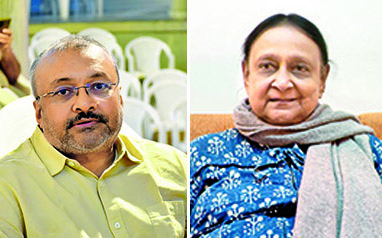
Bijal Shah, a flautist, has taken over as a trustee from his mother, Rupande Shah |
“This democratic seating arrangement, not by design but by convention, respects the musicians and accords dignity to both the artistes and the music. Unlike many other places, where musicians are treated as mere performers, at Saptak they are revered as artistes,” says Anubhai.
The festival garners support from a network of well-wishers in the business community, private trusts, and individuals through donations, memberships, and souvenir advertisements. This helps Saptak retain the objective of the festival — to preserve, propagate, and cultivate a deep appreciation for Indian classical music in students and the broader community.
From its inception, the festival aims to present musicians whose artistry and knowledge inspire students and the audience. The multi-day format fosters an informal conclave of artistes. “When one artiste performs, many others sit in the audience, leading to interactions between performers, students, music lovers and fellow musicians. Whether backstage, at tea breaks, or during transitions, these exchanges create bonds and serve the cause of music. The festival feels like a ‘music mela’ and brings out the best in each artiste,” says Anubhai.
The festival itself is a lesson in thoughtful planning, judgement and tact. Each day there are three sessions with one session dedicated to students or an emerging artiste, followed by an established artiste, and ending with a maestro. This format has remained consistent over the years.
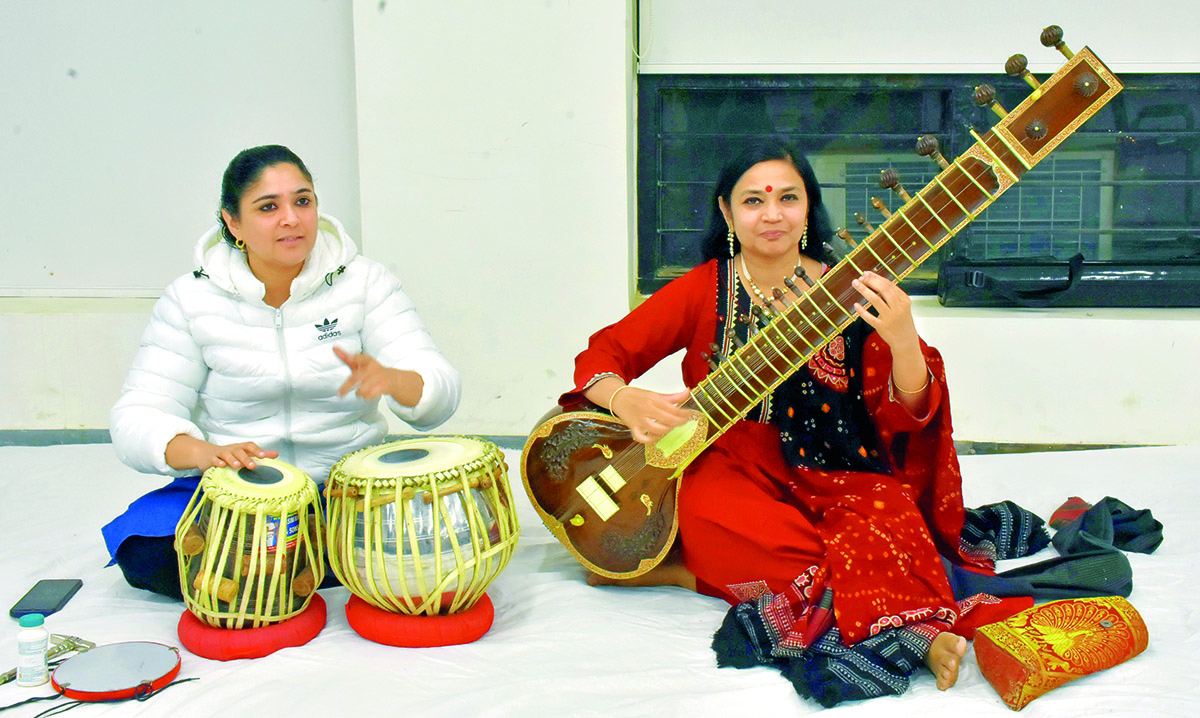 Hetal and Poorvi are trustees after the passing of their parents, Nandan and Manju Mehta
“The programme design is intricate with aspects like sequencing, accompanist selection, balancing vocal, instrumental, and percussion performances, featuring north Indian and Carnatic duets, taal-vadya kacheri, etc requiring meticulousness and immense attention to detail,” adds Anubhai.
A balance is maintained between different gharanas, traditional and experimental genres, coupled with a few sessions of classical dance and lok sangeet.
Many maestros have formed an enduring bond with Saptak and the audience. The artistes interact freely with the audience at the venue and many can be found mingling with their fans over a cup of tea.
“All this has resulted in a knowledgeable, sensitive and discerning audience that listens to the sessions with utmost respect and attention and appreciates the nuances of Indian classical music,” adds Anubhai.
The festival has the complete support of organizers and volunteers who take care of all aspects, from obtaining permissions from the authorities, making parking arrangements and arranging refreshments to setting up the stage, sound systems and decorations.
 “We have had the same vendors and volunteers for decades, all of whom treat the festival as their own which is indeed very heartening. There is a strong sense of belonging and ownership which the team demonstrates. This support from the community at large is invaluable and integral to the success of the festival,” says Anubhai.
Borrowed space
Once the decision to start the school was taken, a premises was needed. Recalls Shah: “We initially started in Darpana but it was not very convenient. It was then that Himmat Bhai Kapasi, who was the trustee of Shree Vidyanagar School, offered to open up his premises after school hours for us to take classes. He was an acquaintance of Nandan bhai. We started off in the library with just two rooms and 10 to 15 students who enrolled for tabla, sitar and vocal classes.”
Since then, the school has grown exponentially. It has close to 400 students. Classes are held six days a week.
Saptak is far from being a conventional music school. Since the teachers are performing artistes themselves, they can effectively mould and mentor students. The objective is to initiate students into performance-oriented learning.
Consequently, pedagogy at the school emphasizes performance rather than theory. While theoretical knowledge is imparted, it is only as a supplement to enhance performance capabilities and to facilitate a deeper understanding of the nuances related to music.
Bijal Shah, who has just taken over from his mother as trustee in the generational change that is underway, explains: “There is no set syllabus, examinations or degree awarded. It is open to anyone above the age of seven as long as they are keen to learn and practise sincerely. Teaching and learning are modelled on the time-honoured guru-shishya parampara whereby students learn by listening to their gurus perform. For senior students, there is a teacher for every two or three students.
Each class lasts 45 minutes, beginning from 5.30 pm. There are three sessions every day. Saptak conducts two terms in a year, summer to Diwali and Diwali to summer.
“Our decision to hold classes in the evening is intentional. Our students are schoolgoing children, homemakers as well as engineers, architects and doctors. While some join with the objective of turning professional, others come to just enjoy the essence of music,” says Poorvi Mehta, 55, elder daughter of the Mehtas who teaches at the school.
“Irrespective of their aim, all students are treated the same and given equal opportunities. We strive to do our best for them. Saptak offers among the most immersive and authentic training in Indian classical music. Students join placing their trust in the school,” says Poorvi.
The school has students from across India. For instance, Drashti Jain and Deepshika Jain have come from Chennai to learn the violin at Saptak due to the high quality of its teaching.
Several students have become well-known artistes. Some have become teachers at the school.
“We have been coming to the school for more than four decades. We learnt the sitar from our Guruji, Manju Mehta, whom we fondly called Mataji. From a hobby it became a passion. Saptak is now an integral part of our lives,” say Pratima Anandjiwala and Varsha Gandhi.
“The aura at Saptak is truly different. Teaching here is a magical experience. The effort invested by the trustees is truly commendable. It is one reason for the stupendous success of the Saptak music festival over the years,” says Dipal Mehta, an acclaimed flautist and disciple of Pandit Hariprasad Chaurasia who has been teaching the flute at the school for three years.
Apart from the faculty and trust members, the school has a number of staunch supporters who appreciate its contribution. The fees are nominal and deserving students are also given fee waivers and concessions.
“When I came here in 2016, I was unable to pay the fees which were already subsidized. But the team at Saptak made sure I learnt the craft. I am trying to give back in a small way by teaching here today,” says Hardik Joshi, who plays the violin.
Also, a number of senior students and ex-students serve as volunteers, looking after the day-to-day operations and administrative affairs of the school.
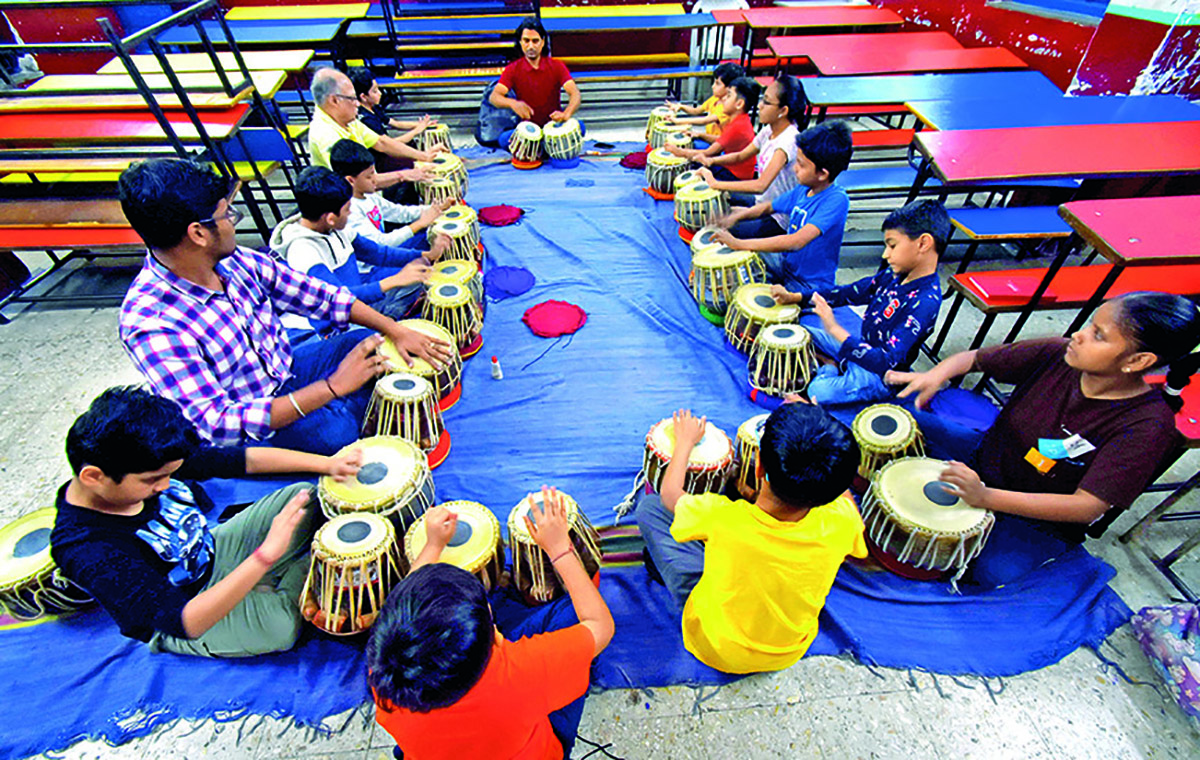 Children learn the tabla
“Saptak is more than an institution, it is linked to emotion for us and the legacy of over 46 years built painstakingly by my parents. They formed deep bonds with the artistes and the audience based on mutual respect and trust. We have imbibed these values and with our team we are carrying forth this tradition,” says Hetal Mehta Joshi, 47, trustee and younger daughter of Nandan and Manju Mehta.
Hetal is a tabla player of repute, a performer and a teacher at the school. Her husband, Sandeep Joshi, plays a key role in overseeing the entire operations of the school and the festival.
Saptak Archives
A major initiative of Saptak is the Saptak Archives which took shape in 2004. The effort has been led by Prafull Anubhai.
As the school and the festival grew in size, the organizers and their associates accumulated a rich collection of classical music recordings which included recordings of Saptak’s concerts.
“At this point we realized that these annals were a treasured asset and an invaluable resource for students, emerging artistes and even music lovers. I myself had a large personal collection of music which I decided to donate to the school,” says Anubhai.
He decided to undertake a project to preserve all such recordings to make the music available for future generations. The school has also received donations of personal collections from several artistes and music connoisseurs who trusted Saptak to respect the artistes’ rights and preserve their music without commercial exploitation.
“We have invested in advanced equipment and taken the help of skilled technicians for the digitization and cataloguing of this vast repository of music which is in various forms, from vinyl records to cassettes. To ensure that this does not become just a passive repository but benefits interested stakeholders, we have given regulated access to school students and music enthusiasts for workshops and group listening activities,” explains Anubhai.
Saptak Archives also has a rich and rare collection of music books. It hosts baithaks (intimate concerts) to share knowledge. Music appreciation sessions and workshops are organized to help music lovers deepen their understanding of classical music. Significantly, Saptak Archives adheres strictly to copyright laws, respecting the intellectual property rights of artistes.
Anubhai explains that a lot of the music is yet to be digitized and documented. This task is now a priority. An app is being built to provide comprehensive information about all the artistes and their musical accomplishments. The team is also exploring a controlled subscription model which will provide archive access to music lovers without compromising the rights of the artistes.
Music outlets
Apart from Saptak’s signature music festival, students and emerging artistes are provided multiple opportunities and avenues to unleash their potential. This is in line with Saptak’s primary mission of promoting the culture of classical music.

There is Saptak Sankalp, which held its 30th edition in 2025. “It is normally held in Lions Hall, Mithakhali, in October. Sankalp is a platform for upcoming artistes to showcase their talent. Every year, the number of artistes who wish to perform increases. Artistes who excel are given a chance. Hence it is a pathway for emerging artistes,” says Poorvi.
The school also organizes an all-India competition, Tabla-Pakhawaj, each year in association with the government of Gujarat. It is held in memory of Nandan Mehta and is titled Pt. Nandan Mehta Shastriya Taal Vadya Spardha. The competition is for aspirational tabla and pakhawaj players across India. The winners get a chance to perform at Sankalp and the Satpak festival.
The school also organizes events for Guru Poornima. Aarambh is a monthly student performance to encourage and nurture young talent. Significantly, there is a system of continuous review and refinement of these events aimed at improvement.
“While we are committed to fostering a culture where new talent is systematically showcased, we religiously follow the Japanese philosophy of kaizen for all our events. This ensures that we constantly improve and there is increased value addition each time we conduct a programme,”
says Anubhai.
Comments
Currently there are no Comments. Be first to write a comment!