



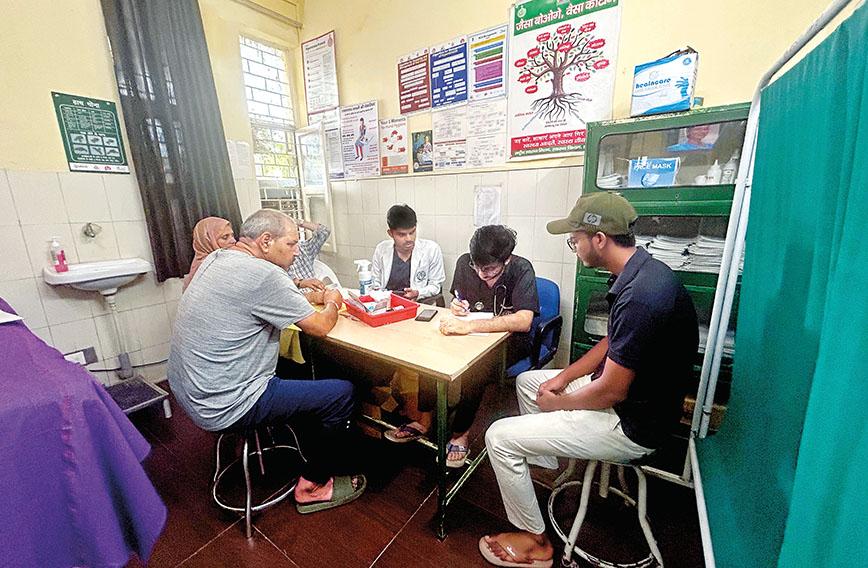
The Ballabgarh project gives medical students valuable experience at the community level
A seamless system is the big learning from Ballabgarh
Anand Krishnan
In 1960, the All India Institute of Medical Sciences (AIIMS) in New Delhi decided to set up a Primary Health Centre (PHC) in a rural area when its first batch of undergraduates began their internship. To expose the interns to functioning rural health services, the entire chain of services for the community through the intermediaries of a PHC was set up. A secondary hospital for specialized services was also established.
After a search, a block in Faridabad district (then in Punjab) was identified and a Memorandum of Understanding (MoU) was signed with the government of Punjab. While the state would provide the funds, any deficit would be met by AIIMS.
The primary objective of the Comprehensive Rural Health Services Project at Ballabgarh was to evolve a pattern of comprehensive health services for a community development block.
It was also intended to serve as a centre providing practical training to medical, nursing as well as graduate and postgraduate students.
These objectives of the Ballabgarh project were in keeping with the mandate of AIIMS to provide models of education, research and health services to the nation.

Over the past 64 years, more than 3,500 students and hundreds of postgraduates have been trained here. Many have gone on to lead national and international public health fora. In terms of patient care, the Ballabgarh hospital, which is akin to a sub-district hospital, currently has an average daily footfall of 850 OPD (outpatient department) patients, 22 admissions, seven to eight surgeries and 250 emergencies.
COMMUNITY TIES
The centrepiece of the project remains its community component. It currently serves a population of 100,000 spread across 28 villages of Haryana. Key achievements at community level include reduction of the crude birth rate (CBR) from 45 per 1,000 in 1972 to 16 in 2024, reduction in the crude death rate (CDR) from 13.5 per 1,000 population to 6.9 and a decline in the infant mortality rate (IMR) from 100 per 1,000 live births in 1972 to 25 in 2024.
Here's a comparison of health indices with rural India during the same period (1972 to 2022). The CBR declined from 39 to 21, the CDR from 18.9 to 7.2 and the IMR from 150 to 29. Most of these achievements are now plateauing, a well-known phenomenon in public health, where after initial successes it becomes more difficult to achieve further reductions.
The experience of implementing the Ballabgarh project has yielded many lessons for public health planners as well as medical colleges in the country. The first and foremost lesson is to invest in sufficient infrastructure — buildings, human resources and vehicles. The PHC and hospital buildings are all built by AIIMS and continuously upgraded to factor in changing technologies and increasing patient load. Also included are hostels for junior doctors and residential accommodation for faculty members who are then available 24/7 for clinical or administrative emergencies. Regular availability of medicines and other essential supplies has to be ensured. This investment was critical for the success of the project.
Efforts were made to ensure community, primary, secondary and tertiary linkages, which are essential for providing comprehensive primary healthcare and crucial for getting community buy-in, as they value curative care the most. Creating such linkages is quite challenging and may not always function especially at tertiary level. But systems need to be conceived and put in place. It was partly made possible because many of the clinical departments at AIIMS provide services at Ballabgarh and the vision of the founders was to create a collaborative model.
One of the strongest pillars of the Ballabgarh project has been the link to teaching and research. Since the early 1980s, undergraduates are posted to Ballabgarh and live on campus in their seventh semester and subsequently during their internship. They are fully involved in delivery of care at the primary and secondary facilities, in implementation of national programmes, in making visits to the communities, investigating deaths and so on. This gives them the experience of practising medicine at community level, unlike any other medical college. The postgraduate students spend almost two years at PHCs and secondary care facilities and learn critical aspects of the implementation of public health programmes and how to run health facilities. Students fully realize the importance of this experience once they go out into the world.
ANNUAL CENSUS
One of the pioneering approaches adopted was to undertake an annual census and make family registers which were computerized between 1988 and 1990. We then created a health management information system, wherein health workers would get a list of children needing specific immunization, or antenatal women requiring home visits or an eligible couple needing a contraceptive refill.
Male or female health workers would then visit the homes of patients according to a fixed schedule every two weeks, using such printed workplans to deliver care. Once a month they would enter these into a computer and return with the next month’s workplan. This is now being attempted under the National Health Mission (NHM). Both these ideas of enumeration and digitalization have the potential to transform healthcare. Such a system is still not functional in most parts of India, and we did this almost 35 years ago.
All epidemiologists say that the biggest challenge in monitoring the health system is lack of denominators. We solved this problem by using computerized data to monitor the annual performance of health workers which provided inputs into their appraisals. This has ensured that our population level immunization and antenatal coverage remained above 95 percent since the 1990s. For estimating population level coverage nationally, we still depend on special surveys like the National Family Health Survey (NFHS) which is carried out every five years. Given the cold storage constraints of the oral polio vaccine, we used to conduct polio vaccine campaigns once a month in the mid-1980s, a precursor to pulse polio campaigns by a decade. This sense of innovation is what makes Ballabgarh unique.
Computerization of the population had a beneficial effect on research as well. It enabled us to create an individual level sampling frame for studies. It also resulted in much better quality of demographic data being collected. Such individualized care also resulted in better connections and a better relationship with the community. This community platform has been used extensively in national and international collaborative research including vaccine and nutrition trials. The Ballabgarh community must be one of the most researched populations in the world with more than 300 publications, an incentive for academicians to work in Ballabgarh.
We have been conducting verbal autopsies for physician-certified causes of deaths of people dying at home since the early 1990s. Initially this was done only for child deaths and later for all age groups. It helped us plan our services better. We can present data which reflects the changing profile of the cause of death in this population going back to the 1970s for children and the 1990s for adults. We were the first to consider this changing profile and initiate work on developing a primary healthcare model for management of non-communicable diseases (NCDs). We set up an NCD clinic at Ballabgarh in the early 2000s, which is now part of the national programme.
SOCIAL CHANGE
The social aspect of the Ballabgarh project needs to be emphasized as well. Historically, Ballabgarh has provided a very congenial environment for students, junior doctors and faculty members to interact socially. It has encouraged teamwork resulting in strong lifelong bonds. Facilities in Ballabgarh provided a home away from home with good food, pleasant evenings, get-togethers or games with faculty joining in, as all were residential. In a lighter vein, many marriages took place in Ballabgarh!
However, there are areas where we have not done that well. We were not able to convert community support into addressing social determinants in the community. This is largely because the team came from a medical background and did not have the capacity in social sciences to attempt such interventions.
For example, gender issues. An adverse sex ratio at birth for the girl child continues to plague this population, but we were not able to address it from a societal angle. Another area was in health promotion and behaviour change — best exemplified by little impact on tobacco and alcohol use. We could also do better in working with district health systems. A sense of rivalry prevailed rather than collaboration.

One of the chief criticisms of the Ballabgarh project is the replicability of the model. No other medical college has developed its NMC mandated rural field practice area to this extent, primarily because of the lack of resources. While the criticism is valid, it does not mean that AIIMS stops showing to the rest of the country what is possible and what is required. Many of the new AIIMS establishments are attempting to do something similar and we need to wait and watch how their efforts pan out.
In recent times, the delivery of healthcare in the district has improved due to national initiatives under the National Health Mission (NHM) while our performance has remained stagnant. It has resulted in the narrowing of the differences in community level performance.
Our hospital continues to outperform nearby ones, which also is a problem as this diverts our focus from primary level to the administration of a very busy secondary level facility.
With larger student batches, increased urbanization, better connectivity by road/Metro and the internet, there has been a radical change in the social aspects of the Ballabgarh posting which have implications for patient care. Also, today the provision of healthcare itself has changed drastically with many administrative and legal issues as well as changing patient expectations. Today, there is a much higher disconnect between those who join medical colleges and the community, emphasizing the need for community-based teaching of medicine.
The Ballabgarh project has been blessed with visionary founders and innovators and supported by a friendly administration, irrespective of the change in leadership. However, if AIIMS is to continue to lead, the current management has to innovate and not rest on its laurels. How well it overcomes these will determine its future place in the public health history of India!
Anand Krishnan is a professor of Community Medicine at AIIMS.
Comments
Currently there are no Comments. Be first to write a comment!