



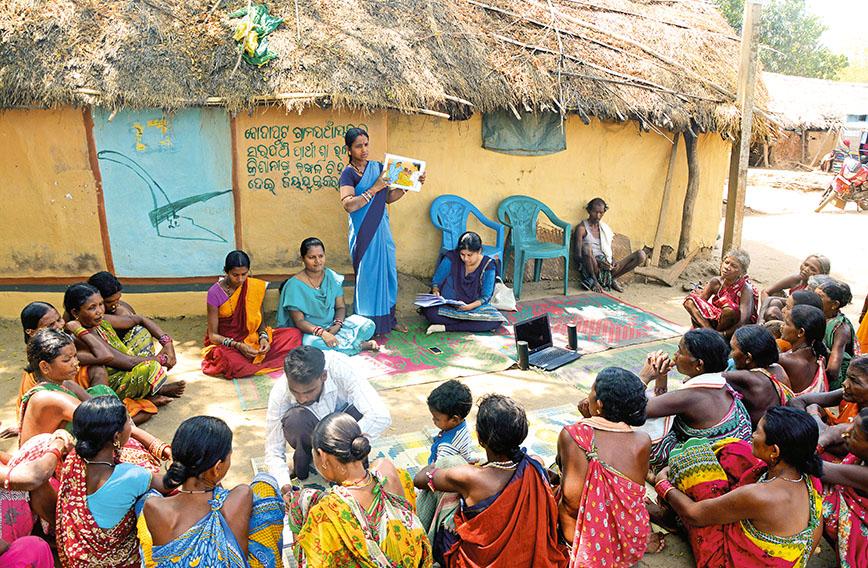
An ASHA educates women on health in a village in Koraput district of Odisha
For better nutrition, train and empower frontline workers
Soumya Swaminathan and Drishti Sharma
By 11 am Mala is speaking to a pregnant woman and her family, advising them on iron-rich foods and the right way to consume iron tablets. She had been told that a team from Delhi would visit her centre today, but that hasn’t given her any flexibility to change the rest of her routine. Her day began before sunrise, juggling home chores and a hurried breakfast, and now she’s flipping between registers and her smartphone, issued by the government, trying to upload data through a sputtering network.
“These days I’m busy with the non-communicable diseases (NCD) register. Just yesterday, a team from the hospital came to do BP, sugar, and haemoglobin tests. Sometimes I’m entering data on the RCH (reproductive and child health) portal till 11 at night,” she says.
Mala is an Auxiliary Nurse Midwife (ANM) posted in a remote village in southern India. Her official duties include immunization, child growth monitoring, antenatal care, nutrition education, counselling on hospital deliveries, anaemia, contraception and, increasingly, digital documentation.
She’s one of millions of women on the frontlines of India’s public health effort, expected to help address child malnutrition and anaemia while managing many other responsibilities, some of which don’t always receive the attention or support they deserve from within the system.

The truth is India’s community health workers, collectively known as the Triple As — ANMs, ASHAs (Accredited Social Health Activists), and Anganwadi Workers — shoulder an immense range of responsibilities, often under challenging conditions. Many trek for miles to reach remote communities, attend regular trainings and manage a growing number of digital apps with little technical support. They struggle to interpret the data they feed on these apps. Many find it hard to pay for transportation out of their own pockets and rely on informal support from family members to meet their growing workload.
And yet, these women are often the first and sometimes the only link between a child or a mother and the nutrition services they need. For programmes like POSHAN Abhiyaan, Anaemia Mukt Bharat, and POSHAN 2.0 to reach their full potential, the frontline workforce needs to be adequately supported, trained and equipped. The intent and ambition to eliminate malnutrition are clearly visible in the many programmes and policies already in place. The next step is to strengthen delivery systems so they work better for those on the frontlines, who serve as the first point of contact between the health system and the community.
What would it take to ease their burden, sharpen their skills, and equip them better? The answers aren’t complicated or expensive. In fact, some of the most effective fixes lie in low-cost, commonsense changes that are already working in pockets across the country.
HEALTH WORKERS
If frontline workers are the backbone of India’s public health system, then strengthening their capacity must be a national priority. That begins with recognizing their contributions. The World Health Organization (WHO) has identified adequate pay, social security, along with supportive supervision as essential elements of a strong workforce, and several Indian states have begun taking steps towards making this a reality.
Joint planning between ASHAs, ANMs, and Anganwadi Workers (AWWs), focused on shared goals and practical coordination, can significantly increase their impact, especially in areas with limited resources. In Madhya Pradesh, NGOs like the Antara Foundation are helping bring more structure to regular village-level health meetings between frontline health workers, creating space for collaboration and joint problem-solving. This model shows how civil society can supplement government efforts by strengthening capacity where it is most needed — at the last mile. With clear roles, simple facilitation tools, and consistent follow-up, such partnerships are already helping improve coordination and accountability on the ground.
There is also an urgent need to equip frontline workers with the right tools — not just smartphones, but materials that genuinely help them engage with communities. Flipbooks, posters, and short videos in local dialects can make health and nutrition education more effective and easier to deliver. Providing locally available, easy-to-cook, nutrient-dense recipes as Take Home Rations (THR) based on ICMR-NIN (Indian Council of Medical Research-National Institute of Nutrition) guidelines is another area for local innovation. For instance, in some districts, inclusion of seasonal vegetables, eggs, dried fish and fish powder are being used to significantly enrich the nutritional value of ICDS (Integrated Child Development Services) meals. These foods are already familiar and well-liked by children.
Likewise, training should go beyond one-time workshops to regular mentorship. It must be on-going, hands-on, and tailored to real-world challenges, from counselling techniques to using digital tools like the POSHAN Tracker.
PATCHY NETWORKS
Digital tools should make frontline work easier, not harder. Yet many health workers spend hours struggling to upload data through patchy networks or navigate apps that are difficult to use. By listening to their feedback and simplifying these tools we can free up time for what matters most: being present in the community. The COWIN app, now adapted as U-WIN, is a step in the right direction. It allows frontline workers to plan immunization sessions and track children who miss their shots, and it demonstrates how smart, responsive technology can actually support the people using it.
What made COWIN a game changer was the speed at which communication loops were established amidst the pandemic. Within a short time, supervisors at every level were reviewing real-time data, discussing it, and making improvements based on feedback from the ground. It proved that when technology is designed to listen and adapt, it can become a powerful enabler for last-mile delivery.
DATA ANALYSIS
While policies are typically shaped at higher levels, strengthening the flow of feedback from the local level can make implementation more responsive and effective. Currently, supervision mechanisms tend to operate at some distance from day-to-day realities, with reviews and feedback often coming from state or national levels occasionally. Creating more frequent and timely channels for learning from the field can help address challenges early and support course correction when needed.
As one block official in a rural district from central India put it, “Statistics are difficult to understand… no one is guiding us on how to find patterns.” Without timely, supportive oversight, even the most committed workers feel adrift. “We are in dire need of motivated people to improve the system…you know, being posted here is seen as punishment,” said a supervisor in an aspirational block.
To support frontline workers meaningfully, we need stronger systems much closer to where the action is. This means building a dedicated cadre of block-level supervisors with a nutrition background who can provide sustained, on-the-ground support. Whether it’s helping AWWs with height and weight measurement, guiding data entry and use, or simply being a visible, accessible ally, supervision must shift from being punitive to being collaborative. When supervision becomes about coaching rather than catching errors, the results are transformative.
At the same time, block teams need the skills to make sense of data. Nutrition indicators are being collected, but they are rarely used to guide local action. Empowering block officials to interpret and act on this data, rather than simply passing it up the chain, can unlock smarter, more contextually suited and faster responses.
To truly support dietary habit change within communities, strategies must go beyond just Information, Education, and Communication (IEC) or standard counselling. It is now widely recognized that individual food choices are shaped by broader social, environmental and commercial factors. For behaviour change efforts to succeed, they must also include changes in the food environment. With the growing availability of foods High in Fat, Salt, and Sugar (HFSS), public health nutrition experts in India are warning against the dual burden of malnutrition — undernutrition and rising obesity — among Indian adolescents and youth.
The experts are calling for stronger regulations on advertising, higher taxes on unhealthy foods, and a greater role for schools in promoting healthy eating environments and improving health literacy among adolescents. Many of these measures, such as front-of-pack labelling, marketing restrictions, and fiscal policies, are already in place in countries like Chile, Mexico, and the UK, offering useful lessons for India’s next steps.
PANCHAYATS
True decentralization means not just better supervision, but deeper community ownership. Panchayats, as the closest elected bodies to the people, can play a vital role in addressing malnutrition. With the right tools and support, local governance can become a strong pillar of India’s nutrition response.
Simple, integrated dashboards or scorecards, designed with panchayats in mind, can help local leaders identify service gaps in areas like water, sanitation, nutrition, and early childhood care. With access to clear, actionable data, panchayats are better equipped to mobilize resources, coordinate across departments, and make targeted interventions.
The Community Healthcare Management Initiative (CHCMI) in West Bengal is one example, where such visibility enabled more responsive local planning. In Karnataka, too, panchayats have taken the lead under the Koosina Mane initiative, helping to open community crèches for the children of women labourers. This demonstrates how empowered local governance can directly support child nutrition and care.
In Koraput, Odisha, the M.S. Swaminathan Research Foundation (MSSRF) showed that empowering communities with knowledge and tools can spark lasting change. Nutrition-sensitive farming revived crop diversity, home gardens, and backyard poultry. The initiative improved dietary diversity and awareness of farming practices that support food and nutrition security.

Beyond infrastructure projects like crèches and clean drinking water, empowered communities can also advocate for more human resources, such as a dedicated nutrition and health workforce, and align these efforts with the local development plans of the panchayats. India’s localization of the Sustainable Development Goals is an encouraging shift towards community-driven development. Tools like the Panchayat Advancement Index (PAI) are beginning to link data-driven local governance with more holistic, measurable outcomes. The larger goal is to enable panchayats not just to react to problems, but to anticipate and prevent them, breaking the cycle of malnutrition with the same leadership and accountability they already apply to roads, and irrigation projects.
These examples show that real, lasting change is possible. Across the country, people are already testing solutions and making things work in tough conditions. What’s needed now is not another round of new programmes but better support for the ones already in place, especially for those who bring them to life on the ground.
That means backing our frontline workers, making supervision more responsive, and giving panchayats the tools and trust to lead. Just as important is giving communities the confidence, information, and space to shape their own nutrition choices. Whether it’s growing their own food, improving school meals, or changing what’s sold and served in their villages, when people lead the way, change is more likely to last. ν
Soumya Swaminathan is chairperson of the MSSRF and Drishti Sharma is principal scientist, health and nutrition policy at MSSRF.
Comments
-

Bhavani - Sept. 4, 2025, 10:46 a.m.
Well-said: "When people lead the way, change is more likely to last"!