



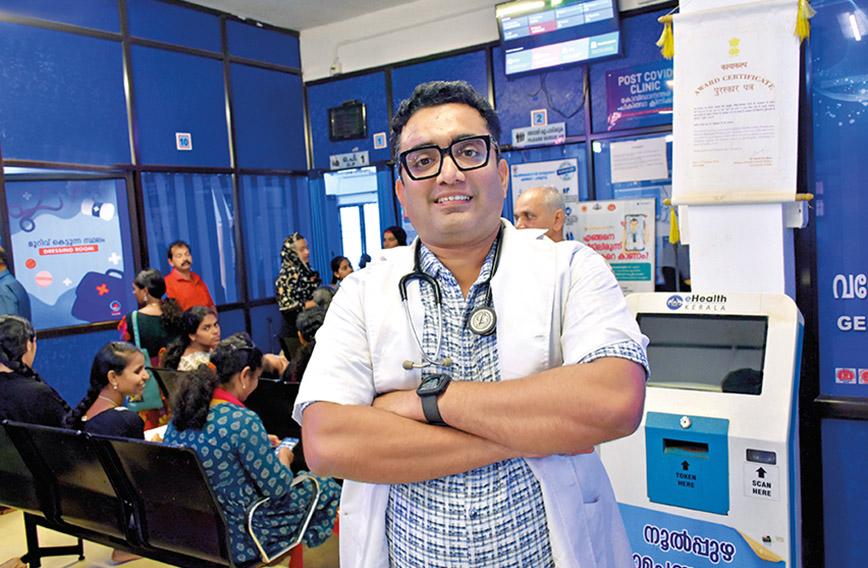
Dr Dahar Mohammed in the OPD of the Noolpuzha PHC
PHC puts Noolpuzha on the map, has everyone on board
Umesh Anand, Noolpuzha
IT is a cluster of dwellings in the middle of thriving forests in Kerala’s Wayanad district. A sprinkling of families of the Oorali tribe live here in single-room structures built by the government. Painted yellow and numbered, the dwellings are set apart from each other.
From one of the dwellings emerges a wasted young Oorali man, Ramesh, wearing a sparkling white surgical mask across his nose and mouth. He has a runaway tuberculosis infection. It began in the abdomen and spread to his lungs and brain.
Poor as he is and living vulnerably in the forest, Ramesh would have been consumed by tuberculosis had he not been taken with a fever to the Primary Health Centre or PHC at the village of Noolpuzha.
Initial tests didn’t reveal tuberculosis, but when antibiotics didn’t work, doctors at the PHC had him taken to the district hospital at Sulthan Bathery, a nearby town and administrative headquarters. His case was then escalated to the larger and more specialized Medical College Hospital at Kozhikode.

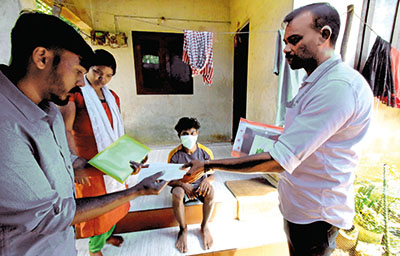
Currently the outreach team of the Noolpuzha PHC manages his treatment in the forest. They show up regularly at his dwelling to monitor his progress. An ASHA or Accredited Social Health Activist keeps watch every day.
We have ventured into the forest and reached the Ooorali settlement with Dr H. Sreenadh, who is responsible for the Noolpuzha PHC’s outreach services. With him is Nidish Lenin, Junior Health Officer, and Geetha, the ASHA for the hamlet.
They have records of the patient in neatly filled ledgers and notebooks. Every fortnight he undergoes kidney and liver function tests because of the toxicity of the medicines. They know that he was losing weight earlier but is not anymore.
The Noolpuzha PHC is a stellar example of how the Kerala state-run healthcare system functions. The PHC with sub-centres is the lowest rung in a tiered system leading all the way to superspecialty facilities.
This is, in fact, the design of the Indian healthcare system. But while it exists mostly in name elsewhere in the country, Kerala has successes to its credit. The PHC has from time to time gone through changes in nomenclature to be called the Family Health Centre and, most recently, the Ayushman Arogya Mandir. But its envisioned role in delivering primary care remains the same.
 |
|
Dr Sreenadh, on the right, checks on Ramesh, |
The Noolpuzha PHC has steadily made a name for itself after Dr Dahar Mohammed came to head it nine years ago. He was just 31 years old then and on his second posting. As a young and idealistic doctor, he set about transforming the PHC from the single dull and dour building that it was into a hub of health services of the kind that Noolpuzha had never seen.
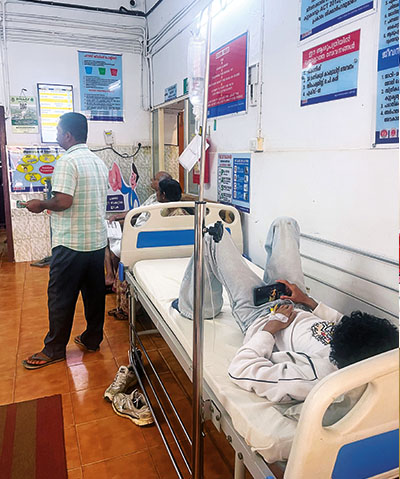
Under Dr Mohammed, it has morphed into a vibrant and attractive facility with several departments. It has a well-maintained ward with 10 beds where patients who need to be admitted are taken in. There are six general physicians at the PHC, including Dr Mohammed, and three are always available during consultation hours in clinics at the OPD.
Where there used to be just one time-worn building, there are now four modern-looking structures — all well-painted, brightly lit and with spacious and comfortable waiting areas. A Tribal Help Desk is prominently positioned at the entry.
The functioning of the PHC is entirely computerized from registering patients to keeping their records. Its staff strength has gone from 30 to 65. Its budget has gone from `9-10 lakh to `1 crore. It has a reserve of `40 lakh.
The PHC serves some 200 patients a day and visiting hours are busy. Its waiting room is full. Since it has transparent systems for registration and consultation, the flow of patients can be handled.
 |
|
|
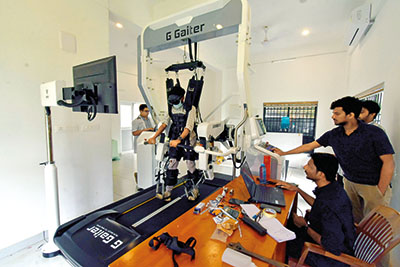
Physiotherapy and gait training |
Innovations abound such as a palliative and rehabilitation care department which provides physiotherapy, speech therapy and counselling to patients who might have been through strokes or accidents. There are dentistry and optometry services.
A PHC is meant to be embedded in the community. It is expected to inspire confidence and trust in local people. And be the first place they turn to for medical help. We witness the flow of patients turning up at the Noolpuzha PHC and realize it has touched that chord with them.
The patients are of all ages, with a variety of complaints. Some are in wheelchairs and others need to be admitted. People of all income levels rely on the PHC.
The Noolpuzha PHC deals with the everyday coughs and colds, fevers, dog-bites, cuts and fractures. There are cases of dengue, malaria, jaundice, typhoid and leptospirosis.
But there are also more weighty and long-term concerns that the PHC addresses. It works for the eradication of tuberculosis, for instance. It reaches out to undernourished babies and mothers. Anaemia is a concern.
It deals with lifestyle or non-communicable diseases such as diabetes and hypertension which are no longer diseases of the rich.
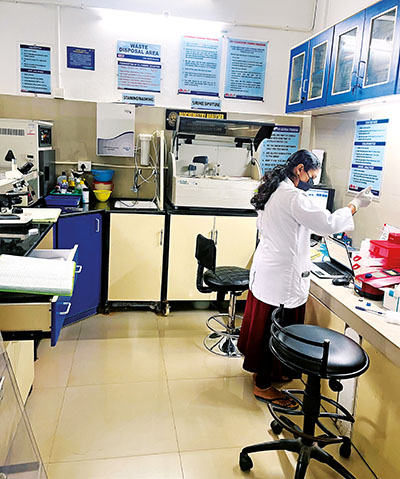
Monitoring and counselling are required and a laboratory at the PHC does many of the basic tests that a patient may need. If necessary, they are passed on to more advanced facilities. Being nearby, the PHC is easily reached for consultation.
The Noolpuzha PHC serves both tribal people and those who belong to other communities. A twin challenge therefore presented itself to Dr Mohammed when he came to head the PHC which was at that time playing a limited role in meeting health needs.
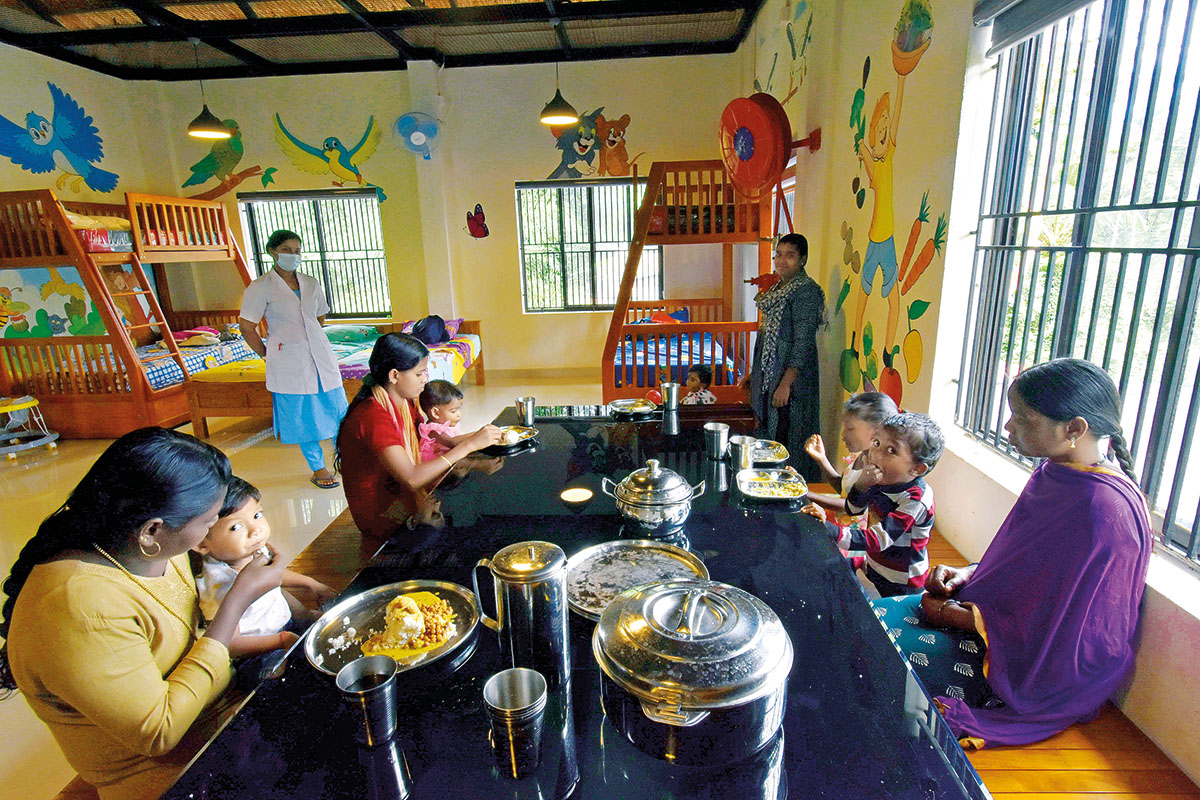 Mothers spend a day at the PHC to understand what a nutritious meal is
Dr Mohammed recalls: “Hardly anyone would come to the PHC. It was only some tribal people and that too for very minor ailments. I set out to change that by drawing up a masterplan for improving human resources and infrastructure which I placed before the panchayat and got the support I needed.”
“We then went on to raise funds from all the sources possible. The panchayat funded us and we also accessed funds from the state government, Central government and companies under corporate social responsibility,” says Dr Mohammed.
An important change he brought in was to position the PHC as being there for improving broad public health parameters and not merely responding to minor illnesses as it had been doing.
 |
|
Many basic tests get done in |
 |
|
A young patient on a drip waits for |
He began addressing malnutrition, anaemia, cervical cancer, leprosy, tuberculosis, leptospirosis and the range of lifestyle illnesses. He held medical camps and conducted vaccination drives.
“Everything that we do is mandated for a PHC. But we make a difference through the innovations we have introduced. It is my learning from this job. For a PHC to be effective, it has to innovate to address the needs of the local population which will vary from area to area,” he says.
The Noolpuzha panchayat has a population of 30,000 or so whose primary health needs the PHC meets. But 50 percent of them are tribals. Wayanad district as a whole has a large tribal population. Noolpuzha is the second-largest tribal panchayat in Kerala.
The PHC’s success has to be judged by how well it serves tribal people who mostly shy away from modern medicine. They need to be reached and brought to the centre itself. It is only then that a case like Ramesh’s stubborn tuberculosis can be isolated and treated.
Outreach is therefore essential. Dr Mohammed tells us that he bridges the gap with the tribes by roping in tribal people to be health attendants and social workers.
“They see us as strangers and it is important to win their confidence. We have a mobile medical team and conduct more than 20 medical camps for the tribal community every month,” he says.
Having tribal people persuade their own to be enlisted for medical attention helps Dr Sreenadh and his roving care team to be effective.
There are several innovations that the PHC has introduced so as to be effective in transforming long-term health parameters.
It has, for instance, a daycare programme to deal with malnourishment. Under daycare a woman and child are brought to the PHC in one of its vehicles and given nutritious meals.
The women are shown how to cook wholesome and nutritious food. They are sent back in the evening with a cooked meal so that the woman doesn’t have to return home and start cooking.
“The standard programme requires the woman and child to stay day and night at the PHC for two weeks. We found this wasn’t working because invariably the woman couldn’t leave her other children behind at home. So, we introduced a system in which we could bring her in the morning and reach her home in the evening,” explains Dr Mohammed.
To deal with anaemia, the PHC has an antenatal tribal home called Amma Taarat, which literally means mother’s love. Young mothers are chaperoned here by PHC staff for a few hours in the day for iron supplement injections and a general check-up.

A dental clinic is a facility the people of Noolpuzha would have to trek to a city to find. Now they can get dental care at the PHC. An entire set of dentures costs just `3,000. For the elderly it is free.
 |
|
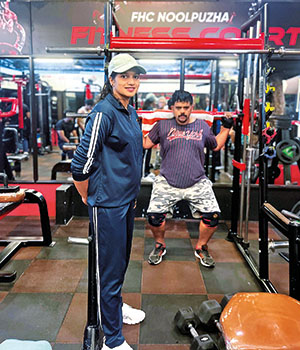
Shamliya Muyees, trainer at the gym |
The physiotherapy unit at the PHC is a game changer. It has the equipment of any modern rehabilitation centre to restore movement, strength and stability. People who have accidents or strokes and lose the use of their limbs find help here. Speech therapy is part of the care offered.
The PHC also has a gym where local people work out to pulsating music under the supervision of two young trainers, one of them a young Muslim woman, Shamliya Muyees. The gym fee is just `300 a month or `10 a day. The gym is full of equipment and as good as any big-city gym.
It has been built around a tree whose thick trunk is at the centre of all the machines and sweaty action. In the early hours it is packed with men working out. Later, from 9 am to 12 noon it is very popular with local women, some of whom come in burkhas after sending their children off to school.
None of these several innovations could have been possible without the support of the Noolpuzha Gram Panchayat. It is the panchayat that funds the PHC and sets aside the money for it in its budget.
Dr Mohammed remembers the time he went with this masterplan for the PHC to the former panchayat president, Shobhankumar. He found ready support which proved crucial for ushering in the changes. The support continues with the panchayat prioritizing healthcare.
“We are proud of our PHC and we are not looking back. We won’t let its standards fall even if Dr Mohammed is transferred as he may one day be, being in government service,” says N.A. Usman, the panchayat’s vice-president.
Noolpuzha is at best a small village on the periphery of the Wayanad Wildlife Sanctuary. You could drive by without noticing. But, thanks to Dr Mohammed and its PHC, people like us go in search of Noolpuzha, giving it its own special place on the map. Its PHC has become its identity.
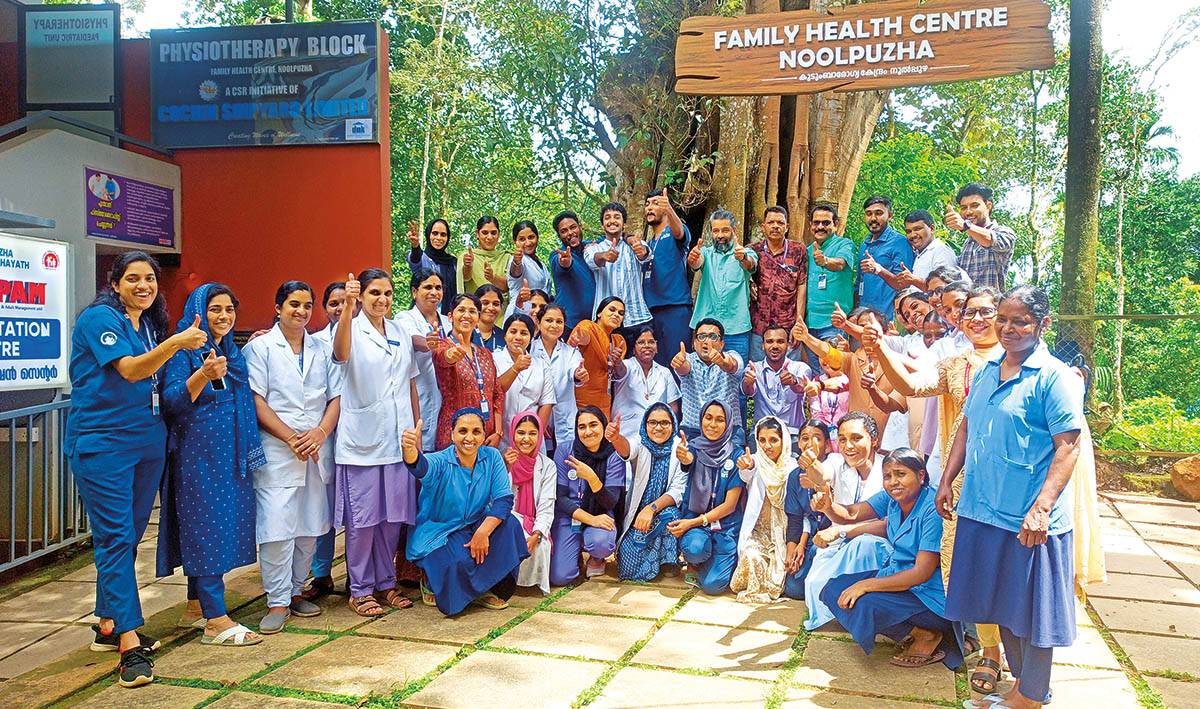 The PHC's spirited staff gets together for a group photo with Dr Mohammed
Comments
-

Shimayla - Sept. 11, 2025, 11:21 a.m.
Wonderful story...solutions journalism is much needed today....
-

Frederick Noronha - Sept. 4, 2025, 10:53 a.m.
Much needed. Some good old good news. And pointers to what's actually possible. Man does not live by bad news alone.
-
Bharati - Aug. 31, 2025, 8:43 p.m.
I read the newsletter enthusiastically as soon as it arrives in my inbox! I can not emphasize enough, how it sets me on a positive trajectory… Thank you
-
Preethi Rajagopal - Aug. 30, 2025, 2:08 p.m.
An ideal health system.Just pray we have such doctors and politocal support in each and every PHC