



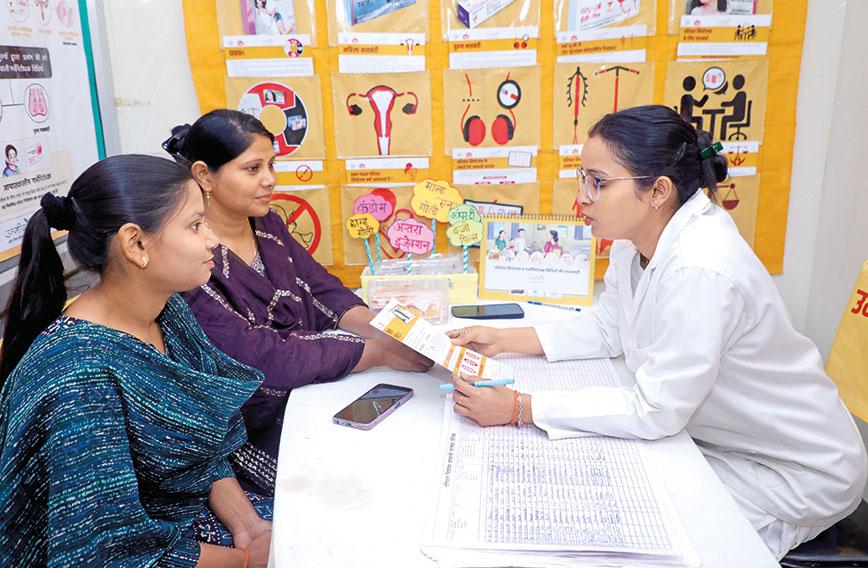
Umeed introduced a Family Planning Corner in PHCs for women who came for check-ups
Privacy is important for rural women seeking counselling
Poonam Muttreja
India’s efforts to integrate reproductive health into Primary Health Centres (PHCs) are crucial. High-fertility states like Uttar Pradesh (UP) underline both the need and the opportunity. The Population Foundation of India (PFI)’s Umeed project, implemented in partnership with the UP government and in collaboration with the Mobius Foundation’s Aakaar project, demonstrates how reproductive health, when embedded in the PHC, can drive measurable improvements in women’s health, community well-being, and system resilience.
Launched in April 2023, Umeed began as a pilot in Jarwal block of Bahraich district. Within two years, and with the active participation and support of UP’s Department of Health and Family Welfare, the programme expanded to 50 blocks across seven high-fertility districts, reaching nearly 1.25 crore people.
What makes Umeed significant is that it embodies the core principles of the PHC as envisioned in the Alma-Ata declaration of 1978 and the Astana Declaration of 2018, which emphasized the critical role of primary health. Umeed also brings in innovations that directly respond to local needs.
The Umeed project enhances accessibility by establishing family planning counselling corners in government health facilities and equipping frontline workers with updated training. It deepens community participation by nurturing Family Planning Champions, engaging gram pradhans and creating platforms for male involvement.
The Umeed programme strengthens inter-sectoral collaboration through District Working Groups, which bring together officials from the departments of health, education, women and child development, as well as rural livelihoods to jointly address barriers to service uptake.
It also tackles the social drivers of poor reproductive health through strategic Social and Behaviour Change Communication (SBCC) through campaigns such as Itni Bhi Kya Jaldi Hai, which challenges early marriage and promotes birth spacing, and Desh Badlega Jab Mard Badlega, which encourages men to share responsibility for family planning.
By targeting underserved women, adolescents, and newly married couples in high-fertility districts, Umeed advances equity and rights while embedding reproductive health firmly within primary healthcare.
Perhaps the most important feature of Umeed is that it strengthens the state health system itself. Facility readiness reviews, conducted jointly with district officials, have identified gaps in supplies, infrastructure, and communication materials. Block Coordination Committees, institutionalized in 49 blocks, brought together over 700 officials across departments to align efforts and problem-solve.
Digital monitoring allowed real-time tracking of outreach and service delivery. By embedding reproductive health improvements within government platforms and processes, Umeed builds capacity that will endure.
PFI also provided technical support to the UP government in drafting its State Population Policy (2021-30), ensuring that the policy reflects a rights-based, gender-responsive approach to family planning and reproductive health.
TRUST DEFICIT
One of the biggest barriers in reproductive health is lack of privacy and trust in public health systems. In many primary facilities, women seeking contraception are forced to ask for it in crowded outpatient departments or in front of neighbours. This discourages open conversation and limits uptake.
A story from Haidergarh Community Health Centre in Barabanki illustrates how a simple intervention, supported by government leadership, can transform care. Until 2023, the centre, which serves 400 to 500 patients daily, had no private space for family planning counselling.
That changed when Umeed, in coordination with the Medical Officer in charge, introduced a Family Planning Corner — first as a kiosk, and later relocated to a dedicated room adjacent to the Lady Medical Officer’s chamber. This has greatly helped in counselling a large number of women who come for other gynaecological problems and antenatal check-ups.
Since October 2024, Umeed has established 66 Family Planning Counselling Corners across high fertility districts. These have already served more than 30,000 clients, showing both demand for and trust in confidential, high quality counselling within government facilities.
Today, trained counsellors provide confidential, non-judgmental advice, and postpartum intrauterine contraceptive device (IUCD) insertions have exceeded 53 percent of eligible clients. The staff at the centres is now actively engaged in sending eligible clients to the counsellors.
FRONTLINE WORKERS
ASHAs (Accredited Social Health Activists) and ANMs (Auxiliary Nurse Midwives) are the bedrock of the PHC in rural UP. Yet many had not received updated training on family planning for more than a decade. Umeed addressed this gap by working with the state government to map nearly 13,000 ASHAs and ANMs into 260 training clusters.
Between September 2024 and early 2025, the programme supported the capacity building of over 10,000 frontline providers — including ASHAs, ANMs, counsellors, and staff nurses — through 237 training sessions and 65 cluster orientations. More than 2,500 ASHAs were oriented in these cluster meetings. In just two months, over 8,100 workers were trained by 120 master trainers using customized modules developed jointly with government health teams.
By equipping frontline workers with technical knowledge and counselling skills, Umeed has strengthened the capacity of the state system to provide consistent, quality reproductive health services at the community level.
Frontline workers, once hesitant, now engage confidently with even male clients. “When a male client once asked me for condoms, I was offended,” recalls one ASHA. “After the Umeed training, I realized it is my duty. Now, I feel proud to speak openly.”
This transformation underscores a fundamental principle: the PHC must provide not just services, but safe and dignified spaces where individuals can exercise their rights.
Reproductive health is deeply shaped by social norms, and Umeed’s design places communities at the heart of its outreach, in line with Alma-Ata’s vision of participation. Through partnership with Panchayati Raj Institutions and Self-Help Groups, 304 Family Planning Champions have been trained to lead discussions on reproductive health, counter stigma, and promote equitable access.
In Jarwal block, 23 gram pradhans underwent orientation on male engagement and family planning, and several have since spoken out publicly in favour of delaying marriage and supporting women’s health.
Community events reinforce this mobilization. On International Women’s Day, family planning counselling camps across six districts provided information to more than 1,000 people, resulting in 255 new adoptions of modern contraceptives.
In Jarwal block alone, Umeed has mobilized over 2,300 new family planning clients, demonstrating the effectiveness of combining government systems with community-driven demand generation.
In addition to grassroots mobilization, PFI has used social and behaviour change communication to shift norms and spark dialogue.
Campaigns such as Itni Bhi Kya Jaldi Hai directly address early marriage, first pregnancy, and birth spacing, reaching millions across over 1,100 villages.
Alongside this, there is the national campaign, Desh Badlega Jab Mard Badlega, through which entrenched gender stereotypes are challeneged and men encouraged to take responsibility for family planning. It underscores that reproductive health and rights are a shared responsibility.
EQUITY AND ACCESS
Primary healthcare has long been recognized as the cornerstone of universal health systems. First articulated in the Alma-Ata Declaration, primary health was framed as essential to achieving ‘Health for All’, emphasizing equity, accessibility, and community involvement.
At the time, reproductive health was not yet a widely used term, but the declaration highlighted maternal and child health, family planning, and health education as core services.
Four decades later, the Astana Declaration reaffirmed the centrality of primary health and explicitly placed sexual and reproductive health (SRH) within its framework, acknowledging it as a rights-based necessity for sustainable development and universal health coverage (UHC).
Reproductive health is not a separate silo within healthcare — it is integral to the very success of the PHC. When women and adolescents can access contraception, maternal care, safe abortion, and accurate information, they are healthier and more empowered to participate in education, income generation, and decision-making. This has ripple effects across households, societies and economies: reductions in maternal mortality, stabilized fertility rates, improved child health, and stronger communities.
From a system perspective, reproductive health services are preventive, cost-effective, and reduce the strain on higher-level facilities. By ensuring access to family planning counselling and commodities at the primary level, unintended pregnancies — and the complications requiring tertiary care — are prevented before they occur.
The evidence is compelling. According to the National Family Health Survey-5, India still faces a 9.4 percent unmet need for family planning, and in UP the figure is even higher, at over 15 percent. Contraceptive use remains heavily skewed toward female sterilization, with over one-third of married women nationally relying on it, while use of modern spacing methods remains low at about 17 percent.
Early marriage continues to be widespread, with nearly 23 percent of women aged 20 to 24 married before the legal age of 18. These figures point to systemic barriers — lack of access, poor awareness, and entrenched gender norms — that the PHC must address if it is to deliver on its promise.
Poonam Muttreja is Executive Director at Population Foundation of India.
Comments
Currently there are no Comments. Be first to write a comment!