



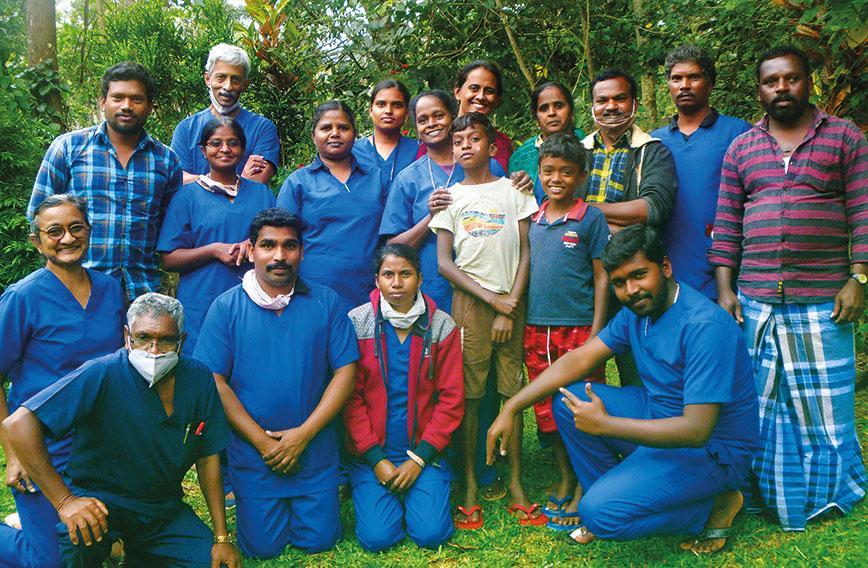
Rajkumar Ramasamy (standing, second from left) and Mary Ramasamy (kneeling) with their team
‘I realized Adivasis can do many interventions themselves’
Rajkumar Ramasamy
It was a depressingly cold, wet night in Nalloorkadu, a remote Adivasi village in the lower Kodaikanal hills, accessible only on foot in 1991. I was away from my wife, Mary, an obstetrician trained at Christian Medical College (CMC), Vellore, and my two little daughters who were in Oddanchatram, 40 km away.
I had decided to spend two or three days each week away from the Christian Fellowship Hospital, a wonderful, busy secondary care hospital where I worked. Why? Because I realized what India needed was not more hospitals but effective primary healthcare which would reach the weakest sections of society.
So, I was staying in Adivasi homes in remote villages after conducting mobile clinics in the evenings and early mornings when people were at home with the help of some fine nurses. After a few visits to the villages, one evening, I was feeling overwhelmed and alone because the health needs of the Adivasis were enormous. Rampant tuberculosis, severe anaemia, which led to tragic maternal deaths and common infections like pneumonia, were taking lives.

What I did not realize that night, foolishly, was that the resources I needed were with the amazing Adivasi communities themselves! Interactive health education sessions, often at night in villages and schools, helped people realize that many health interventions could be done by them. The community also helped us choose health workers to train.
To cut a long story short, my wife and I now work as a team with two nurses and 10 health workers, mainly from the Adivasi community. The following stories in primary healthcare depict the challenges and rewards of our healthcare system where staff and community work as a team.
Praveen and his parents moved to a local Adivasi village in our area after having lived in isolated coffee estates. Praveen was virtually blind, despite being born with normal vision, because he had developed juvenile cataract. His parents had sought treatment for him but had found it difficult to negotiate the healthcare system in hospitals. Praveen’s case was brought to our attention by a voluntary health worker in the village. An agricultural labourer, she also comes for training to the health centre every month and she can treat and prevent many basic illnesses. Voluntary health workers are our helpers, guides, eyes and ears in the village.
On Praveen’s behalf we lobbied with a paediatric ophthalmologist in a tertiary hospital in Madurai. He agreed to treat him for free. Praveen and his parents were helped to negotiate the hospital environment, but it was only after four visits that surgery was done in one eye.
However, attempts to take Praveen to hospital for his second eye surgery proved futile. His father would repeatedly bring the child home just prior to the scheduled surgery. Finally, a home visit was made. It became clear that his father was suffering from a severe anxiety disorder which caused him to cancel the surgery due to irrational fears about its outcome. His father underwent psychoeducation for his anxiety disorder and was started on medication. There was dramatic improvement in his functionality. The boy finally went through successful cataract surgery in his other eye.
ADVOCACY MATTERS
What did this story tell us? That field visits are an essential component of primary healthcare. Reaching out to people enables us to provide care to those who do not access health services due to fear, physical needs or financial issues.
Advocacy for specialist care for the patient carried out by the primary team, that understands his or her socio-economic background, enables access to such care.
Home visits can be a game changer. However much we try to treat all patients equally, the relationship is never equal with the health staff being regarded as kings and queens. At home, however, patients are the kings and queens and we are their guests. Conversations at home are more open. Other realities and problems that can hinder health interventions can be understood and circumvented.
Ordinary village folk, who may be poor and not had access to education, can make a remarkable difference in primary healthcare if trained with respect and empowerment. They play multiple roles, including advocacy. They help patients in need of continued care get access to treatment. Their partnership can reduce the health professional’s workload, making the latter’s work more targeted and effective.
Mental illness is very common. It can cause tragic hardship to the family. It is often not recognized. However, common mental illnesses can be treated by a family physician and the team effectively 90 percent of the time without referral to a psychiatrist.
PATIENT FOCUS
Nalini, 22, an unmarried agricultural worker, lives in a village surrounded by a reserve forest inhabited by elephants and without any public transport for six kilometres. She was brought to our health centre, suffering from high fever for four days. The health workers assessed her history and vital signs. They were found to be of concern. A blood count and urine tests were carried out, as per protocol, so that when the doctor saw her the results were at hand.
Nalini was advised to go to the hospital for admission. She refused because she had come alone with her younger sister and she was very fearful of hospitalization. She was at ease in the health centre because she knew the health workers were from her own community and understood her. The health workers said that if we sent her to hospital with a referral letter, she would just go home instead.
The hospital’s advice was to start intravenous antibiotics according to evidence-based standardised protocols that covered common serious infections. The health workers helped Nalini stay near the health centre with relatives. The next morning the health workers phoned her because her name was on a recall list of patients who needed follow-up. Nalini felt encouraged. She valued the phone call so, as requested, she returned to the health centre. An assessment showed she had improved and the treatment was successfully completed.
What did this story tell us? The best evidence-based guidelines in treatment need to be known but health professionals also need to know when to safely modify guidelines if their assessment is that individual and contextual factors will affect the delivery of treatment. Rigid adherence to guidelines will lead to poor outcomes especially in vulnerable people.
In primary healthcare we treat the person and not the disease alone! Teamwork allows that to happen because health workers from the community often know the contextual and individual factors that must be considered in the final treatment if it is to be effective.
Recall systems are essential. component of primary care. Such systems encourage continuity of care. Recall systems need to be set up in the health centre, as in Nalini’s case. Or they can be field-based so that those in need of continuity of care for chronic diseases are cared for. In our health centre every village has a file of persons who are in need of continuous care.
20 BIDIS A DAY
Karthik, 38, an agricultural worker with two schoolgoing children, had pain in his right knee after a fall two weeks earlier. The health workers assessed him first as not an emergency case. With consent a preventive health check was done using a form as a guide. The check-up costs barely `80 and gives more information than many ‘master health check-ups’ that cost much more.
The health worker noted that Karthik smoked 20 bidis per day. “Karthik, I am going to ask you a question because I am concerned about your health. What do you think about smoking?” asked the health worker in a non-judgemental manner. A three-minute discussion followed — “Why did you say smoking is not good and perhaps you should stop?” and so on.
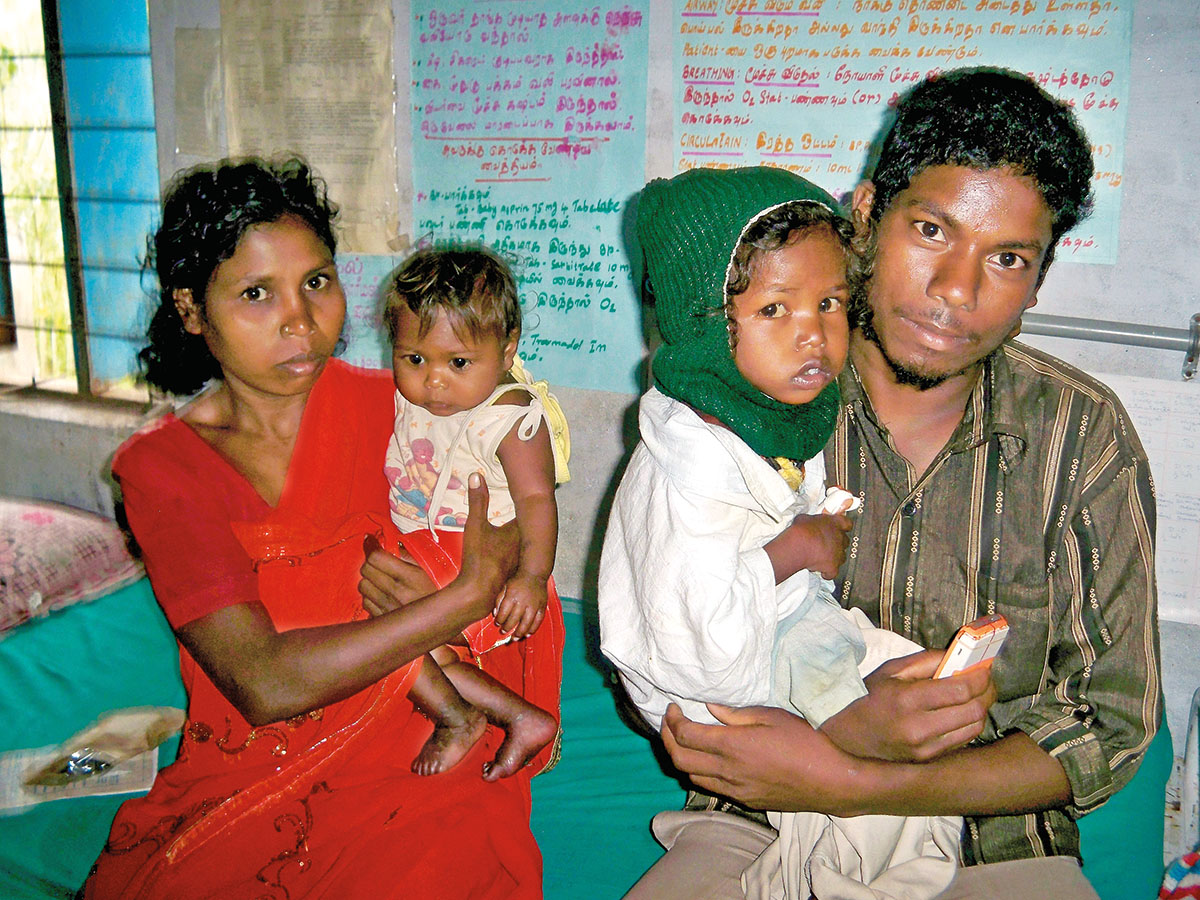 Vulnerable sections of the community must feel welcome and at ease in health centres
Karthik never felt threatened or blamed. He appreciated the interest shown in his health. The doctor managed his knee injury and addressed Karthik’s fears that the injury might affect his capacity to work in the long term. The next year when Karthik brought his son for treatment he smiled and said he had stopped smoking!
This story tells us that in primary health care preventive care can be naturally integrated with curative care. It can save enormous expenses in healthcare and prevent illnesses.
A non-judgemental respectful approach to preventing unhealthy lifestyle habits achieves more success than lecturing or shaming.
Healthcare costs are the biggest cause of severe debt among the poor. These stories show how primary healthcare reduces costs not just to families, but to the nation. It can make the alarming spiral in healthcare expenditure more sustainable.
In primary healthcare we can take steps to ensure that vulnerable sections of the community feel welcome! We take sides when we select staff from such sections, we choose people who understand them, who undertake home and field visits for the vulnerable and not just the powerful. Leaders in family medicine need to ensure that this essential characteristic is preserved and that the focus should not be restricted to clinical excellence.
In primary care we know the best treatments and guidelines but we also learn how to adapt them safely when contextual and individual factors make changes necessary. This means that primary care specialists are specialists in their own right! In many countries with effective primary care systems, primary care doctors compulsorily need to undergo training for three years before they can practise as general practitioners.

In India training in primary healthcare has been labelled family medicine but the number of seats available annually is a dismal one percent of post-graduate medical training. Whereas in other countries family medicine seats comprise 30 percent of post-graduate seats. The number of seats in family medicine in India can be increased through a rigorous well-designed examination for the DNB (Diplomate of National Board) course in family medicine. It can be open to anyone who has completed a set rotation in family medicine in any approved secondary healthcare institution, including a compulsory year in primary healthcare facilities.
Many people often ask us: Has this journey been worth it? Sharing the burden of the poor can be sometimes very hard emotionally and financially and on your own family. But the joy and love you receive from the people in so many ways can be wonderful. The people continue to teach me how to appreciate life, even tolerating my weaknesses. I am at peace. I have tried to do what a God of love who cares for social justice wanted me to do.
Comments
Currently there are no Comments. Be first to write a comment!