



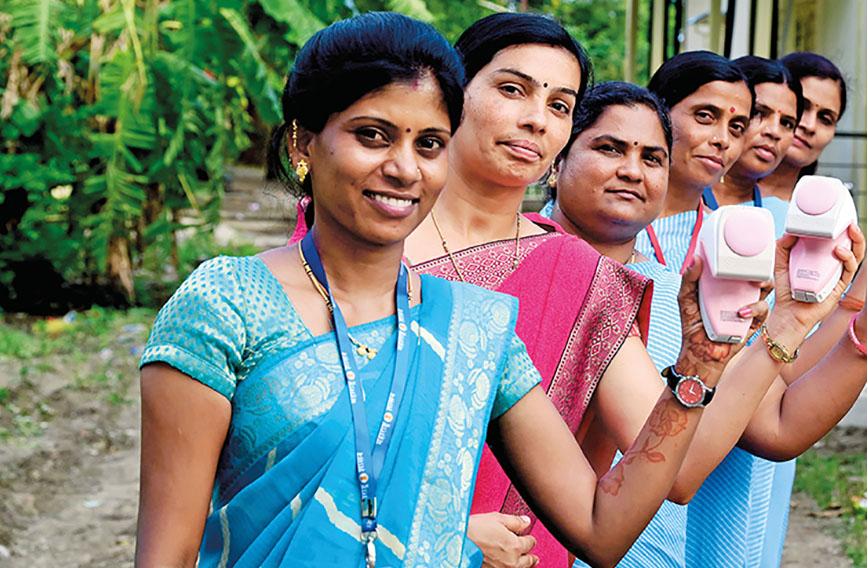
iBreastExam enables frontline health workers to conduct breast screening anywhere
Tech provides access equality and lowers cost of screening
R.A. Mashelkar and Sushil Borde
Since Independence, India has made remarkable progress in health, conquering plague, reducing maternal mortality, and extending life expectancy. Our multi-tiered healthcare system, spanning village sub-centres to tertiary hospitals, ranks among the world’s most thoughtfully designed for scale and diversity. Programmes like Ayushman Bharat represent bold reimagining of healthcare delivery.
Yet challenges persist: 600 million Indians battle anaemia, 1.4 million face cancer diagnoses annually, over 110 million live with diabetes, and 75 preventable maternal deaths occur daily. Despite well-intended policies, execution falters. Infrastructure gaps, quality issues, chronic underfunding — we spend under 2 percent GDP while the global average is 7 to 15 percent — workforce shortages, and system inefficiencies create barriers. Incremental improvements won’t suffice. We need transformative approaches.
A fundamental shift in approach is what we urgently need that would sometimes require exponential thinking and disruptive models — to achieve bigger, faster, and more inclusive results. While bridging income inequality for all Indians might necessitate decades of sustained economic growth, we could potentially achieve ‘access equality’ much sooner by ensuring every Indian gets access to basic healthcare and truly becomes ‘included’ in the benefits the health system offers.

This represents the essence of Inclusive Innovation — a philosophy of using less resources to create more value for more and more people. This core principle of ‘More from Less for More’ (MLM) becomes particularly relevant when we consider transformation of healthcare in a resource-constrained environment like India.
When we contemplate transforming public healthcare across India’s diverse landscape, MLM emerges as a fundamental solution approach. While we certainly can and should add more hospitals, train additional doctors, and build superior infrastructure, these represent inherently long-term solutions requiring massive resource mobilization. Simultaneously, we need something more agile and responsive — approaches that deliver exponential value despite existing constraints and limitations.
EARLY DETECTION
To achieve significant impact with constrained resources, we must leverage high-impact interventions. Screening emerges as a transformative lever. With over 60 percent of India’s disease burden now from Non-Communicable Diseases (NCDs), early detection becomes a game changer for health outcomes and costs. The National Programme for Prevention and Control of NCDs appropriately emphasizes screening. The economics are compelling: Stage I cancer treatment costs one-tenth of Stage IV while offering dramatically higher survival rates.
Breast cancer exemplifies this challenge. Every four minutes, an Indian woman receives this diagnosis. Despite being highly curable when detected early, nearly half succumb — primarily due to late-stage diagnosis. Current barriers include expensive mammography machines (`15 lakh to `80 lakh) available only in Tier 1 cities, leaving rural areas with no access. Even when available, compliance remains poor due to painful procedures, privacy concerns, and wage loss. Taking healthcare to people is only half the equation — ensuring actual utilization requires addressing behavioural barriers often overlooked in policy design.
This is where iBreastExam offers a breakthrough. A simple, handheld device that is non-invasive, painless, portable, and highly affordable at `250 per test, it empowers frontline workers to conduct breast screening anywhere. Over 600,000 women have already been screened using iBreastExam across more than 15 countries. It enables mass screening and triaging, allowing only positive cases to be referred for further testing. A powerful example of MLM, iBreastExam proves how high-technology, ultra-affordable innovation can drive early detection and save lives at scale.
The Anjani Mashelkar Foundation (AMF) began operations in 2011 with a clear vision of celebrating and supporting inclusive innovation across the health sector. Over the past 15 years, we have recognized and supported numerous phenomenal health-tech innovations, most of which have been successfully integrated into public healthcare ecosystems to create substantial positive impact for underserved populations.
Our experience has revealed that individual innovations, while powerful, achieve maximum impact when supported through comprehensive ecosystem development that addresses funding, research, deployment, and scaling challenges simultaneously. Here are two examples from a portfolio of over 15 Anjani Mashelkar Prize winners.
CONQUERING ANAEMIA
Anaemia affects two-thirds of Indian women and children. While treatment is straightforward, population-scale detection remains challenging. Conventional haemoglobin testing presents multiple barriers: invasive blood draws, time-consuming procedures requiring trained operators unavailable in remote areas, and poor accessibility in resource-constrained regions where anaemia prevalence is highest.
EzeCheck transforms this landscape. It is a non-invasive, ultra-affordable, Artificial Intelligence (AI)-powered, portable device assessing anaemia without drawing blood. Semi-skilled workers can operate it after minimal training, and provide instant readings for just `10 per test. Over 25 lakh screenings have been conducted, making it integral to the Anaemia Mukt Bharat programme across Assam, Jharkhand, Odisha, Uttar Pradesh, and Himachal Pradesh.
The AMF’s 2024 pilot screening of 10,000 Pune schoolchildren revealed crucial insights. Previously, students fled painful prick-based tests, discouraging peers. With non-invasive testing, compliance was phenomenal. This illuminates a vital truth: creating policies differs from implementing them to truly serve people and overcome behavioural barriers like pain, fear, and misinformation.
AI-POWERED LUNG SCREENING
Chronic respiratory disorders burden India heavily. We account for 30 percent of the 550 million people globally suffering from tuberculosis (TB) and Chronic Obstructive Pulmonary Disease (COPD). While TB represents a public health success story with declining death rates through comprehensive interventions including active screening, free treatment, and community outreach, it remains far from eradicated. The next wave of progress requires low-cost, scalable screening tools.
COPD prevalence is rising due to air pollution and lifestyle changes. Traditional spirometry diagnosis presents challenges. It involves complex, painful procedures requiring bulky equipment and trained staff, both scarce in rural areas.
Swaasa revolutionizes this landscape using AI to analyze cough sounds through smartphones. Patients simply cough into phones for lung health analysis. Operating on regular smartphones eliminates the need for expensive hardware. Semi-skilled workers can conduct screenings after a brief training session, democratizing respiratory screening.
Over 300,000 assessments have been conducted, with discussions underway for Central TB Division deployment and CSR (Corporate Social Responsibility) foundation partnerships for community screening.
AN ENABLING ECOSYSTEM
While these innovative solutions are powerful tools for public healthcare transformation, the biggest obstacles often emerge long before technologies even enter public health ecosystems. The challenges are systemic and multifaceted, requiring comprehensive support beyond technical development.
Certification cycles for medical-grade devices are long and rigorous, often requiring multiple years of validation studies and regulatory approvals. Convincing stakeholders within conservative healthcare ecosystems — often appropriately cautious about adopting new technologies that affect human lives — becomes an uphill battle requiring persistent advocacy and demonstration.
Sustaining early-stage startups in the healthcare space proves incredibly challenging due to extended development timelines, limited revenue opportunities during validation phases, and the substantial capital requirements for clinical trials and regulatory compliance. Government tender processes are complex and difficult to navigate, particularly for smaller companies lacking extensive procurement experience.
Pilot deployments are almost universally demanded upfront by potential adopters, often without any guarantees of eventual scaling or programme continuity, creating financial strain on start-ups. Even when a solution demonstrates clear superiority over existing approaches, it can require years of persistent effort to reach the populations for whom it was originally created.
Understanding these systemic gaps, the AMF has consciously evolved over the years from operating merely as a platform for innovation recognition to functioning as a comprehensive ecosystem enabler — one that supports transformative healthcare innovators at every critical step of their development and deployment journey.
COMPASSIONATE CAPITAL
Healthcare innovation requires specialized funding that understands disruptive start-ups’ unique challenges — longer gestation periods due to clinical validation studies, resistance from conservative medical communities, and regulatory delays. This demands
patient capital: strategic, mission-aligned, long-term funding rather than quick return-focused investment.
The AMF partnered with Gharda Chemicals to launch the Keki H. Gharda Innovation Foundation, to provide financial backing for high-technology, inclusive innovation with emphasis on healthcare serving underserved populations. Though operational for less than a year, the fund actively invests not just in start-ups, but in clinical trials, pilot programmes, and manufacturing capacity. This represents a fundamentally different catalytic capital model — enabling science for social good rather than for purely commercial returns. We call this ‘compassionate capital’, balancing financial sustainability with social impact.
GLOBAL PARTNERSHIPS IN RESEARCH
The AMF is actively forging world-class research and development (R&D) collaborations to ensure that high-technology solutions continue evolving with rigorous scientific methodology and cutting-edge capabilities. Public healthcare demands absolute robustness, adaptability to diverse contexts, and ability to scale effectively — making continuous R&D investment non-negotiable for sustained impact.

One particularly unique and productive partnership involves collaboration with the Applied Artificial Intelligence Institute (A2I2) at Deakin University in Australia. A2I2 brings internationally recognized expertise in machine learning and AI applications to collaborate directly with the AMF’s portfolio companies in building powerful AI models for prediction, diagnosis, and treatment optimization.
For example, one maternal health platform has significantly benefited from A2I2 scientists’ expertise in refining and enhancing risk-prediction algorithms, improving both accuracy and reliability of early warning systems for pregnancy complications. This collaboration represents a remarkable story of how cutting-edge researchers from a developed nation are working directly with grassroots health-tech start-ups in India to protect the lives of excluded, underserved women in the country’s most remote regions.
Such partnerships demonstrate the global nature of healthcare innovation, where expertise and resources can be mobilized across boundaries to address local challenges with world-class capabilities.
R.A. Mashelkar is an influential thought leader globally recognized and honoured for his contributions to science and technology.
Sushil Borde is the President of the Anjani Mashelkar Foundation and a passionate innovator.
Comments
Currently there are no Comments. Be first to write a comment!