




A nurse provides information on contraception
‘Care delivered by local nurses has been transformative’
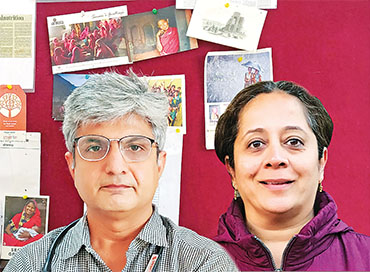
Pavitra Mohan & Sanjana B. Mohan
In southern Rajasthan, faced with dwindling land sizes and disappearing forests, many young tribal men would migrate to cities such as Ahmedabad to work as manual labour, leaving behind women, children and the elderly. In the absence of men and cash, they find it even more difficult to access distant and expensive healthcare.
Basic Healthcare Services set up a network of primary health centres (PHCs), called AMRIT Clinics, in six such communities in southern Rajasthan with the aim of providing low-cost and responsive healthcare.
Nurses from similar communities were trained, supported and mandated to provide healthcare in the clinics. Supported by a visiting physician and enabled with simple technology, protocols and diagnostics, they are able to address a large proportion of the healthcare needs of the population.

Other important elements of services include 24/7 availability, required drugs and equipment, community engagement for their health and well-being and linkages with referral hospitals for those needing specialized care. Community health workers further deepen the link with communities.
WOMEN'S POWER
At Basic Healthcare Services we started with the belief that nurses, skilled and supported by physicians and enabling technology, could provide healthcare to such populations. Physicians would train, provide teleconsultation and on-site consultation for chronic and more difficult conditions. We took into account the fact that over the past decade or so many young girls from tribal areas had been opting for nursing as a profession. Such nurses, from similar remote and marginalized communities, were more likely to empathize with the patients. That provided us with a large force of women to address the huge gap in providing healthcare.
In the 10 years since they began, the clinics have helped save thousands of lives by taking care of a large proportion of the health needs of communities, including infectious diseases, non-communicable diseases, reproductive health conditions and childhood illnesses.
One such clinic is now accredited for safety and quality by the National Accreditation Board of Hospitals & Health Care Providers (NABH), demonstrating that high-quality healthcare is possible even in such remote and resource constrained settings.
The services have also influenced substantial change in behaviour. Women, who would deliver at home, now prefer going to a health facility. At one time, the word tuberculosis would invoke fear and denial. People would delay seeking care. Now they come early for treatment.
The AMRIT experience shows the transformative impact of primary healthcare delivered by nurses and supported by physicians and health workers.
|
Pavitra Mohan and Sanjana B. Mohan |
What do the nurses say about their own experiences in dealing with patients? Priyanka, one of the most senior nurses, though all of 25, described in her own words how a woman with very high blood sugar came to the clinic: “This woman came here and asked us to measure her blood sugar. The glucometer recorded Hi, meaning a blood sugar higher than 600. She then informed that she was on insulin previously but had stopped it some time back as her treatment from Gogunda was very expensive.
“I spoke to Sir (primary healthcare physician) who advised starting IV fluids and insulin. The phone line here is very erratic and after some time the phone stopped working. It was important to discuss the progress with Sir, so I went with Hemant (the health worker) to the nearby village (about five kilometres away) on a motorcycle. There is network availability on top of the hill and I walked there from the road, and spoke to Sir who advised the treatment.
“I told the family that it would take some time to go and come back. The family was very supportive. They said, ‘Sister, we are seeing your efforts and concern and we trust you. We will wait. You please go and talk to your Sir.’ Since that day, she is much better. Earlier she had difficulty in walking, today she came again and was walking comfortably. The family also confided that earlier they would spend a lot on buying insulin and had to stop treatment. But now they will be able to continue.”
Rekha, also at Morwal in Gogunda tehsil of Udaipur district, had conducted a delivery. In a quiet and confident voice she recounted the case: “It was the third child of the woman. The delivery was done well and the baby cried nicely. After the baby was born, however, the placenta did not come out. We gave an injection of oxytocin and performed uterine massage, but to no avail. Finally, we called the 108 Ambulance provided by the government and referred her to Gogunda Community Health Centre. I know this was a life saved but I wish we could have managed it here.”
Hemant, a bright and enthusiastic health worker, had this experience to narrate: “We referred Kaluba, who had severe pneumonia, to the hospital in Udaipur. The ambulance, though, took him to the Community Health Centre in Gogunda where he was prescribed medicines and told to go home.
“When I spoke to him and learnt he was about to leave Gogunda for home, I immediately asked him to wait there and quickly left for Gogunda. I convinced him to go to Udaipur and made him board a bus. I also called up Jitendra (a colleague based in Udaipur who supports the patients referred from the clinics). Kaluba got admitted to the hospital and is now much better.”
RIGHT TO HEALTH
Primary healthcare, defined most simply, is: healthcare provided to all, especially the most marginalized, with their participation, and for their needs.
The basic premise of the primary healthcare approach is that poor health is an outcome of social, economic and political disparities, and improving health outcomes sustainably would require improvements in wider social, political, and economic conditions.
Primary healthcare therefore is not restricted to simply delivering a set of responsive health services, but requires promoting the values of health as a human right, involving communities, and promoting equity.
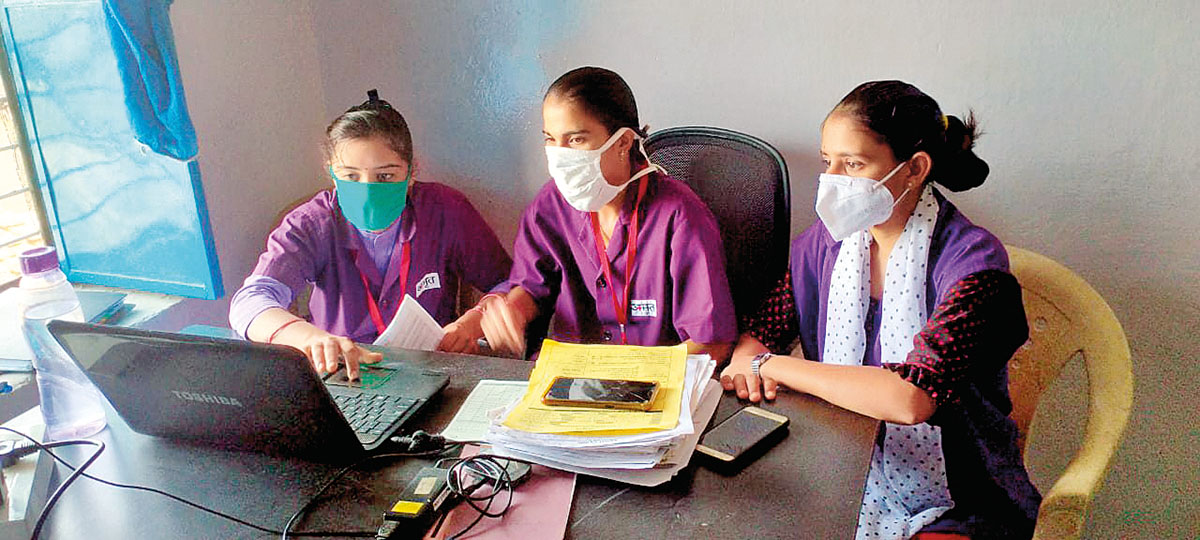 Connectivity can be poor but technology is an important part of the AMRIT Clinic model
Juxtapose these with the values that India’s Constitution, founded on principles of democracy, espouses: fraternity, equality and social justice. It is not coincidental that the primary healthcare values sound similar to our Constitutional values.
The goal of development should be to put the last first. That should be particularly so in healthcare. But who are these people who have been relegated to be the last? Who are those who are first?
They are those who live, on an average, 14 years less than the first: a rural man belonging to the bottom quintile has a life expectancy of 62 years as against 76 years for an urban man in the top quintile. They have little to eat: 55 percent of mothers of a child below three years, have a BMI of below 8.5 in the populations we serve. A similar proportion of their children are undernourished.
Can you take half a minute to recall all that you ate and drank in the past 24 hours? This is what mothers of young children in rural India where we work recalled having eaten: less than two-thirds had eaten any vegetable, and less than half had eaten any pulses. None had consumed any milk, eggs, meat or fruits.

In rural areas, they live in remote hamlets. The nearest functional facility could be as far as 50 km and the nearest hospital could be 100 km. A 40-year-old woman was brought by her husband on a bicycle to our clinic some 10 years ago, soon after it was opened. The clinic is some 100 km from the nearest city, and 25 km from the nearest facility. She had been unable to walk for some months because of severe arthritis of her joints, including knees. In the absence of any accessible health facility, they could not consult a formal provider, because of which she had reached this stage. She has since been coming to our clinic — to our joy, walking on her own along the tortuous roads.
Even when “the last” person is able to reach the facility, she is often mistreated — poverty and caste play a role in how you are treated, as shown by results from many hospitals that come in from across the country. In a significant research across facilities in UP, women in labour were found to be widely mistreated, including being slapped by the staff on duty.
The monthly family income of people in our areas is `6,000. Many migrate to cities, at the early age of 14-18 years, as secondary wage earners; their peak is at around 30 years of age. By the time they reach 40 or 42 years, they become ill after years of hard and hazardous work. At that point they often return to their villages, when their children become primary wage earners. Most of us would often be peaking in our careers then.
Given these realities, what kind of health systems should we build? Services should be closer to where people live, and care should be provided irrespective of people’s ability to pay. Healthcare teams need to understand, respect and respond to social, economic and cultural realities of people they serve. They should treat them with dignity. We attempt to do so through a network of AMRIT Clinics in South Rajasthan.
Comments
Currently there are no Comments. Be first to write a comment!