



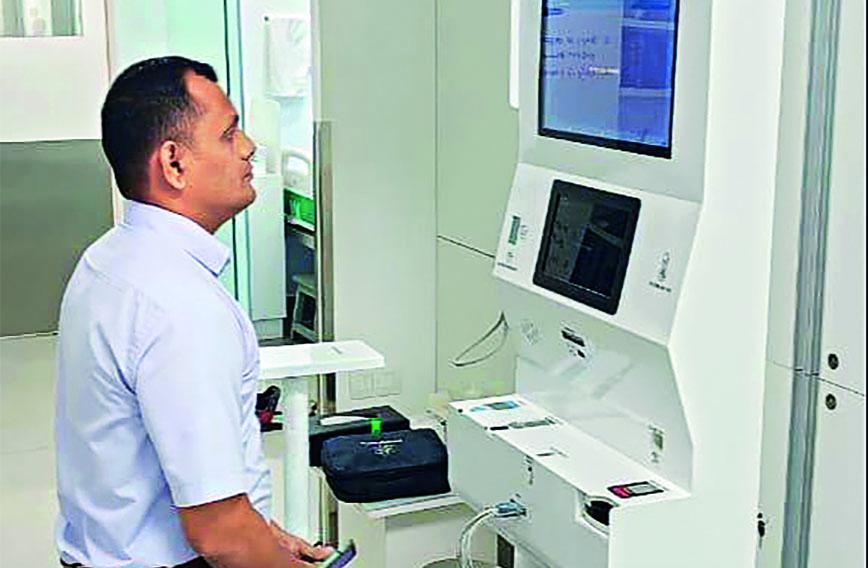
A digital health kiosk
Tech for the PHC: Predicting outbreaks to supply logistics
Kiran Karnik
The well-being of a nation is best indicated by the health of its people. The size of the economy (GDP) is important and more so, its derivative, per capita income. The latter, though, hides inequities and so the Gini coefficient — a measure of income inequality — has also to be considered. Yet, all these, even overlooking their measurement and data problems, address only the economic part of people’s lives. Wellness is at least as important (just ask a rich person with health problems).
This differentiation is important because, despite being the fourth largest economy in terms of GDP, India wallows at the lower end of global health rankings. Even amongst countries with similar per capita income, we come out badly in a host of health indices. The excuse of climatic or cultural causes will not wash, since our neighbours — Sri Lanka and Bangladesh, in particular — fare better than us, despite both being much smaller economies with per capita income at a level lower than ours.
Studies point to numerous reasons for India’s near-dismal health record. Certainly, the poor outlay on health is a major factor: the total health expenditure has been hovering around 3.5% of GDP for the past few years, and government expenditure — while higher than it was — is a measly 1.85% of GDP, with the target of 2.5% (set in the 2017 National Heath Policy) yet far from realization.

Under Ayushman Bharat, there is an attempt to provide comprehensive healthcare, through two major initiatives. PM-JAY (Pradhan Mantri Jan Arogya Yojana) provides cashless cover of up to `500,000 for each eligible family per annum for secondary and tertiary care hospitalization. It aims to cover 120 million poor and vulnerable families (about 550 million beneficiaries). The second initiative is for primary healthcare. In this, the health sub-centres and primary health centres (PHCs) are to be transformed into 150,000 Health and Wellness Centres. Many observers note that while PM-JAY gets a lot of attention and is comparatively easier to implement, primary healthcare continues to be in an unsatisfactory state.
PM-JAY is certainly a saviour for many, who may otherwise have become completely bankrupt through hospitalization expenses. Its extension to a wider population is welcome and will benefit many million more. However, it would be even better if, in the course of time, the requirement for secondary and tertiary care is itself minimized. This is crucial for individuals because, for most, hospitalization is related not just to medical costs, but to a loss of wages. For them, sickness means that there is no earning on those days; worse, it could lead to losing their job and a descent into poverty.
FILLING THE GAPS
Preventive healthcare is, therefore, crucial and — as a next step — primary care to identify early any potential major problems or to treat the immediate minor ailments so as to minimize any work-days lost as a result of sickness. Primary healthcare in India has suffered the fate of primary education: comparative neglect in early years. While we can boast of world-class institutions of higher education (though only a few dozen), the overall quality is dismal. The cause can be traced to poor basic or foundational education. Year after year, research shows that a large proportion of Class 5 students cannot read a Class 2 text, and many cannot do simple arithmetic operations.
The linkage between primary education and primary healthcare is, however, not limited to an analogy of their similar historical neglect or the foundational role of both. The two are connected in a different way too. Poor basic healthcare leads, amongst other things, to diarrhoea amongst children, stunting not only physical growth but also mental development. This is made worse by poor nutrition, often related to poverty. Sickness leads to missed classes; added to inadequate cognitive development, it results in poor academic attainment. Thus, health affects learning, with its impact being felt even in later years — in fact, lifelong.
Given this (and more), one would assume that the case for the greatest emphasis on preventive and primary healthcare is obvious. Yet, the focus and funds move to secondary and tertiary care: doubtless important in themselves, but less so than primary healthcare. Building hospitals and reimbursing private ones is easier than the more difficult task of rejuvenating the many moribund PHCs.
In recent years, technology has added a new dimension to healthcare. Breakthroughs in various areas related to human biology, new devices, and the use of data analytics, machine learning, and artificial intelligence (AI) are transforming the field. Some of the advances are sophisticated, expensive, and aimed at speciality treatment, affordable only by tertiary care facilities. However, many new developments are now directed towards more basic issues and suitable for use at PHCs.
At a broader level, it is critical to monitor community health parameters to identify, as quickly as possible, any spread of epidemics or of sicknesses that may have been caused by polluted community water sources. Simple technologies (a tablet or just a cell phone) could be used to enter data and transfer it in real time to a central facility, where automated analysis could instantly point to any widespread dangers. Increasingly, such data can be fed into AI-driven predictive models which can foresee any spread of disease before it strikes, enabling preparation and advance action to forestall it or to mitigate effects.
TRACKING SUPPLIES
Technology can also be used to keep track of medical supplies available at the PHC, to decide on the re-order point for each medicine depending on delivery time and consumption; to automate the ordering process; and to optimize the supply logistics. Though there are pros and cons to it, tech can also be used to ensure and check that the doctor and paramedical staff are available at the PHC at the designated timings. Medical data of each patient can be stored for immediate access by the doctor, and for follow-up and reminders by the paramedics. The last could also be automated and would be useful particularly for those required to take regular medication.
Soon, there will be models that can take community data, combine it with precision weather forecasts and local data — some, including imagery, collected via satellite or drone sensors — and generate even better predictions. Community health forecasts could become like today’s weather predictions. Like red warnings of heavy rainfall, cities and talukas could receive red warnings for an impending health danger. Gen AI could be used to automatically generate relevant alerts and send them out to all cell phones in the area via messaging and social media platforms. All these could contribute to preventive community healthcare — not in some distant or imagined future, but in a matter of months. All it requires is enlightened leadership and some funds.
QUICKER DIAGNOSIS
At the individual level, new technology is revolutionizing diagnosis. At an accelerating pace, a multi-disciplinary approach that combines biology, electronics, and AI-driven computer software is resulting in innovative new approaches that diagnose through a range of mainly non-invasive means. These use breath, sweat, infra-red, ultrasound or other electromagnetic waves as indicators that determine illness. Many are familiar — thanks to Covid — with non-contact infra-red thermometers and clip-on finger devices for determining blood oxygen. Other such clip-on devices can help detect anaemia, a serious problem especially for young women, by providing data on haemoglobin.
Another serious ailment in India is tuberculosis (TB), for which early detection and continued treatment are vital. Now, just coughing over a cellphone could help diagnose TB and other respiratory diseases almost immediately, thanks to AI. For women, breast cancer is a serious problem. Though here, too, early detection is critical, women are often reluctant to get a check done due to social (privacy) reasons. New technology now enables early detection through a non-invasive, non-contact device.
This new generation of innovative devices, though based on high-tech and deep science, are simple to use and require minimal training of the user. The knowledge and expertise needed for analysis and diagnosis are transferred to the “backend”, where sophisticated computers with huge databases and models that use high-end AI can do the work of a highly trained super-specialist. These “inclusive innovations” ensure low cost per test, with economies of scale having the potential to further cut costs. Most of them also take note of socio-cultural realities: for example, the sensitivity of women about tests that involve contact or touch by service providers.
Technology has been in use for telehealth for a while. Such remote consultation has now moved some notches up with the new diagnostic tools that provide data to track more illnesses. This enables more complex cases to be addressed through tele-consultation with a specialist, supported by AI, at a medical hub hundreds of kilometres away. In a new model being tested by HelpAge India, the whole chain is integrated: diagnostic tests in locale (at a PHC), telemedicine (remote consultation), diagnosis and prescription of medicines by the remote doctor, the actual (physical) delivery of medicines through a mobile health unit (MHU), and follow-up in subsequent visits by an MHU. Continuing follow-up, where required, could also be done by automated messaging to send reminders — a task well suited to Gen AI. All this requires many links in the chain to work together; a task that is not easy, but achievable.
Prevention is a key element of public healthcare. This has so far been dealt with as mainly a medical issue. While medical science contributes substantially, socio-cultural issues and communication are vital factors. Medical experts have established that open-air defecation is a cause of disease. However, ending this cannot be solved by merely constructing toilets, as we have seen. It requires social change, involving deep-rooted beliefs and habits. Another important finding is that a simple routine of washing hands with soap and water before eating can reduce diarrhoea. Getting this message across and making it a habit requires communication skills. In this, the offspring of new technology (social media, short videos) can be a major means.
All these new technologies — implementable at the village level — make it possible to take medical care practically to the doorstep of all, barring the small percentage of cases needing hospitalization. As technology enables more individualized care, with medicines and dosages tailored appropriately for each person, a doctor at the PHC who knows her patient (like the GP of yore) can add an invaluable human touch of personalization. This brings to the fore the role of PHCs and the importance of strengthening them. The intention of upgrading and transforming them into Health and Wellness Centres is well-founded; it now needs to be backed by leadership and adequate funding.

Given the demographic shift and the rapidly ageing elder population (now, about 150 million; 300 million in two decades), geriatric care must be an additional focus area for primary healthcare. A new cadre of specially trained caregivers (like ASHAs or Accredited Social Health Activists) and doctors is required. Another important area is mental and emotional health, given that loneliness and issues like depression are major problems for the elderly.
Like basic education, primary healthcare is a necessary public function. Any attempt to privatize this would be inappropriate and would adversely affect especially the disadvantaged. Despite its inefficiencies, the State is best positioned to provide this and must continue to do so. PHCs are key to the well-being of individuals, the critical first step in the overall system; they are also the foundation of a healthy nation — an essential element of a “developed country”.
What is needed is not just their renaming, but the transformation of PHCs to convert them into hubs of public health. They must take charge of and be responsible for general community health, a place where all can go freely and with confidence that they will get the best possible care. Reinvented, tech-enabled PHCs can truly revolutionize healthcare.
Kiran Karnik is a public policy analyst, author, and columnist. His most recent book is ‘Decisive Decade: India 2030, Gazelle or Hippo’.
Comments
Currently there are no Comments. Be first to write a comment!