



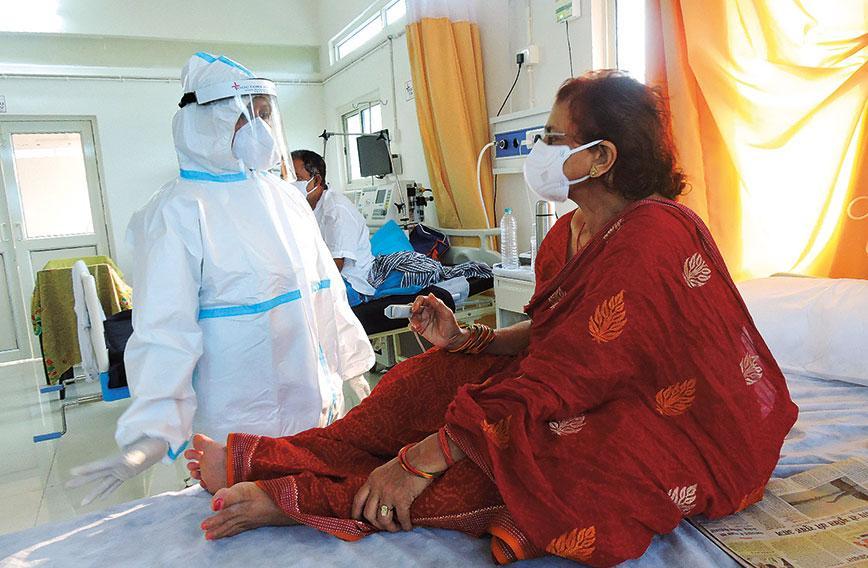
The PHC should be the first to spot signs of an outbreak
Chandrakant Lahariya
STRONGER primary healthcare is the foundation for early detection of the emergence of a disease and for disease prevention. With trained health workers close to the community, awareness and health education can be imparted. Primary Health Centres (PHCs) are frontline clinics which treat diseases and provide suitable referral to patients.
If there is one major learning from the Covid-19 pandemic, it is that stronger primary healthcare supplemented with well-functioning disease surveillance systems are a sine qua non for epidemic readiness.
The PHC system is able to achieve all this at much lower cost than what hospitals, which are largely focused on treating the sick, can achieve. Yet, the importance and relevance of the PHC is not always appreciated. That’s why it is imperative to have some historical perspective on primary healthcare to understand its role and relevance.
Although the need for stronger primary healthcare emerged during the Covid-19 crisis, its role and relevance have been recognized for more than seven decades and even before the birth of the World Health Organization (WHO) in 1948. In India, a stronger primary healthcare foundation was articulated and advocated by the Sir Joseph Bhore Committee set up in 1943.
It also needs to be remembered that primary healthcare, perhaps not in nomenclature but in principle, has been the site of most public health activities including tuberculosis elimination, malaria control and family welfare programmes of the country.
The Alma-Ata Declaration of 1978 underlined its importance in achieving the goal of ‘Health for All’. Inspired by it, several countries, including India, started interventions to strengthen primary healthcare. India released its first national health policy in 1983 and witnessed one of the fastest expansions of primary health centres and health sub-centres soon after, from 1984 to 1988. These enabled the universal immunization programme in 1985.
HOLISTIC TO SPECIFIC
Yet, in the years that followed attention got diverted from primary healthcare. It was replaced by externally-funded, donor-assisted verticalized national health programmes, which were known for quick results. Another reason for primary healthcare being sidelined was limited financial resource allocation for health by both national and state governments. The third was liberalization of the economy and growth of the private sector in health.
Large hospitals became an excuse for the government to abandon its responsibility to invest in healthcare. In fact, during the decade of the 1990s, government spending on health went down to the lowest ever of around 0.9 percent of GDP. The vacuum created by reduced government spending resulted in rapid growth of the private sector in hospitals and primary healthcare was nearly forgotten.
It came back into focus once again in 2005, when the National Rural Health Mission (NRHM) was launched. The focus was only on rural areas. Subsequently, the National Family Health Survey (NFHS) data for 2005-06 was analyzed by independent subject experts. They pointed out that the primary healthcare system and health indicators in many urban areas were worse than their rural counterparts in the same districts and states.
In 2013, the National Urban Health Mission (NUHM) was launched. The urban component was supposed to strengthen primary healthcare in urban areas. The two programmes, NRHM and NUHM, were combined into the National Health Mission.
A weak primary healthcare system is not an India-specific challenge. Most low- and middle-income countries suffer from the same malaise. Diseases such as Ebola and Middle East Respiratory Syndrome (MERS) rose repeatedly. A number of public health emergencies of international concern surfaced despite five-star hospitals in metro cities, which were ready to treat you but could do nothing to prevent disease.
In the decade post-2010, the incidence of diabetes, hypertension and cardiovascular diseases also grew. These diseases needed primary healthcare physicians and closer-to-home facilities. Alongside, mental health was becoming a cause for concern. All these required lifestyle modifications and, for most of them, hospitals were not useful.
INDIAN RESPONSE
In the run-up to these developments, India released its third National Health Policy in March 2017. The new policy recognized the foundational role of the primary healthcare system in tackling nearly 70 to 80 percent of the health needs of the population.
The policy also advocated that two-thirds of government spending on health should be directed towards primary healthcare.This was the most explicit national recognition for stronger primary healthcare since Independence and another impetus post the 1980s.
However, no one could have foreseen the Covid-19 pandemic. It was in the early part of the pandemic that WHO released detailed technical guidance and practical PHC adaptation strategies — triage, continuity of routine care, outreach, telemedicine, community health teams — to maintain essential services during pandemics. This author was also involved in global preparedness and assessment of PHC readiness for pandemic-related services.
By the time the pandemic got over, it was widely agreed that a stronger primary healthcare system was essential to being prepared for future epidemics and that the next one could be approaching earlier than we could imagine.
A BMC scoping review, published in July 2024, examined 167 studies across 48 countries. It identified 194 resilience building interventions categorized under governance/leadership, financing, workforce, infrastructure, information systems and service delivery.
The key interventions included were telemedicine, workforce training (including psychological support), community outreach, and robust digital health information systems. The PHC specially helps in community outreach of services in real time and is closer to the people. There is plenty of evidence from multiple countries that set-ups which had stronger first-point contact as in primary healthcare fared much better in responding to the Covid-19 pandemic.
CONSTANT VIGILANCE
A pandemic is a one-off event but outbreaks and epidemics are more frequent. This has been recognized for several decades. The rise of such outbreaks and epidemics is attributed to faster modes of transport, urbanization and crowded living conditions, antimicrobial resistance, rising temperature and climate change as well as deforestation and increased human and wildlife interaction.
Many of these challenges are being faced in Asia and Africa. In fact, there are data-guided and scientific estimates that the number of potentially harmful pathogens will increase in the decades to come. Most will originate from animals and then transfer to humans (the zoonotic diseases).
It is against this backdrop that the idea of ‘one health’, where the health of humans, animals and the environment is intertwined, is being discussed. There is global dialogue that even implementation of a ‘one health’ strategy must be anchored in PHC networks — particularly in zoonotic hotspots.
For example, PHC doctors and staff will need to coordinate with veterinary officers when clusters of animal borne infections appear, and use early warning systems at the sub centre level to activate a response.
The lessons from the Covid-19 pandemic reinforce primary healthcare as the backbone of both routine health issues and emergency response. Global directives align with India’s own reforms via Health and Wellness Centres. The incidence of epidemics and a pandemic is closer than we imagine.
Being prepared and strengthening primary healthcare can prep us to respond quickly and possibly mitigate an outbreak’s impact. The key is to invest in primary health centres and keep learning from the past to be prepared for the future.
Chandrakant Lahariya is a practising physician and epidemiologist. He is co-author of ‘We Will Win,’ a book on the pandemic.
Comments
Currently there are no Comments. Be first to write a comment!