


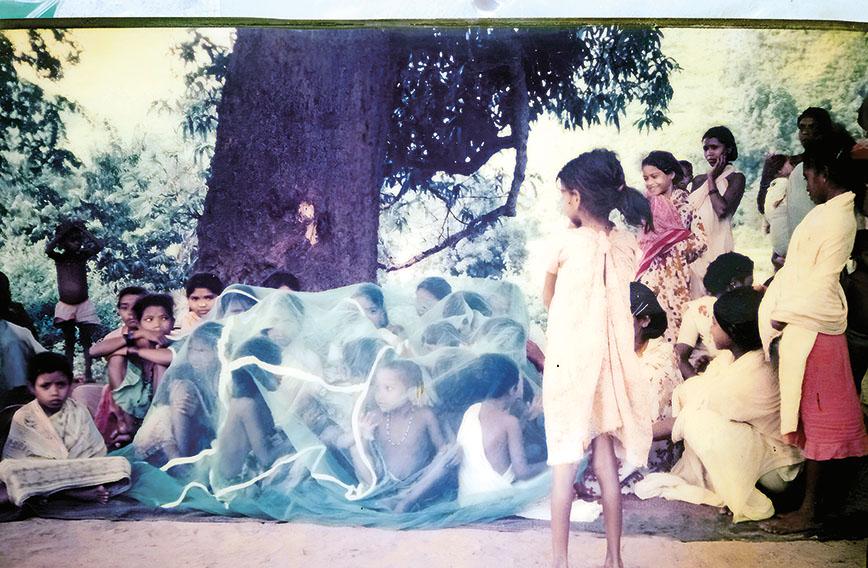
Children in mosquito nets. The People’s Movement Against Malaria brought down infant mortality
‘In community dreaming we found the answers we were looking for’
John Oommen
My wife, Mercy, and I are originally from Kerala. We grew up in Tamil Nadu, trained in Community Health and Maternity Nursing at Christian Medical College (CMC), Vellore, and then spent over 30 years, from 1993 to 2024, living and working at the Christian Hospital, Bissam Cuttack (CHB), in Rayagada district of Odisha. We retired and withdrew in June 2024. We now look back on those three decades to ask ourselves — What are the lessons learnt on primary healthcare?
For 29 years, I led the Mitra community health team of CHB, working with the people of 54 predominantly tribal villages. Over the years, I also served in the administration of the hospital — in human resources, finance, construction, maintenance. They are all part of the game, from leading board meetings to clearing blocked drains in heavy rains. I have had the opportunity to see life from multiple angles. Let me share some stories from the frontlines and some lessons and insights.
A secondary-care hospital with 200 beds, CHB's main focus is on four vital departments: Medicine, Surgery, Obstetrics-Gynaecology and Paediatrics. Every year, we serve over 75,000 outpatients and 14,000 inpatients, doing over 5,000 surgeries and 2,800 deliveries.

In 1993, when I first joined the community health work initiative, we were working with 38 tribal villages. Our team was mostly from the tribal community. We went only to villages that had invited us with a written resolution. Demand must drive supply. Roads were scarce. We walked sometimes 10 or 20 km, trekking village by village, carrying medicines in our knapsacks, offering healthcare.
Time and again, we would find desperately sick patients in remote villages who could only be saved in a decent hospital. We would rush them to CHB and support them as they recovered, following up on them through a network of community health nurses and village workers.
Primary healthcare is great, but you need the back-up of a secondary hospital to handle emergencies and more complex patients.
DATA IS KEY
I began providing care as I had been trained, assuming that the most important issues would be those related to mother and child health. In 1994, we placed a notebook in every village and called it the Swasthya Patta. We asked the villagers to record every pregnancy, birth and death in a simple, easy-to-do format. The data was collated monthly, and at the end of 1995, we were stunned by what it told us.
The Infant Mortality Rate (IMR) was 201 per thousand. The Under Five Mortality Rate was 350 per thousand. This meant that 35 percent of children were dying before they reached the age of five. And a third of all deaths in the community and in the hospital were due to fever, mostly malaria. But we were working hard to provide immunization for diseases like diphtheria and pertussis that did not even exist in this community.
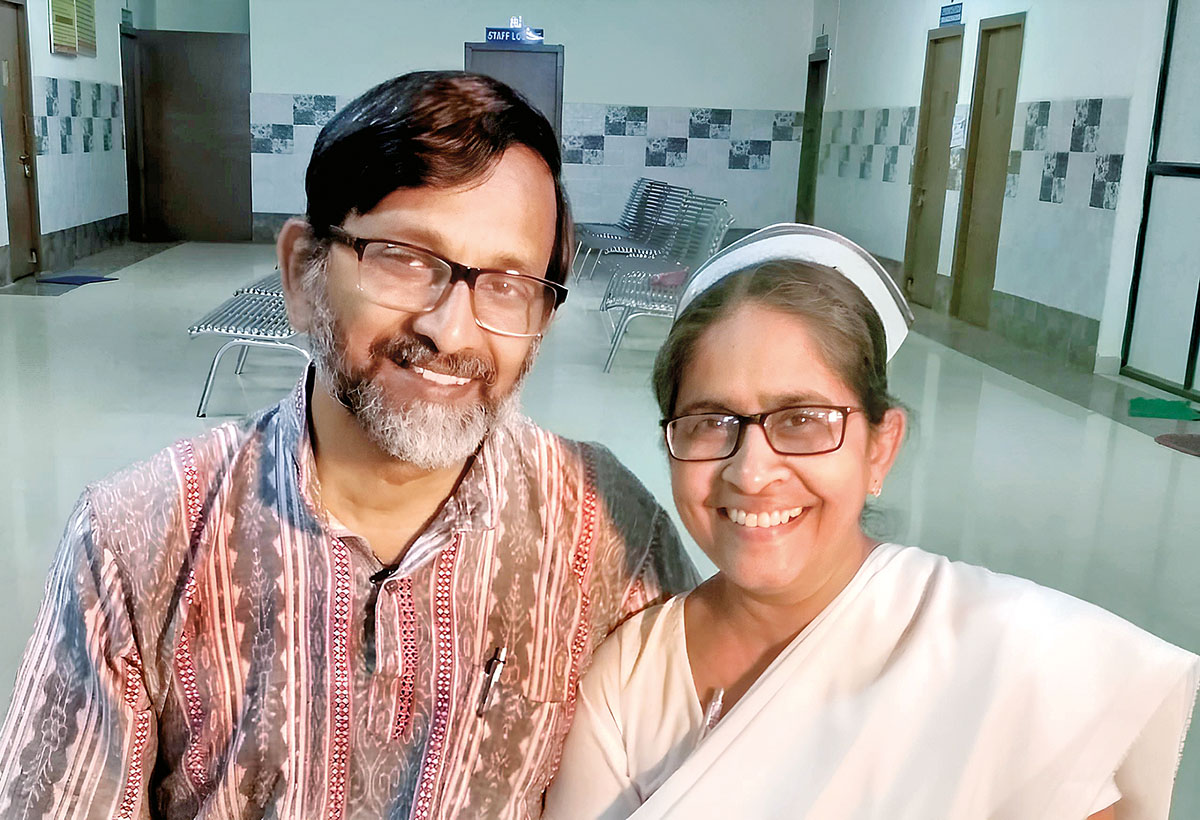 John and Mercy Oommen
The data forced us to focus on the real problems of the people we served. We launched the People’s Movement Against Malaria. And the indicators came crashing down.
This propensity to follow government orders from capital cities rather than recognize and address the real health priorities of the community continues today. In tribal health, the general consensus seems to be that the top health priorities have remained unchanged for decades — malaria, tuberculosis, sickle cell anaemia, malnutrition, and mother and child health (MCH) issues. We fail to see that the epidemiology of illness and death in the tribal community has expanded to add many others.
Our data shows that the most common diagnosis in adult males is now hypertension. The commonest cause of death is now Chronic Kidney Disease of unknown origin (CKDu). The rising cause of death in young men are road accidents. But the adult male is nobody’s priority in public health. Scrub Typhus is a very common and significant problem, but just not on the public health radar. Data must be valid, true and current. Data must be not only of utilization indicators, but also of outcomes.
COMMUNITY POWER
Back in 1996 we had been providing primary healthcare as we knew best in 38 tribal villages for three years. We would visit each village every 28 days, armed with vaccines, medicines and attractive toys — to get the children closer to the needles! But we would not do anything unless the village asked for it in writing, based on a resolution they had passed in their village meeting. It was necessary to protect them against our well-intentioned but sometimes misdirected priorities. Our definition of the zoo depends on the side of the bars we are on.
There is a village called Khumbia in Sahada panchayat which, at that time, had just 26 tribal families. It was way off the road. We had to walk a lot to get there. Not a single child was going to school. Literacy rates were in single digits. And they had not yet voted to accept our offer of immunization.
One month, when we reached Khumbia, we found that six children had died since our last visit four weeks earlier. Little children with whom we had played the previous month. All the stories sounded distinctly like post-measles bronchopneumonia. Completely preventable by a measles vaccine in infancy or a simple antibiotic for lung infection. But they were gone.
We sat down and cried. There was nothing else we could do. We knew we had failed. My MBBS and MD Community Medicine from CMC Vellore and all my great plans to save the world were futile. All we could do was cry with the community. As the tears eased, I realized that I had been trying to push them down the path I thought was best for them, whereas I was an outsider with little understanding of their lives and their culture.
A question formed in my heart and came out thus: “What is your dream for your village? For your children? What do you want your village to be like maybe 10 years from now?” There was an initial silence and then slowly ideas started flowing. A road. An irrigation canal. A school. Healthcare was not their top agenda.
HUT AND MEALS
After much discussion, it was decided to try Dream 3 (a school), as a key to the others. We volunteered the services of a young man who had studied up to Class 10, Jaysen Kumbrika, to live in their village for a year. The village agreed to host him, build him a hut and help him with meals. We would pay him a small honorarium. He moved in and started classes for children during the day, and adult literacy sessions at night. In one year, we saw transformation. Six children got admission to government residential schools. The whole village was energized. And even immunization coverage crossed 80 percent.
We learnt a precious lesson from Khumbia. Respect the community. Respect their knowledge base and priorities, their dreams and ideas. Help them make their dreams come true, rather than trying to force our assumptions and objectives down their throats.
Soon we were doing Community Dreaming Sessions in different villages and with different groups. Ideas poured in. We added some of our own too. And they got collated into four dreams that Mitra continues to pursue.
We dream that one day, all people will be healthy, all people will be educated, there will be no more poverty, no more hunger and all people will be able to live and die with dignity, regardless of caste, creed, gender or socio-economic status. A dream worth living for. A dream worth dying for.
The most vulnerable cluster of villages we worked with was in the Malkondh Hills, the border between Bissam Cuttack and Chandrapur blocks.
These two blocks had reported a negative growth rate between the Censuses of 1981 and 1991 of minus 10 percent and minus 8 percent respectively. And we were working in relationship with 16 Malkondh villages. The literacy rate was 7.6 percent. The female literacy rate was 1.2 percent. Only two people from these 16 villages had ever passed Class 10 in its history.
A Community Dreaming Session in the main village of Kachapaju in May 1997 changed everything. This village was different. Their dreams were not of roads or canals. They dreamt that one day there would be a Collector from their tribe, a doctor, an engineer, teachers, nurses, policemen, forest guards, drivers….
The village elder, Judhisti Saraka, threw cold water on these dreams. They all depend on education, he said, and the government school in our village functions only a few days a year when the teacher deigns to come to the school.
He then turned to me and said, “Give us a school like the one you studied in. Give us a school that is true to our culture, our religion, our language, an Adivasi school where children grow up proud of their parents and their tribal community. Do that, and these dreams may come true.”
I panicked. With an annual budget of `5 lakh in total, and a fear of long-term commitment, I felt this was sheer madness. I withdrew from the meeting with my tail between my legs.
But the school happened anyway. The 16 villages formed an association — The Malkondh Anchalika Sangho. They arm-twisted the Christian Hospital into partnering with them to make their dream school come true. It was in July 1998 that the Mitra Residential School, Kachapaju (MRSK) was born. In 2023-24, when the school and the community celebrated 25 years of MRSK, we found that over 700 children had been given a chance to live and learn at MRSK. Our nursing students undertook a study on the research question: Did the Dream of May 1997 come true?

We suddenly realized we were sitting on an accidental Randomized Control Trial with a stratified random sampling. We surveyed the birth cohort from the 16 villages who were now aged 18 to 32 years, comparing those who went to school and those who didn’t. The education achievement, and professional training were expectedly starkly different in the two 400-500 member cohorts. But what hit us in the solar plexus was an unexpected finding. The death rate among MRSK students was about two-and-a-half times lower than in those who didn’t go to school (1.5 versus 3.8 per thousand).
Tragic as it was, it validated what we had sensed and believed all along — that education is long-term medicine. Primary education does more for health status than healthcare itself.
I ask young doctors and medical students, whenever I get the chance: “Why do you do what you do? What do you want to get in the end? When you reach 60 and look back, what do you want to see? What difference will you have made?”
They ask us: Was it easy? We say no. But was it worthwhile? Oh, yes, absolutely! And if you have to choose between Easy and Worthwhile, which would you take? We would choose Worthwhile any day. For you can buy a mattress for `500,000. But if you do not get sleep, what is the use?
Comments
Currently there are no Comments. Be first to write a comment!