



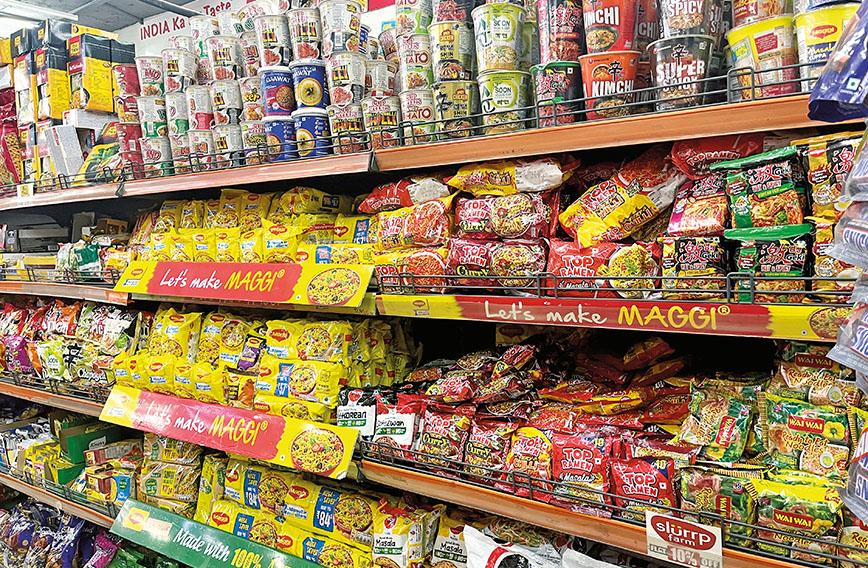
Restrictions on advertising junk food should be put in place
Experts, not companies, should be deciding nutrition policies
Arun Gupta
In 2013, I came across a paper published in The Lancet, 'Profits and Pandemics', which profoundly impacted my understanding of non-communicable diseases (NCDs) and their link to aggressive marketing of unhealthy commodities — alcohol, tobacco, and ultra-processed food products (UPFs). That was my first serious encounter with the term “ultra-processed foods”. I call them products.
Such food products are also known as HFSS or High in Fat, Sugar and Salt foods. They have addictive potential, and engineered formulations by a broken food matrix, designed to increase palatability, shelf life, and profits. All this at the cost of public health.
In the paper, transnational corporations were cited to be the major drivers of global epidemics of NCDs via the rise in sales of these unhealthy commodities in low-income and middle-income countries. The authors assessed the effectiveness of self-regulation, public–private partnerships (PPPs), and public regulation models of interaction with these industries.
They concluded that unhealthy commodity industries should have no role in the formation of national or international NCD policies. And that public regulations are the only evidence-based mechanisms to prevent the harm caused by unhealthy commodity industries.

Scientists continue to raise concerns about conflicts of interest in policy development. As one author wrote in a recent editorial, “There are so many solutions to the problems caused by these industries. But as long as industry is in the room when policies that affect them are being written, rates of commerciogenic disease will continue to grow unchecked.” I endorse this absolutely.
In 2013, India was still grappling with stubborn undernutrition indicators. Vested interests were pushing ‘nutrition products’ to treat babies. Prevention was nowhere to be seen. While that struggle remained unresolved, a silent wave of overweight, obesity, and diet-related NCDs began rising across India’s socio-economic strata with low-income groups seeming to be more affected. Obesity prevalence now stands at one in four adults. Promotion and marketing of UPFs is reported to be the leading cause of rising consumption and obesity.
THE BIRTH OF NAPi
Noting the push of nutrition products and the conflicts of interest in policy development, in 2016 I proposed forming a collective of independent experts to speak out on nutrition policy without corporate influence. That idea transmuted into a national think tank on nutrition called Nutrition Advocacy in Public Interest or NAPi. It consists of independent experts with decades of experience in epidemiology, human nutrition, community nutrition, paediatrics, medical education, administration, social work and management.
With support from the late Keshav Desiraju, former Union health secretary, and several like-minded professionals, we established NAPi under the aegis of the Breastfeeding Promotion Network of India (BPNI). I took on the role of convenor, and Desiraju graciously agreed to be our chairperson — remaining so until he passed away in 2021. This group, being voluntary and grounded in integrity, marked a turning point.
At the start, NAPi interns conducted a small 45-household survey in Delhi. They found that, despite knowing that UPFs were harmful, households still consumed them and one of the reasons was advertising. NAPi soon recognized that the public’s exposure to UPFs was largely shaped by advertising and celebrity endorsements.
We began publicly challenging prominent campaigns. One early success came when we raised concerns about a “Junior Horlicks” campaign on a TV channel. Following our advocacy, the campaign was withdrawn.
We began to write about UPFs, diets and regulations to curb UPF intake. The media graciously accepted our opinion pieces. One of the first, “Unseen Dangers of UPFs”, was translated into most Indian languages. We also began to fact-check UPF products and flag their risks.
We deepened our engagement with the global scientific community. Prof. Carlos Monteiro spoke in India, where he presented the foundational evidence behind the Nova Classification, developed by a team of researchers at the University of São Paulo, Brazil, led by him.
The Nova Classification reframed nutrition by categorizing foods based on the extent and purpose of processing rather than just nutrient content. Nova offered us a breakthrough tool to measure the impact of consumption and demand policies and regulations to control them. This perspective resonated powerfully with me.
In 2020, NAPi organized a global webinar on UPFs. It was attended by 350 participants from 63 countries. By then, scientific papers using Nova had begun to appear at an unprecedented pace. These developments galvanized us.
We connected with researcher Phil Baker at Deakin University in Australia and with those in Chile, Peru, Mexico and Argentina who were already regulating unhealthy foods through front-of-pack labelling (FOPL), marketing restrictions, and taxation. We decided to focus on influencing India’s food labelling policy.
ON THE GROUND
In 2021, NAPi formed a Working Group on Front-of-Pack Nutrition Labelling (FOPNL) of HFSS/UPF products. We developed a comprehensive ‘Policy Brief’ and facilitated a broad coalition of public health groups to launch a ‘Position Statement’ in 2022. This statement has now been updated and accepted for publication in a peer-reviewed journal. NAPi also issued critiques of policy and related statements.
Understanding the need for broader mobilization, we invited professionals and civil society members to join us. A network group, Public Health and Nutrition Advocacy, emerged with over 150 members. Dissemination of knowledge picked up speed.
Over the past few years, we have presented our analyses, our views on the risks of UPFs and their rising consumption, highlighting the need for regulation such as warning labels on the fronts of packaged food products and restrictions on advertising them — specifically if aimed at children.
Our efforts caught media attention at The Hindu, Hindustan Times, The Times of India, The Economic Times, and many other publications. Press briefings since 2021 have been drawing unprecedented attention, a testament to the urgency and credibility of the issue. The term “ultra-processed foods” has slowly entered public discourse in India. The narrative is now set.
We have written to every office concerned to adopt the right policy in the interest of public health. We even presented our concerns to the Scientific Committee of FSSAI (Food Safety and Standards Authority of India). But it did not help.
A draft decision on FOPNL was notified for public comment by the government. It was disappointing to see that the Government of India stuck to the ‘star rating’ system. Obviously, the food industry was happy and far from opposing it. The decision seemed to be biased in favour of the food industry. Experts did an extensive critique of the decision, and the study used to arrive at it. The draft decision seemed embedded with conflicts of interest.
EXPERTS JOIN IN
We amplified our campaign. Many experts joined in to write about these issues and shared their comments with the food authority, opposing the ‘star rating’ system.
The study, done by IIM Ahmedabad, on which this decision was based was found to be flawed in method and interpretation. However, we did not see any change. We mobilized many organizations to submit written comments to FSSAI on this policy.
We began to further analyze legal frameworks that impact advertising of UPFs. Despite three regulatory instruments that govern misleading advertising, UPF promotions continued unchecked. We identified the reasons laws were open to interpretations that benefitted industry. The term “misleading” was not objectively defined and that bothered us. Similarly, HFSS was also not defined.
While undertaking this exercise, we stumbled on the Ministry of Health and Family Welfare (MoHFW)’s National Multi-sector Plan of Action to Control NCDs (2017-2022), which contained precisely the actions we had been demanding and which had not been implemented: A clear ban on advertisements of HFSS food products, and an interpretative FOPNL.
We made numerous efforts to set in motion implementation of such regulations but have met with no success so far. We have written in peer-reviewed journals on why India should have these regulations. Our publications, The Junk Push (2023) and 50 Shades of Food Advertising (2024), documented how advertising targets children, promotes brand loyalty, and glamorizes unhealthy choices. We sought information under the Right to Information (RTI) Act, and learnt that progress on amending the laws had been halted.
We have been consistent in pointing out systemic conflicts of interest embedded in India’s regulatory framework. The Advertising Standards Council of India (ASCI), a self-regulatory body dominated by the advertising industry, is tasked with adjudicating complaints about misleading advertisements under the Advertisement Code of the Ministry of Information and Broadcasting.
Allowing food industry-aligned bodies to police themselves is not only ineffective, it undermines public health. We have objected to ‘stakeholder meetings’ called by FSSAI to develop regulations in which the majority of the participants are from the food industry.
In 2023, we were approached for technical support by 3S And Our Health, a Kerala-based civil society group. They filed a public interest litigation (PIL) in the Supreme Court urgently demanding mandatory warning labels. The court took a firm stand. It directed the Union government to act within three months and later extended it by another three months with a clear warning that further delays would not be tolerated. This legal momentum is a remarkable milestone.
TANGIBLE IMPACT
One of the most tangible impacts of our campaign has been the shaping of India’s public health narrative around UPFs and HFSS food products. The tide has begun to turn.
NAPi was invited to be a ‘member’ of an Interdepartmental Committee to prepare guidelines on protecting the consumer against unhealthy food products by the Ministry of Consumer Affairs. In 2024, we gave our inputs to the Indian Council of Medical Research-National Institute of Nutrition which issued “Dietary Guidelines for Indians”.
The guidelines define UPFs and High in Fat, Sugar and Salt (HFSS) food products. We note that the FSSAI and the Union Ministry of Health are increasingly using these terms.

The Economic Survey of 2024–25 cited our research and recommended strong mandatory warning labels and advertising restrictions on HFSS/UPF products and said no to self-regulation.
Despite the formidable lobbying power of the food and beverage industry, some gains are visible. The FSSAI has committed to coming up with definitions of HFSS food products. This is a critical building block for future regulation.
ONGOING BATTLE
Comprehensive advertising restrictions are the need of the hour. The scientific linkage between UPFs and rising obesity, diabetes and heart diseases is now firmly established. Evidence is growing by the day as more than 32 diseases have been linked to rising consumption of UPFs. New challenges are emerging in the form of free trade agreements that allow tariff-free entry to UPFs.
A forthcoming Lancet series on UPFs, which I am a part of, promises to further global understanding and accelerate action. We are also experimenting in schools in Delhi to empower them to read labels on food products. We have an increasing interest to link with agroecology experts to reduce the demand for UPFs/HFSS food products. We have begun to invoke the Right to Life and the Right to Health (Article 21) for this work.
Arun Gupta is a paediatrician and public health campaigner.
Comments
-

Narasimha Reddy Donthi - Sept. 13, 2025, 10:38 a.m.
this is wonderful work. We need more people to join, especially Doctors and other related subject experts, in this campaign. We need to target HPF products continuously.