



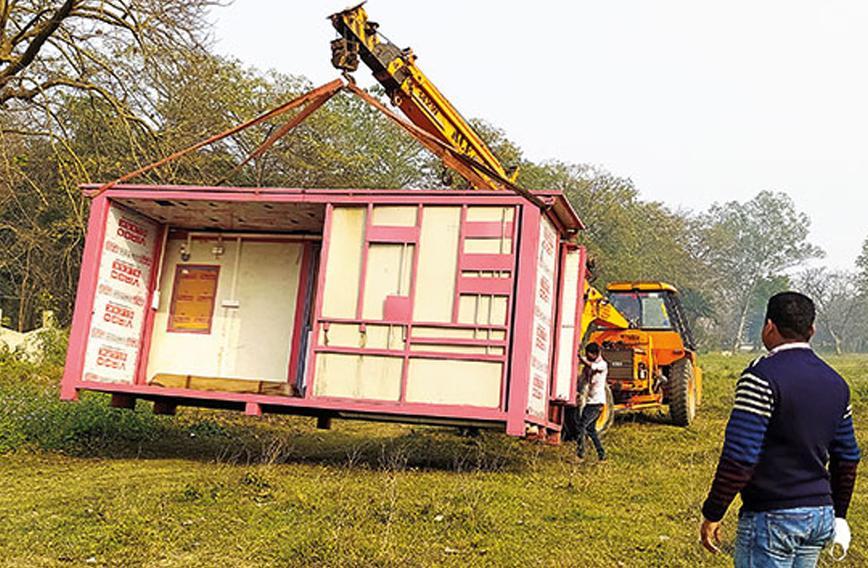
What is this? A hospital coming up in Muzaffarpur...
Time to put the basics of public health in place again
Rita and Umesh Anand
CHANCES are that you are wondering what the picture above is all about. Believe us, it is of a cancer hospital that was in the making in Muzaffarpur, Bihar. The cabins being hauled by the crane are the easily installable components of a hospital structure. They had come to Bihar all the way from Chennai where an IIT start-up devised the technology and design.
It was 2021, the pandemic was still around and the Muzaffarpur hospital project was two years behind schedule when it was decided to have a two-month deadline to speed up things. That seemed to be asking for the impossible. But technology for the ‘portable hospital’ from IIT Chennai came in handy.
The story we wrote back then was: ‘Muzaffarpur gets its cancer hospital on a truck from Chennai’. The hospital has since been up and running for a while, treating hundreds of patients and attracting competent physicians and surgeons to a part of the country where such a facility for treating cancer didn’t exist even as the number of cases grew.

Now cancer patients in that region of Bihar have an option and no longer have to go to cities. For those who couldn’t afford the journey the hospital gives them hope where none existed.
A backlog in healthcare hangs like a dark cloud over India. A growing economy needs healthy people. How can facilities and doctors be taken to places where they are needed most? How can medical treatment be made affordable and accessible to all?
A lesson starkly delivered by the pandemic was that no one is safe unless everyone is safe. It is important that the standards of care that the privileged enjoy be available to the majority.
To achieve such equality, there is no alternative to being in mission mode. After years of neglect, it is time to get down to basics. We have seen while doing stories that there is no substitute for innovation, zeal and passion. The medical profession needs a reset and a return to its core values.
But while all these are required in plenty, a big responsibility rests with governments to regard healthcare as an important social investment and attract talent. Without this, good doctors finally give up and succumb to the comforts of the private sector where the interests of public healthcare are at best narrowly served. Corporate hospitals being businesses, most of them listed, work for profit. What is needed is a system that embraces the millions who cannot afford to pay and lack the confidence to enter private facilities.
The Primary Health Centre (PHC) is the foundation of the healthcare system. It meets the innumerable small healthcare needs of people, identifies bigger problems deserving of referral to secondary and tertiary hospitals and serves as an antenna for disease outbreaks.
The PHC’s hallmark is its accessibility. Patients can reach it easily and it can reach them. Whether it is making sure tuberculosis patients take their medicines properly or identifying a cancer in its early stages, the PHC is invaluable. It also creates awareness about hygiene and nutrition. It manages lifestyle diseases like diabetes and hypertension.
The problem is that PHCs in most states have been neglected to the point where they barely function. Our health coverage in the past 22 years has been about spirited efforts in taking primary care to people. These efforts have been in the voluntary and government sectors. It has been a mix of initiatives, some by secondary hospitals that have been stepping in with primary care for communities because of the lack of functioning PHCs. How much better if the role of the PHC could be strengthened! Nicer still if successful examples could be showcased.
It was to this end that we decided to have primary care as the theme of this anniversary issue of our magazine. We succeeded in getting knowledgeable contributors who take us into the background, institutional role and functioning of PHCs. We also have inspiring first-hand accounts from doctors — Dr John Oommen, Dr Rajkumar Ramasamy, Dr Deepak Singh, and Dr Pavitra Mohan and Dr Sanjana B. Mohan. They have all worked long years in remote areas providing innovations which governments should look at while energizing the healthcare system in India. It is important to get down to such basics.
Kerala is, of course, always cited as an example of how PHCs should function as part of a larger healthcare system. Rajeev Sadanandan, former health secretary in Kerala, has traced the evolution of the Kerala model, the many reasons for its success and the gaps in the present system.

But we trekked to Noolpuzha village in Wayanad district to spend time at the PHC there. It must be Kerala’s most innovative and successful PHC. In nine years, Dr Dahar Mohammed, who went there on perhaps his second posting as a young government doctor, has turned the PHC into a state-of-the art facility which attracts patients from other panchayats as well. He has several innovative initiatives in nutrition, anaemia and rehabilitation with palliative care. He is supported by a spirited team.
Kerala shows us the advantages of decentrallization and political interest in public health. Better services have been bringing in votes which is why panchayats invest in PHCs in Kerala.
Alexander Thomas details the history of the PHC. R.A. Mashelkar unpacks innovations that make diagnostics cheaper and easily available. Kiran Karnik envisages what technology can do for the PHC. Soumya Swaminathan and Drishti Sharma write on health and nutrition. Anand Krishnan tells us about the learning from AIIMS’s Ballabgarh model PHC. Chandrakant Lahariya examines the role of the PHC during outbreaks in the context of the pandemic.
Primary healthcare deserves more attention than it has been getting. Our attempt is to create space for it in public discourse and prompt policymakers and politicians to act.
Comments
Currently there are no Comments. Be first to write a comment!