



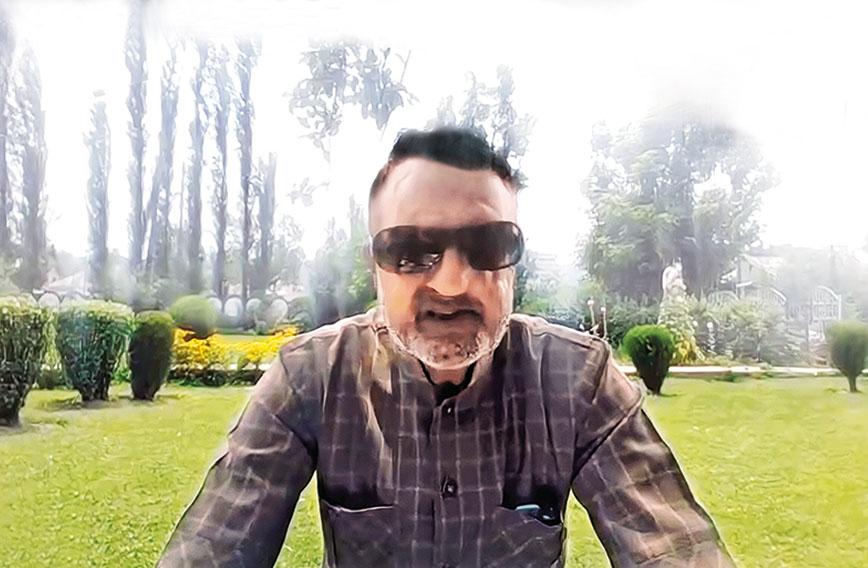
Bashir Ahmad Mir: ‘There should be an assessment of risk’
‘Border villages should be given special insurance’
Civil Society News, New Delhi
When the border with Pakistan heated up after the massacre of tourists in Pahalgam, people in villages on the Line of Control (LoC) were badly affected. They have long been accustomed to cross-border exchanges of fire and their lives have always been fraught with risk. But the drones, missiles and artillery shells that rained on them this time around were doing much more damage.
What they were experiencing didn’t make it to national headlines, but they were truly on the frontlines of the conflict. Lives were lost, cars and houses destroyed. Getting out of the villages for their own safety was the only way out, but it wasn’t easy.
When the guns fell silent, among those who went to see how these villages could be held was Bashir Ahmad Mir of the Human Aid Society.
Mir’s own story is very special. Many years ago, he was shot in the face by terrorists and left to die. Lucky to be alive, and after many rounds of treatment to restore his face and his sight, he set up the Human Aid Society to fight for peace. Incredibly, he chose to look after the orphaned children of terrorists who had been killed!
We got Mir on a zoom call from Baramulla to find out more about the plight of those villages on the LoC. A more humane voice we couldn’t have found. We should know because our association with him goes back 15 years when he was in the first Civil Society Hall of Fame.

Q: You have travelled to border villages to see for yourself the fallout of shelling, missiles and drone attacks during the conflict. What is your impression?
Actually, I would like to begin by talking about the impact of two incidents on the people of Kashmir — first the Pahalgam terror attack in Baisaran where 26 tourists and one local were killed, and then Operation Sindoor.
I am 60 years old. I have seen conflict since its inception in 1989. As you know, I was a victim too. But this is the first time I am seeing Kashmiris, regardless of religion, class or any other difference, protesting together against the terror attack in Baisaran. Before this people did not have the courage to protest.
When I was brutally attacked even my mother and my relative who was also an eyewitness could not summon the courage to speak up against anyone. But this time Kashmiris came onto the streets to protest. The attack worried Kashmiris. The second worry was when our innocent children, studying in universities and colleges across the country, were beaten up and harassed for no fault of theirs.
When Operation Sindoor took place, J&K was the most affected, especially our border areas in Kashmir. In Jammu, RS Pora and Pathankot were affected. But areas nearest to the border are in Kashmir. Three areas were badly hit: Uri, which is always in the line of fire, the second is Tangdhar, a village in Kupwara district, and the third is Poonch Rajouri in Jammu.
Q: Which places did you visit?
At that time, I thought about what my role should be as a concerned citizen. In times of conflict, it’s not organizations which count but individual responsibility. I convened a meeting because I realized people from border villages would start moving out of their homes and probably arrive in our area too. We constituted teams of our members to go to those areas to witness firsthand the damage taking place and reach out to people.
First, we went to Uri, about 40 km away and the closest. Our priority should be to help our neighbours first. It is our responsibility. They began coming to villages here. It became a challenge for us. We saw them as our guests and made suitable arrangements. Our auqaf committees looked around for homes which had an extra room for them.
Q: How many people sought shelter?
About 90 percent of people left their villages. Only the elderly, the disabled or those who were adamant on staying back, remained. I would say about 40,000 people were displaced. They did not all come to Baramulla. Some went to stay with relatives elsewhere.
On May 10, when the ceasefire was declared, we saw the destruction caused by shelling in Uri. About a dozen homes were utterly destroyed, reduced to rubble, several homes were partially destroyed, windows, doors, glass shattered. Because of shelling some houses caught fire and were burnt down. Those who sought shelter in Baramulla were mostly poor people living in the upper reaches of the border area. They had to leave everything behind including their livestock in the forested area where they live.
On May 13 we went to Tangdhar. In Uri there were no deaths except for one lady who was fleeing and got hit by a car on which a shell fell. In Tangdhar, more houses were damaged.
We saw a set of four houses owned by four brothers. All were accurately destroyed by shelling. They were located close to the army camp which was barely 100 metres away. I think the target was probably the army camp.
It’s difficult for us to go to Tangdhar. It is 165 km away. In Karnah village they have just one connecting road which is blocked by snow for five or six months every year. They told us, we die every day. They live in a sort of narrow pathway surrounded by hills. They said they were grateful that the weather was alright when the conflict took place. Otherwise, they would not have been able to move to a safer place. We have been telling the government for many years that a tunnel should be built from Sadhana Top to the Kupwara district headquarters. Local civilians and the army can use it. The army too finds it difficult to move around here.
Q: So, you need another route connecting this area?
Yes, and I have mentioned it in the report I sent to the prime minister. The good news is that the government has agreed and released the funds for the tunnel. Of course, we don’t know when work will begin, but the tunnel and the funds have been sanctioned by the government.
The government has built bunkers but to go into them is difficult. Shelling takes place all the time. For people to leave their villages and get to these bunkers is dangerous and difficult. People would prefer individual bunkers but if the government finds that financially unviable, then bunkers can be built at mohalla level. Wherever there are five or six houses together, a permanent bunker can be constructed because shelling is not a new development.
People have to put up with it every day. During the recent operation it was especially harsh, heavy and loud. We did not encounter this earlier.
Then we went to Poonch Rajouri. Not many properties were destroyed here, but there was loss of life. Surankote used to be regarded as the safest district, people told us. In fact, people from border districts would come here for shelter and safety. But this time Surankote was targeted. People here were even more fearful than those in the border villages, who have, you could say, seen it all now — shelling, missiles, drones.
Politicians and government officials visited Surankote. Yet people were relieved to see us, members of civil society. They were suffering from mental trauma. They wanted a sympathetic hearing. We met a man who sold bread. Shelling hit his home at night. His two daughters got buried under the rubble. They were rescued. We tried speaking to his daughter who was about 10 or 12 years old. Her hand was injured. She just couldn’t speak because she was completely traumatized.
We also visited the home of a maulvi, Muhammal Iqbal. The media had called him a terrorist. We met his fearful family. They said he had been their sole breadwinner. He has a handicapped son and small children. His family said no one is happy about the death of a family member; however, we are relieved he did not die in our house but 10 or 12 km away, if he had died here no one in the village would trust us because of the media’s fake news that he was a terrorist. He died in another place, those people were witnesses, so the family was mentally relieved.
We also met Mohammad Rameez. He was working in a school as a lab assistant. Rameez, his two children, Zoya and Zeen, were seriously wounded by shelling. The children died. He was taken to Jammu Medical Hospital. His wife, with the help of local people, read the janaaza, buried her children, and then went straight to fulfil her duty to her husband. She didn’t tell him their children had passed away. He came to know later.
The videos that were spread caused Naseem Akhtar, wife of Azam Malik, to die of a heart attack on May 19. Fake news and videos are adding to people’s trauma.
I have requested the government to arrange for mental counselling. Displaced people have returned to their villages after the ceasefire. But they live in a heightened state of trauma all the time.
Q: What else should be done for people in the border villages?
They have been given a compensation of `130,000 by the government. It is too little. It will cost people close to `200,000 to just clear all the rubble of their destroyed houses. The government is also giving `6,500 for repairs of partially damaged homes. But to just fix one glass costs at least `1,000. The windows are invariably broken. You need to pay the karigar as well.
Third, in Tangdhar and Poonch many commercial vehicles and private ones were badly damaged. People depend on them for their livelihood. They are insured but the companies are delaying payments. They say the damage is due to war, though our country did not declare war. It was an operation. No sirens went off. Emergency was not declared.
Q: War insurance has been mooted for border villages. What is your opinion on this proposal?
If we have a war in our area, and I hope it never happens, the damage will be so extensive the insurance companies will not be able to pay up or settle all the claims. Also, very few people take insurance. They will benefit but war affects everyone. What about the majority?
In my opinion, border villages, even without war, live in a perpetual state of war. Insurance should cover the entire area. There should be an assessment of risk. In what range are people located from grenades, guns, golas, etc.
Q: How many people are insured?
Very few, maybe one or two percent.
Q: What do they take insurance for?
For vehicles and houses. You buy a car on loan, then you have to take car insurance to ply it on the road. About one or two percent of house owners also opt for property insurance and life insurance.
Q: But does property insurance cover damage due to shelling?
No, it does not. If a vehicle is damaged due to shelling, the insurance company does not accept the claim.

Q: If a person is injured due to shelling, does the company accept the claim?
During this operation the insurance companies did not settle claims, saying it was a war. But prior to this, they used to pay for smaller injuries and took premiums too. Now they say insurance does not cover war.
Q: What would you suggest as a solution?
My suggestion is that regarding cars which have been insured and for which people have been paying premiums, insurance companies should pay 100 percent without any delay. Those cars have been burnt or broken or are in a state of disrepair. For people it is their livelihood. It is not a large number.
Another suggestion I have is that companies like Jio or Bajaj could perhaps under their CSR (Corporate Social Responsibility) programmes choose one area and repair maybe 10 houses. In Uri, about 60 houses have been damaged or ruined. The NHPC (formerly National Hydroelectric Power Corporation) is working there on a hydel power project. They can carry out a survey and finance two or three rooms for people who have lost their homes.
Q: What would the population of affected people be in these border areas?
Roughly 200,000 to 300,000.
Q: Can people perhaps build their homes differently so that less damage is done by shelling?
Homes here are built on pillars on slopes and safe basements can be built. There are places where vehicles can’t reach and material is sent on headloads. But that will merely increase costs to some extent. For those living right on the border the government needs to identify places where safe shelters can be built. These are their traditional hereditary lands which they will not leave. Some villages, especially in Karnah and Uri, are so close that if someone puts on a light across the border, its beams are visible here.
Q: Are there health facilities available?
Our state is dotted with health facilities. We have sub-centres and small dispensaries, about one or two km away from settlements. We need to strengthen and equip them. The infrastructure has been built by the government.
They need to look at it and fill the gaps after an assessment of what’s missing. Health facilities are needed round the year. It’s not always a bullet injury that requires urgent attention. It could be routine ailments. Or first aid requirements. My suggestion is to hire local medical staff for the centres because they live here and know the situation. If a person appointed to a health centre in a border village lives in Srinagar or Baramulla, he may not come if he hears the situation is bad here. A relaxation in transfer policy is needed.
Q: Are there any other recommendations you’d like to make?
Yes. Videos and fake news frighten people and must not be allowed to circulate on social media. For the past 30 years some of us have seen bullets and bodies so you could say our minds have been hardened. But there are people who have not been exposed to all this. One video is enough to frighten them to death. It creates panic. And then we find out that the story or the video circulating is fake.
The government has also offered employment to some of those affected by the conflict. My request is to set aside age limits. Some of them have small children or old parents to support. Maybe the person’s age is a little over the limit. Also, loans taken for commercial vehicles or houses that have been damaged should be waived. ν
Comments
-

Primila Lewisl - Aug. 2, 2025, 4:56 p.m.
I have known Bashir Mirji and his Human Aid Society for almost 20 years. We have worked together to develop the Society under Bashir’s dedicated and tireless leadership starting in Baramulla and gradually expanding into other areas. Bashir and his dedicated team have grown in strength, courage and commitment despite many hurdles and challenges. They are an example to all who claim to work for the common people. I have read this interview from distant Oxford. I salute Bashir and his colleagues. May they continue their efforts with support from all those who stand with the poor and downtrodden and for peace.