



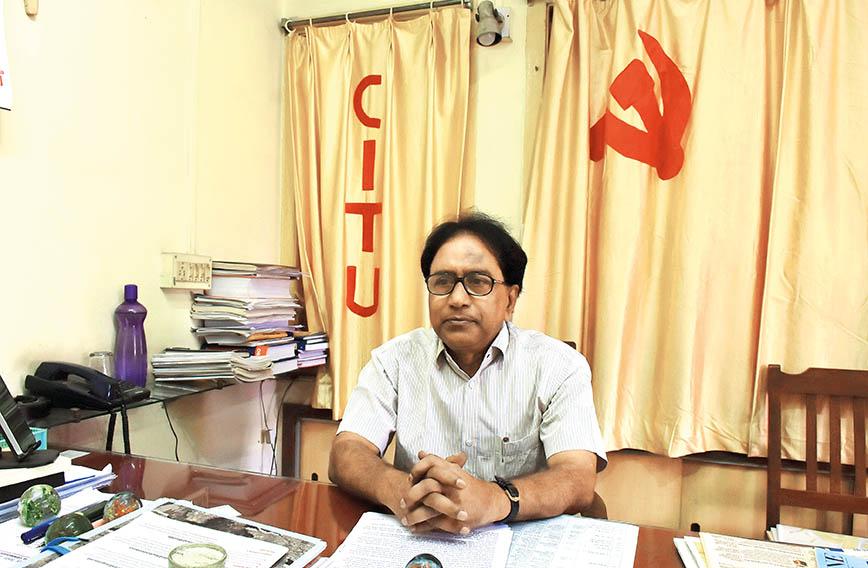
Ziaul Alam: ‘The SME sector is the backbone of employment’ | Civil Society picture/Ashoke Chakrabarty
‘Every worker should earn Rs 26,000 a month’
Aiema Tauheed, Kolkata
There is simmering resentment among workers across categories over sparse wages, poor safety standards and living conditions. Left parties hold the view that the Union government’s four Labour Codes — on wages, social security, occupational safety, health and working conditions — will not make things better.
Civil Society spoke to Ziaul Alam, general secretary, Centre of Indian Trade Unions (CITU), aligned with the Communist Party of India (Marxist), on what lies ahead.
Q: You have been critical of the Labour Codes notified by the Union government. But do you have any effective counter-strategy, apart from some protests?
We’ve engaged with these Labour Codes since 2020, from the time they were placed in Parliament. We thought that the philosophy behind it was ease of doing business, as the prime minister put it. But ease of doing business must balance with ease of living.
Since 2020, across India, there is sporadic unrest among workers because the Union government has paralyzed the functions of the labour department, the labour courts and tribunals handling labour cases. As a result, labourers, workers, employees don’t have any forum to present their grievances.
You cannot dismantle this tripartite consultation mechanism at every level and hide the principal employer to ensure ease of doing business. Bring them to the table because workers are working for the overall turnover of the company.
In most sectors, the turnover or profit, before tax or after tax, is going up. That’s how so many billionaires are being added every year in India. But where does profit maximization come from? It comes from the effort of the workers.
So why should they not demand or feel that since the enterprise is growing, their living conditions should improve too? This is the main conflict.
Q: How is CITU trying to restore this tripartite system?
All 10 central trade unions, including CITU and even the Bharatiya Mazdoor Sangh (BMS), are engaging with this issue. It is to sensitize employers and understand whether they want to come under the ambit of the Labour Codes.
In most sectors, the actual employer or management feels that without consultation with workers, “We cannot run the factory even for one hour.” Because the workers contribute the most to ensure the factory functions.
We will continue to do what we did in the past at shopfloor level, at company level and at enterprise level. Without that tripartite forum, how will you decide what percentage the bonus rate should be? Should it be 16 or 20 percent? Consultation is needed.
In the production process, particularly in manufacturing and organized service sectors, consultation is a must.
It is meaningless to say that with this number of workers such provisions will be activated and beyond 300 you will have different rights.
The supply chain consists of many enterprises. At every layer they employ multiple numbers of workers. It could be five or 150. Even for marketing, you deploy promoters, advertisers, promotion and sales agencies. There are workers in shops and retail outlets too. So workers at every stage are important contributors, which actual employers do not deny.
CITU has formed sectoral teams to study what was going on before the Labour Codes and what is happening after them. What has emerged is that most workers and actual employers want consultation.
We also wrote a letter to the Union government pointing out that since 2015 the Indian Labour Conference, which was scheduled to be held every year and was inaugurated by the prime minister, has not been convened. What is the reason?
Q: What is the alternative you are offering to workers in terms of minimum wages, safety, housing benefits, and social security? Will you include education and health? Currently a worker spends a considerable part of his/her sparse earnings on all that.
What we have studied and calculated — and this is our first demand — is that no worker family can survive without wages of less than Rs 26,000 per month across India. This is the benchmark.
Whether we are talking about a worker on contract, a temporary worker or casual worker, without Rs 26,000 the worker’s family cannot meet the costs of education, health, food, housing. Alongside there must be a dearness allowance component to take on the consequential effect of inflation in every quarter.
Segregate and enlist the sectors which are rising, are profitable, important, and strategic, where different forms of skills are needed, and sectors which depend on multi-layered supply chains. Depending on the skill, hardship and hazards required, the scale of wages should be determined.
Three types of scaling — unskilled, semi-skilled and skilled — do not match with emerging, evolving and changing sectors where we are adopting more science, technology and machinery.
For ITI (Industrial Training Institute) and technical graduates you cannot just pay Rs 13,000 or Rs 20,000. You cannot say you are not getting any value addition. They are adding value due to their technical training.
Secondly, in any job or employment, there must be a defined employer-employee relationship, which is stated in the appointment letter. Almost 50 to 60 percent of workers don’t have defined employer-employee relationship. The worker or employee must receive an appointment letter ratified by the principal employer.
The employer cannot just say, “Don’t come from tomorrow.” Workers must be given a show-cause letter and the worker or employee should be given space to reply.
Whether you employ someone for one month, or three months or as an independent worker, the appointment letter is a must.
Also, in some places, workers carry identification cards with only the name of the contractor or the firm which has employed them. Not right. The principal employer and the company’s name must be on that identification card, because they are getting the service provided by the worker.
Q: On the issue of wages, industries — especially the SME sector — could object. Would you make wages elastic, depending on the sector’s ability to pay?
Actually, SME sectors employ more than 50 percent of the workforce in our country. These are the main labour-intensive sectors.
The SME sector is the backbone of employment. No big firm can operate without SMEs in the supply chain. It is a very important and strategic sector.
At micro-level, in household enterprises, families do part of the finished work, whether it is garments, leather products, etc. Because of this, many products that are widely used are comparatively cheap in India. Without high establishment costs, they are part of the supply chain which supplies to the big firms.
There must be a security- and safety-sensitive policy by the government for such sectors. The rate for electricity charges must not be the same as for the big firms, as it is currently.
Family micro enterprises must have a safety net for food, housing, children’s education and medical needs, along with wages. Multiple agencies of the government need to step in — women and child departments, education, skilling, marketing, etc.
China adopted this policy and they deliver unfinished products at a cheap rate.
For most micro-level enterprises, the family head is also the worker. Over the years he or she sometimes recruits neighbours for some jobs. This is not a typical employer-employee relationship. They are all owners. But reducing their costs and safeguarding their infrastructure is required.
Small firms need capital and land. The work is clearly defined. The owner of the firm employs around 10 to 15 workers but has no resources for training, skilling or adopting good machines. So financial support by the government is required.
Medium enterprises employ 100-plus workers. In small and medium sectors, almost 100 percent of workers are on contract. You will find the same workers working there for 20 or 25 years.
But since they are on contract, the employer avoids many social security clauses. The relevant Labour Code is undefined and hazy where the contractual worker is concerned.
Ownership of responsibility comes automatically if employment is assured. That is the main cause of unrest among contractual workers.
In the 1960s, till the 1980s, in the public sector the government employed about five lakh permanent workers. Today that figure has shrunk to less than a lakh. But the overall number of workers engaged on contract has increased to 12 lakh.
What the government is trying to do is evade workers’ lawful entitlements and their right to enjoy secured lawful entitlements.
The labour court says it is the employer’s prerogative to hire people on a temporary or permanent basis.
The work is the same but the names of the workers are not. They are employed for six months and before they become eligible for certain entitlements like bonus you oust them. That bonus is not a liability for the employer.
Q: According to the Labour Code you can’t announce a strike as long as the management is in dialogue. What can a trade union do in such a situation?
We do not take permission from the employer or the government when we go on strike. It depends on the employer-employee relationship, whether the employer is a government enterprise or a private one, big enterprise or a small or medium one.
If negotiations fail, and there is no provision in the code by which the government can sensitise the employer to be fair to workers, then we don't need any permission from anyone to sell our labour or skills.
Q: What are the difficulties you face in unionizing workers in an industrial belt?
In new upcoming sectors, there is a vacuum. A growing number of workers are engaged in the gig economy, but neither the Union nor state governments have formulated any policy defining employer-employee relations, workers’ rights, employers’ responsibilities or employers’ rights.
Only a few states — Jharkhand, Karnataka, Tamil Nadu, Rajasthan, Kerala — have introduced some sort of text for discussion. But the gig economy itself is rising, particularly post-Covid. So we are forming unions. Sometimes the government tries to obstruct us. They are giving us many clauses to fulfil eligibility requirements.
Domestic work, care work, elder work, childcare work are all services serving the economy. There must be provisions and legislation for their safety, security, pay, leave, medical, etc. It is absent.
In so far as conciliation, bargaining and discussion are concerned, all labour officers — whether assistant, additional or deputy — were designated as commissioners. That means their role was quasi-judicial.
But the Labour Code has converted them into facilitators. That means they have no power to take legal action. You are just reducing their importance.
Q: How important is broader solidarity in your fight for farmer-worker rights?
We have formed the Samyukta Kisan Morcha which has 500 to 600 farmer unions. We have the All India Agricultural Workers Union.
We are also reaching out to slum dwellers, as the government has not yet framed policies for them. We want to draw a clear line between the government, that is pro-big business, and the have-nots.
Comments
Currently there are no Comments. Be first to write a comment!