



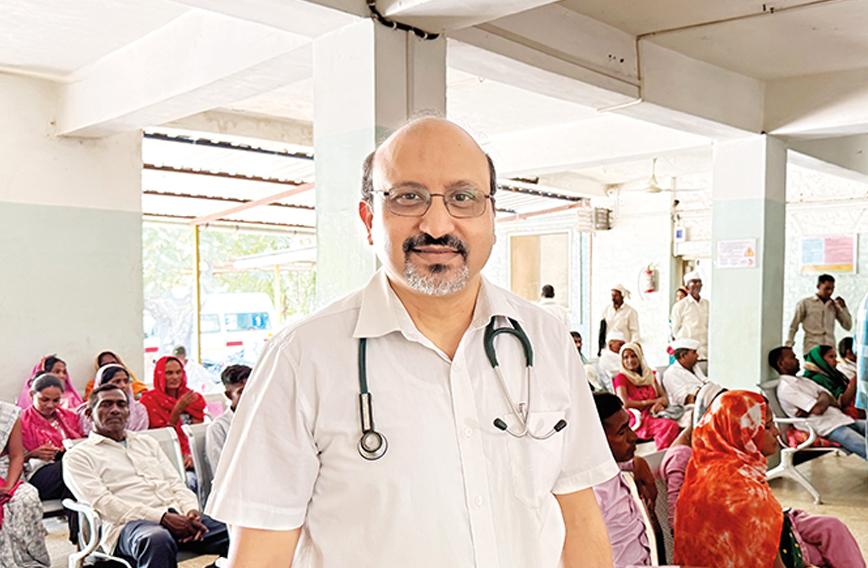
Dr Deepak Singh: ‘The impact of our hospitals can’t be measured in standard ways’
‘Healthcare should be high quality at a low cost’
Civil Society News, New Delhi
The hospital business is booming. Doctors are demanding and getting astronomical paychecks and commissions. For millions of Indians, however, accessible medical facilities with reliable and affordable services are still a distant dream.
It is clearly time for a reset of the system. Several small hospitals with public-spirited doctors have shown that it is possible to bring down costs and provide quality care. They remain true to the original values of their profession and serve those who need them most.
The Emmanuel Hospital Association (EHA) is one such fellowship of physicians and surgeons. They run 20 hospitals in remote corners of the country. We spoke to Dr Deepak Singh, executive director of EHA, on their alternative model for public healthcare.
Q: How many people do the Emmanuel Hospitals serve? Collectively, what would their catchment be?
The association has been in existence since 1969. We started off with five hospitals. In these five decades we have had an impact in underserved areas. But we don’t measure our impact in terms of numbers because we are small compared to the requirements of the population.

In terms of catchment, our Chinchpada hospital serves people over a 300-km radius which would be about two million people. All the 20 hospitals taken together, you could say, have a catchment of 40 million.
Chinchpada, which is a small 50-bed hospital, sees about 30,000 outpatients and treats about 4,000 inpatients in a year.
Across 19 locations, we see close to 900,000 outpatients and treat about 80,000 inpatients in our facilities. Apart from that, we have a big community engagement initiative which takes care of close to 450,000 direct beneficiaries.
Q: People whose homes you go to?
Yes. We reach out to the community. We are talking about mental health. We are talking about palliative care. We are talking about home-based disability rehabilitation.
Q: Do you function in an integrated way as a chain of 20 hospitals? What is the model?
The model has a hedge kind of structure. You have an outer hedge, which is the EHA. Then, you have regions where there are a certain number of hospitals. And then there is the hospital unit itself. It is a very interdependent model. We have a lot of policies which are central and executed across all our locations, including our community health projects.
Our salary structure remains the same. All our protective policies also remain the same. We have a feedback mechanism. The hospital and the community projects convey feedback into the chain higher up and the chain then conveys feedback from the top as well.
But we try to maintain more of a bottom-up relationship, rather than a top-down one. Dictation comes mainly from what is happening in our ground operations rather than an official from the top trying to talk down to the units.
Q: So it’s a loosely structured system within one identity. What then is the shared identity of the Emmanuel Hospitals?
What is common is our vision, which is a fellowship for transformation through caring. We work as teams, so that we can see transformation first in ourselves, then in the teams that we work with, and then in the communities that we serve. We base our transformation on the care we are able to provide with our hospital services or through our outreach or palliative care services.
Two things that matter to us are righteousness and justice. We are a faith-based organization, so the definition of righteousness for us is nurturing the right relationships between people. We have a right relationship with God, we have a right relationship with ourselves, and we have a right relationship with the community.
And justice. This is about restorative justice to people who are in need, people who are vulnerable, people who do not have anything, people who are on the margins.
Q: Is this something on which there is no compromise across all your 20 hospitals?
Yes. This is what we hold dear and this is the foundation we build on.
Q: How do you judge the success of a hospital and evaluate its performance?
It is an interesting question because there are the tangibles and the non-tangibles. There are things that we can measure like the numbers of people we are able to reach out to in the community.
But I think the non-tangibles are transformative. One example I’d like to give you is of our palliative care. When we started reaching out to these families, who were steeped in so much trouble, in so much sorrow and pain, we realized that they think that cancer is an untouchable disease.
People from the community would not go near the person who was suffering, including people from the family. And that has slowly changed. We have been able to bring about awareness that cancer is a regular disease.
Another example I can cite is of a person with leprosy who had come to our hospital. He had a toe which, you know, was disintegrating. We put him up on the examination couch. One of our doctors just held his foot and dressed his toe and he began weeping. He said nobody had touched him before. It was the first time in his life that a doctor or healthcare worker touched him.
Similarly, for a lot of people with mental health needs, it’s quite bad out there. In villages, mental health is sometimes thought of as being possessed by a demon.
We have seen people being brought to our hospitals in chains, literally, bound onto beds. Slowly, with care, medication and counselling, these people can live a normal life.
The impact of our hospitals therefore can’t be measured in standard ways.
Q: Hospitals in the private sector are especially focused on numbers — quarterly, half-yearly, annual. Do you do this at all?
We do use such forms of assessment, but in a very different way. We see how many people have accessed our services, what our numbers are, how many people come in, how many people pay their bills.
The private hospitals have investors whose expectations they must meet. But for us, the investment comes from our patients. We use money from the people who pay for those who cannot pay and need to be subsidized or treated free. A number we underline is how much of our total revenue has been used to treat patients who cannot pay.
Again, for most private hospitals, the focus would be on profits. They have to produce numbers that would be able to maintain not only standards, but also pay staff.
But for us, more and more of our hospitals are dependent not on profit, but on how to break even based on what we charge.
Thirdly, we try to assess how low-cost we can be at all times. It is not about reaching the highest number we can charge, but the lowest number we can charge while maintaining services and taking care of patients. These are probably the three ways in which we differ from most private hospitals.
Q: But there will be a common minimum standard that you would follow in terms of the standard of healthcare that you offer. How do you define that? What is the base?
In healthcare, that is very difficult to define because you could be like a Mayo Clinic and still not be doing healthcare at all. Or you could be the poorest hospital and doing the best.
The definition I go by is that the poor deserve the best. What is available in a good hospital should be available to a poor person — simple diagnostics, inpatient care, surgical services, ICU care. What takes care of their most difficult diseases is my definition of the base.
The poor have the most complicated diseases. If anybody comes into a hospital with any kind of illness, we should be able to take care of them. That is the base.
Of course, there are some sub-specialties which we may not be able to take care of, like cardiothoracic surgery or neurosurgery, because these are very high-end. But the others, yes.
Q: What this means is that the whole country actually pays much more for health services than they need to.
There are several aspects to it. What we’ve also realized, and we’re doing a study on it, is that the government actually spends much more than some not-for-profit hospitals on the healthcare that they provide because the cost of their human resources is very, very high.
Q: Do you think there is a need to reassess the way healthcare gets charged?
I think there has to be a change in attitude. I believe that to provide quality low-cost healthcare to the most needy in society, not only does the service need to be low-cost, the service provider too needs to be low-cost.
Now, I don’t mean that the service provider becomes poor. What I mean is that the service provider takes what he actually needs and not what he imagines he needs.
I think that is the challenge with healthcare because as the medical profession becomes more and more sub-specialized, charges are becoming higher and higher. As a sub-specialist I can charge `1,200 for a consultation, but I can also do it for `20.
Let’s find a middle ground, is what I would suggest. A reassessment is probably required not only of knowledge and practices, but also of attitudes to see what the main need is.
Q: Doesn’t this, in a sense, go back to the foundations of the profession?
Definitely. The cost of hiring doctors and providing services keeps rising. Who has answers for the people who are at the bottom of the rung in our pyramid? I believe it is the government that has those answers, along with public-spirited healthcare services.
Therefore, we need to re-anchor the profession, whether it is private, corporate-driven, public-spirited or government into what is actually needed and what is the direction in which the country is to be taken. We have to ask whether what we are doing is need-based or are we basing it on the needs of the healthcare provider.
Q: How do we establish that?
Diagnostics is an example. A terminal
cancer case comes into a hospital and a CT scan is done. But is it really required? In a hospital like ours we don’t do it because the scan in such a case is only academic. So, is it ethical? Is it moral to actually do that scan and put them through that expense and that radiation? I don’t think so. I’m just giving an example.
Q: Should there be new and affordable protocols for what needs to be done?
Yes and no. There is an ideal in medicine. This is what we should be doing. And then there is what we need to do, you know, and there may be small and big gaps in between.
I would probably suggest here that we do what we need to do for people without means. And we do what we can do for people with means. If there is a person with less means who would not be able to go through the entire protocol, I would then avoid doing what is not necessary.
Q: Is there a need to reset the ideal?
Yes and no. Again, the ideal is set by research papers which are mainly based in the West. All that research which goes on in the West is based on populations which are very, very different from ours. Now, if we were to implement that research in our own context, it has to be handled differently. We are not the same. We are different in a lot of ways.

Q: Are you saying we need an Indian ideal?
Yes, we do need an Indian ideal but it should be based on evidence. It cannot be anecdotal.
Q: When you took over at the Chinchpada Christian Medical Hospital, you found it in terrible shape. In 14 years, you made it sustainable.
Yeah, but one of the terms we truly are not very keen on is sustainability. That is a word which probably means a lot of things without actually having any impact.
If you look at it in terms of healthcare, then sustainability means that you have an X number of people, you have X revenue, and X profit. In our context, you will probably have an X number of patients who are in need. That is always a constant, and probably just going to keep increasing exponentially. That is what I see.
But do we have an X number of service providers? No, the ideal is never there. It is always based on a skeletal team which works hard in these locations. Then when it comes to revenue, again, the costs are so low that the revenue just meets our operations and is almost never enough.
Therefore, for sustainability, there are two things that we rely on — volumes on one side to be able to manage our operations and funding on the other side to be able to keep the facility in terms of technology and so on up to date.
We have been blessed by people who have stood by us over the years. And then, of course, there are philanthropies like the Azim Premji Foundation, that we’re really grateful to,
the Tata Trusts and our overseas partners. So, yes, sustainability for us includes both aspects — fundraising as well as the volumes that we do.
Comments
Currently there are no Comments. Be first to write a comment!