



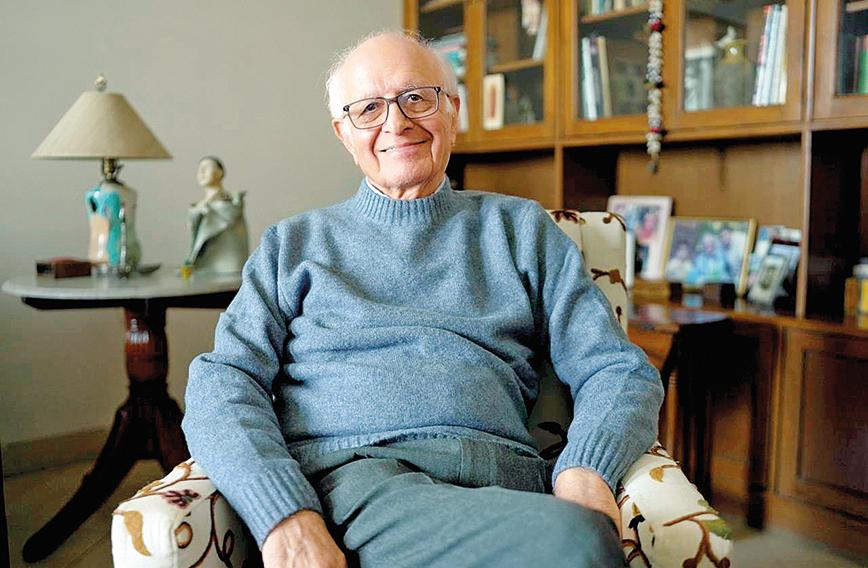
Arun Maira: 'CSR is a convenient cop-out for companies. A company's purpose in law is to maximise profits for its investors.'
‘The World Bank-IMF crowd has nothing new to offer India’
Civil Society News, Gurugram
Anyone witnessing the presentation of the Union Budget would have noticed how much of an industry-related exercise it is. The government bends over backwards in pleasing corporations. Businessmen flood TV channels, trying to outdo each other in fawning over the finance minister and the prime minister.
Since reforms began, India’s growth story has been scripted as some kind of matinee show with TRP-driving budget telecasts ensuring that people continue buying tickets. Arun Maira’s is one of the few voices that seeks an overhaul. Having spent a career in the corporate sector, he believes that the reason for inequality is the stranglehold that corporations have over society. The limited liability company, he says, needs to be redesigned so that it serves society and not merely investors and shareholders.
As a young man, Maira set out to serve the country. Instead of joining the IAS, he ended up in the Tata Administrative Service. In those days being in a Tata company was not very different to serving the country. On TELCO’s shopfloors he mastered learning and listening — from workmen who would be helped to acquire better skills and move up in life.
Maira would like policymakers to similarly learn and listen a lot more from ordinary people about what matters to them instead of pursuing reforms through subterfuge cheered on by moneyed interests. His recent book, Reimagining India’s Economy: The Road to a More Equitable Society, provides valuable insights into the challenges the country faces in meaningfully bringing people out of poverty. It shouldn’t be just jobs, but good jobs. Not just education, but skills and critical thinking.

In all fairness we must tell our readers that in this magazine we are on Maira’s side. He is a member of our Advisory Board. Apart from his corporate life, Maira has also served in the Planning Commission. It makes him specially interesting as an insider with a difference. Read below an extract from a conversation with Maira at his Gurugram home.
Q: The headlines are all about how GDP is going up and poverty is coming down with India on its way to being the third largest economy in the world. You, however, seem to have serious concerns. What worries you?
The growth we are experiencing is not solving the problems of India. It is not inclusive and it is not environmentally sustainable. It is making a few people rich and even very rich but the vast majority are being left out. It is important, therefore, not just to tinker with the Indian economy but reimagine it.
The GDP can only measure what is economically measurable. We want more women in the workforce so that their wages can contribute to the GDP. But the work they do in their households, farms, for their families is not counted. We talk of the demographic dividend but where are the jobs that the young can do?
If poverty is going down, by what measure is it so? India fares poorly in terms of inclusion, growth creating good jobs and growth at cost to the environment not only in relation to the developed world but also comparable countries.
Q: The cover of your book has an image of a man and a woman, both labourers, carrying clusters of high-rise buildings on their heads. The building we are sitting in right now could be one of them. So, where should we begin challenging our concepts of economic growth?
We should begin by talking to the people for whom policies are ostensibly intended. What do they want? What will work for them? Our planners, our economists and policymakers have preconceived ideas. They don’t talk to people and learn from them.
The chief economic advisers we've had since 1991 (except the present one), and some before Rajiv Gandhi's time, have all been educated in Oxford, Cambridge, or US universities, and most of them have done stints with the World Bank and IMF. Look at the history.
When Mr Modi says we are slaves to Macaulay it is not just about using English, but (importing) ideas about growth and economics which aren’t rooted in Indian realities. We’ve had a crowd of people continuing who are always beholden to those ideas. NITI Aayog has the same set of people, beginning with (Arvind) Panagariya as vice-chairman.
Q: Mr Modi set out to change that but the orientation of his government is no different. GDP remains the rope trick it has always been. We should be looking more closely at AQI.
We should but we are not. I think your question is why are we not. The previous government wasn’t doing things right and we are still not. So why not, is the question. Let me answer it. I’m saying there should be a change in the thinking of the persons who are responsible for measuring whether the economy is doing all right. But these persons continue to come from the same Washington-IMF crowd.
In the run-up to the 2014 elections, Mr Modi touted the Gujarat model for the rest of India. A book on the Gujarat model was written by none other than Jagdish Bhagwati and Arvind Panagariya.
At that time, they were loudly, especially Bhagwati, insulting Amartya Sen for the Nobel that he got, which was about human development and its indicators. And Amartya Sen’s whole philosophy was to build the capabilities of people, enable them to build their own capabilities, and they will build your nation and your economy.
That means primary education and primary health must be universally and freely available and equitably the same for all. And, therefore, the implication is that privatization of health and education is a no-no for a society that’s going to be improving equity and giving equal chances to all.
Q: But you were in the Planning Commission.
When Dr Manmohan Singh, as prime minister, invited me to join the Planning Commission, I said, ‘Who, me? What do I know about the Planning Commission?’ I was on holiday in Europe with my wife when I received the call. I had decided I had had enough of being on company boards. Of course I felt honoured and accepted. But when I met him as a formality before joining, I said I hoped he hadn’t got the wrong Maira because I wasn’t an economist.
He said, ‘No, no, I know you. I have read you.’ And he pulled out from his shelf my book, Transforming Capitalism: Improving the World for Everyone (which was published by you from Civil Society). ‘I’m inviting you because you’re not an economist. You seem to be reflecting on the situation of common people’ — and that was his concern.
He said that, as the head of a government, one must be concerned about those who don’t have power, who don’t have money, not about those who already have made so much.
Sonia Gandhi won an election by questioning the India Shining slogan of the BJP. When the Congress appointed Dr Manmohan Singh as prime minister, industry felt reassured that they had their man, a celebrated reformer and economist. And yet when they invited Dr Singh to CII's annual summit, he lectured the industry leaders assembled on the need for a new social compact.
So, here was the architect of India’s economic liberalization in 1991, who when he was chosen as prime minister had raised hopes in industry that India would move closer to the capitalist, free-market economies, saying to CII that our whole model of growth since 1991, which is industry-led, was not delivering results for the people.
In the Planning Commission, we had this big thing about PPP (public-private partnership). Yeah, education may be PPP. Health is PPP. Urbanization, PPP. Why? Two reasons. One is, yes, the government itself is short of resources, financial resources. So, invite capital markets and the private sector to put money in. Two, the private sector is more efficient. See, we’ve got public sector stuff and they don’t do it as well.
In PPP, public is the government in collaboration with private entities, but where are the people in deciding what the objective of a project should be?
In cities like Delhi, we make flyovers and highways and all the rest. And then say we have become modern like Singapore or somewhere else. But in that you begin to exclude people from our vision of what a good country is. Pedestrians, cyclists and even three-wheelers are kept out.
It’s for the benefit of whom? Saving the time of people who in any case have more time. Right here in Gurugram we have a fancy road connecting the highway to fancy buildings like the Aralias and Camelias. But ordinary people, maids, for example, who used to work on both sides of the road earlier and could easily cross can no longer do so. For whom is this place designed? It is designed for us. Not for the whole city. We’re leaving out the people we count on to support our fancy lifestyles by not considering how they will live, how they will work, how they will travel all together.
Q: Is the stranglehold of companies too great?
It is, it is. Tech companies are controlling the world because they control all mediums of communication.
Q: Is there a need for a better social compact?
You cannot have it. CSR is a convenient cop-out for companies. A company's purpose in law is to maximise profits for its investors. It’s a limited liability corporation that is not fully liable for the effect that its profit-making has on society and on the environment. This idea of a limited liability corporation is the seed of the problem. It’s a matter of redesigning institutions. Humanity progresses by designing vehicles in which to carry itself to its aspirations. Those vehicles are institutions.
We, in civil society, have kept on perpetuating the power of the corporation by saying it’s perfectly all right, you do what you do but give some of your money back to us.

When the law on CSR was being drafted in India, I had joined the Planning Commission. I found out from the Ministry of Corporate Affairs, which Salman Khurshid was in charge of, that they were announcing some CSR law.
I told Montek that I would be writing to Salman opposing the idea. Montek said that it wasn’t the custom to write directly and what was wrong with the idea, anyway?
The idea got passed. Politicians loved it. Most corporations loved it. They could now say, ‘You leave us alone to make our profits.’
Q: What you are suggesting is the need to change the legal structure of the corporation?
Unless you change the legal structure of the corporation that is engaging with society, it will not pay attention (to the needs of society). I’ve been an independent director on the boards of the finest companies — Tata and Godrej, Birla and Mahindra. And I found that this is the dilemma all the directors have. As an independent director, I would sign off on my fiduciary responsibility when I became a director that I was obliged to make the corporation, not society, survive.
Q: What should the legal structure of the corporation be?
People who do the work should be able to get the fruits of their labour including the surpluses. The wealth created in the process should be theirs, not just the income. We talk of a circular economy. Let’s look at circular wealth. Currently, what is happening is that financial wealth is increasing, labour’s wealth or the people’s wealth is either static or is actually being sucked out. The people, by their work, should be able to own wealth. Now the only way they can do that is if they are owners of their enterprise.
Q: Do you really ever see this happening?
In India, we had and have the idea of cooperative ownership. There is the example of Amul. Look at the prosperity it has created. If there is a Gujarat model, it is this. So, you need cooperative enterprises where people who work are the owners of the enterprise. They take decisions by consensus. They have accounts as clearly laid out as the limited liability company. But, control over what should be done with the surplus is with the collective of workers and not with the investors.
And this is where Mahatma Gandhi said something very, very wise. He said he was not a subscriber to communism or capitalism. In both systems the power to take responsibility for the work they do and enjoy the fruits of their labour is not with the people who actually do the work.
(Edited version to better reflect Arun Maira’s comments.)
Comments
Currently there are no Comments. Be first to write a comment!