



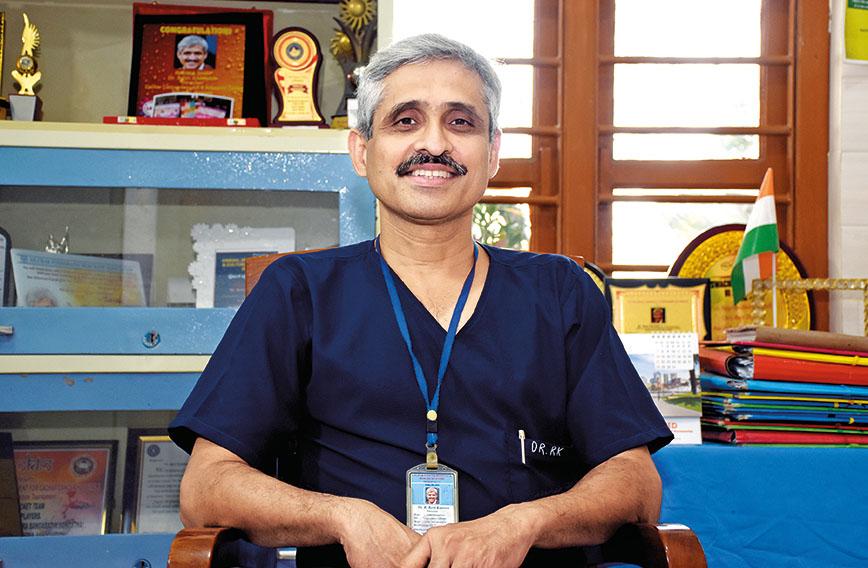
Dr Ravi Kannan: ‘Assam has done well because it has spread out its cancer centres’
‘Survival after cancer is tougher for the poor’
Civil Society News, New Delhi
When Dr Ravi Kannan signed up with the Cachar Cancer Hospital in 2006, he was an accomplished surgeon based in Chennai. The shift to a remote corner of Assam was a conscious choice to take his skills where they were needed most.
The Cachar hospital had been set up with donations a decade earlier because no such facility existed in those parts. Now, roughly 20 years after Dr Kannan joined, it is a bustling facility with a staff of 500 of whom 18 are well-qualified doctors.
Cancer is a troubling cloud over India’s public health horizons. The rich and middle class have access to the care they need. But the poor, both in cities and rural areas, struggle to cope.
Surviving cancer has become easier. But being a cancer survivor is a tough number. It requires savings, stable employment, access to nutrition, mental strength and social support.
Not surprisingly, the poor lose out even though they are the most affected. Hospitals like the one Dr Kannan runs in Assam are needed in multiples.
On a busy day, we spoke to Dr Kannan late in the evening after a long day of surgeries and OPD consultations.
Q: You were in your OPD before this interview. Who were your patients?
Our patients are extremely poor and take a lot of trouble travelling to this hospital in Silchar. Our policy is to see them the same day no matter what time it is. The OPD often runs late, till 8 pm or 9 pm.
Q: And you have an OPD in the morning?
It’s from 9 am and open all day.
Q: What kind of cancers are you seeing? Which are the predominant ones?
A lot of tobacco-related cancers, head and neck, oesophagus, and lung. And then in women, we see breast cancer, cervical cancer, gallbladder cancer.
Q: And how many cancer cases in a year does your hospital see?
We see about 5,000 new patients and around 30,000 follow-up patients. All of them may not be cancers. Cancers will be about 3,000.
Q: This hospital existed before you got here.
Yeah, much before.
Q: And it was set up because there weren’t any facilities at the time.
Right.
Q: How much of a difference does this one hospital make now?
It is no longer one hospital. The Tata Trusts have created a Section 8 company with the government of Assam and they have what are called Assam Cancer Care Foundation Hospitals. They’re looking at having, I think, 14 hospitals across the region. They have one in Silchar too. Assam has a population of about 40 million. The state sees about 50,000 new patients every year.
Guwahati has many cancer centres now. Earlier there was only the Barua Cancer Centre. Now, in the medical college they have a State Cancer Centre. There are also a number of private cancer centres. The volume of patients is enough to keep many hospitals busy. If every hospital were to focus on the patient at hand, this is a problem that can be well tackled.
Q: So, are you saying it is possible to catch up with the incidence of cancer in the Northeast?
Yes, yes. See, unlike in many parts of the country where the number of patients far outnumbers the resources available, it is not the scenario here. We have enough. But there is tremendous poverty. And so, the need to support patients is very high. Many patients are daily wage earners. When they come to the hospital, they lose their earnings.
If they have to come to the hospital again and again, which is often the case with cancer treatment, there is a loss in their daily income. Then they have to spend money on transport, on staying somewhere, food, and also make sure people at home are cared for. At the same time, they have to ensure the patient is cared for as well.
Often patients report late because these challenges are huge. As a result, outcomes are poor. If only patients would report on time, if only our community outreach would be stronger, if only early detection programmes could be implemented across the region, outcomes would be much better.
We have a smaller population in the Northeast compared to other parts of the country, around 50 million. The number of new cancer cases would be between 50,000 and 60,000 annually.
It is not a big problem to take care of 60,000 cancer patients in a year, because we have cancer centres in almost every northeastern state now.
Q: It is manageable provided you have these facilities up and running and meeting the needs of the patients.
Correct. A smaller population is the advantage we have compared to other parts of the country. But then there are barriers because of geography, weather and travel. I think if we put our minds together, these barriers can be surmounted.
Q: So how should people be putting their minds together? What is the strategy?
See, Assam has done particularly well because it has spread out its cancer centres. Each centre should invest time and effort in its own communities. They could go out, create awareness about cancers, create opportunities for early detection closer to homes, work with sub-centres and Primary Health Centres (PHCs) and all the medical infrastructure that is available across the region.
They should be disseminating information about the resources available so that patients are reassured that they don’t have to be put out of pocket to get themselves investigated and treated.
In addition to what the government provides, each of these cancer centres can reach out to local communities for food, for shelter. They will all be willing to donate small amounts of money, say, Rs 2,000 to Rs 5,000, to get some simple tests done. There will be money.
So, if every cancer centre will take it upon itself to serve the communities they are located in, I think together we can make a huge difference. We can do what other parts of the country have not been able to do.
Q: Does your hospital do outreach?
We have a very large community presence in several districts around us. We are trying to decentralize. One of the things about cancer care is that if patients have to come again and again, which they need to for follow-ups, they will drop out. So, what we are trying to do, in addition to this hospital in Silchar, is to set up a hospital in Dharmanagar which is in North Tripura. We are looking at putting up a hospital in western Manipur. And then around each of these hospitals, we will have satellite centres.
For major decisions, they may have to come to the main hospital, but they can go to the satellites for chemotherapy, for palliative care, follow-up, and diagnosis. Each of these satellites will be supported by what we call PEP facilities — Prevention, Early detection and Palliative care.
These are one-man shows — one trained health worker on a two-wheeler goes to homes. This actually started off with the purpose of providing home care to people who are dying but are too sick to come to the hospital — basically, palliative care.
But then we expanded it because when we go to homes in villages, the community collects to see what is this tamasha happening. They’re a captive audience. It becomes an opportunity to talk to them about lifestyles, signs of cancer and symptoms.
We also have a questionnaire. As a result, for every 1,000 people we address, we spot one or five people with cancers. It becomes an opportunity for us to educate people and encourage early detection. We also tell them the PEP team will visit the homes of people who are on intense care.
A patient I have operated on and sent home with sutures and a drain doesn’t have to come back to have the sutures removed. Somebody will go to their home and do it.
The fourth thing we’re doing is to have active follow-up of patients we have treated. Many people don’t come back to the hospital. We will go to the homes of such people to make sure they are well and don’t have symptoms. If they have symptoms, we encourage them to come to the hospital. Fifthly, with the PEP programme we are trying to improve voluntary blood donation.
Q: Is communication a challenge?
Communication means basically talking again and again, using language that people can understand. Essentially, we are reassuring people that if there is a problem and it can be detected early, it is curable. To get detected early and treated, they don’t have to lose their property, homes and cows. There is support available from the community, the government, and hospitals.
People also need to be helped to understand that healthcare is their right. It is not a favour that an organization or doctor is bestowing on them.
Healthcare is a basic human right and the doctor is paid a salary. The doctor is not doing anybody a favour by treating somebody. They should be treated well and respectfully. Nobody has any right to misbehave with them.
Q: To what extent is the environment a cause of cancers?
I think the bulk of it here is due to lifestyle, use of tobacco, alcohol, areca nut, dietary preferences and practices, amount of physical activity, some infections and inflammations. Generally, the community is physically pretty active. The cancers that we see here are all predominantly traditional cancers that are linked to tobacco or alcohol.
Q: What is the survival rate for the poor after they undergo treatment?
If patients are treated appropriately and, apart from drugs and surgery, they are given physiotherapy, nutrition and rehabilitated well, the cure rate should be the same as amongst the rich.
But amongst poorer communities, cure rates will not be the same because they are undernourished and have a lot of comorbidities. They approach the hospital for treatment late and often defer treatment or default during treatment. Therefore, survival rates amongst poor people are lower.
Q: What effect does cancer treatment have on people with low incomes?
The poor are mostly on daily wages. When the breadwinner has to go to the hospital over and over again either for himself or someone else, there is no income. Kids drop out of school. More than 40 to 50 percent of them will not go back to school.
Several generations are impacted by cancer, heart disease or a major neurological problem. The other thing is, we treat a patient, he or she gets cured, but almost 80 percent of them will not go back to productive employment. For whatever reason, they are unable to restart earning.
Education and livelihoods are very intimately related. If we don’t pay attention to these, we would actually end up doing more harm than good without even realizing it.
Today I was talking to a patient. She had come with her daughter who is not even 15 years old. I asked her where her father was. She said he had gone to work. They were from Karimganj. The father goes to work in Haflong, in another district. He’s a daily wage earner. He has a respiratory illness which prevents him from working on many days. I asked her how many siblings she has. She replied that she has two brothers. The mother explained that the elder one works in a hotel in Bengaluru. So, I said, let me talk to him. I wanted to because the mother has a bad cancer. She said the boy is only 15 years old. I asked how, then, did he go to Bengaluru to work? She said her sister's son also works there and he took him along to work.
This 15-year-old boy is supporting the family. The third child is in Class 2. The girl is now in Class 7 or 8. We come to know because we ask.
I would need to tell the social worker this woman will probably die. The father is unwell. The brother in Bengaluru is unlikely to go back to school. He was in Class 7 when they sent him to work.
I would also tell the social worker that we somehow have to protect this child’s innocence and ensure she goes to school so that she doesn’t lose opportunities in life. And the younger brother continues to study. How do we safeguard them while taking care of her mother? These are the issues that we have to grapple with.
Q: Cancer treatments have quite an impact on the body. People can’t go back to physical labour quite so easily. When is somebody really cured?
It is very, very difficult especially in poorer communities. They have a lot of muscle wasting. Their muscles have to be built back. It is very difficult for someone who has been out of employment for two years to suddenly get up and start working.
Q: Is survival from cancer a privilege only the rich enjoy? There are so many cancer survivors who might as well be dead.
Many patients who are doing well are likely to be from affluent communities who have had good support, good care, who are not nutritionally compromised before we start treatment. They have access to good nutrition during treatment. Of course, their own mental strength cannot be underrated.
Q: The quality of survival is what we should be looking at here.
In rich communities too the emotional trauma cannot be minimized, but at least the physical component can be better handled.
Q: There are poorer people with greater determination to come back into active life who recover much better?
Correct.
Q: It is often argued that we should be spending more on healthcare. Should we be looking at spending more money on helping people live better as part of our healthcare policy instead of just focusing on treatment in hospital?
We need to spend a lot more energy and time on promoting health which is at present a low budget activity. The returns in terms of diseases prevented and livelihoods lost will be far more than in treating illnesses. I think as a nation our scientific minds, legal minds, economic minds and our will should be used for health promotion.
Cancer occurs because of tobacco, alcohol, dietary practices, lack of physical activity, and some infections and inflammations. Heart attacks occur because of tobacco, alcohol, dietary practices, lack of exercise. Stroke occurs because blood vessels in the brain get blocked or they rupture.
So many non-communicable diseases have the same etiological practice. When you go about preventing cancer, you’ll also prevent heart disease, stroke, reduce diabetes, and hypertension. You’ll promote overall health much more.
Q: Cancer treatment figures prominently in the business plans of corporate hospitals. Cancer specialists are paid much more in the private sector. Why will they go to the public sector or remote areas?
There are cancer hospitals in several cities across the Northeast. Most of them are in the public sector or with non-profits like ours. Most corporate facilities are centred around Guwahati, the biggest city here.
I think if the government were to plan its resource allocation in terms of specialists, they would be more equitably distributed. As the number of specialists grow they will out of necessity move from Tier 1 to Tier 2 cities, and to rural areas. It will happen on its own.
Q: They will be the ones who couldn’t get jobs in the city.
It doesn’t matter. Healthcare requires good knowledge, not extraordinary brilliance. There are protocols for the management of blood sugar, hypertension and so on. We have protocols for managing most stages of cancers.
We also now have what is called the National Cancer Grid. We have about 350 cancer centres across the country. We have also come up with India-specific guidelines — what cannot be compromised, what is ideal to have and what is good, if you have the resources.
Where cure is concerned there is no compromise. Where you’re looking at some improvement in quality of life or some increase in survival. As a nation we can take care of our sick people much better than we are right now.
Comments
-

Sampreeti Purohit - May 11, 2026, 2:13 p.m.
For the poor (and the added disadvantage of being residents outside of the "mainland India"), it is unfortunate that diluted focus is given on disease detection awareness and post recovery care. Awareness regarding symptoms, detection and confidence to demand healthcare as a right must be boosted, since, a disease this expensive adversely affects all members of the family and directly ruins any possibility to escape their vicious cycle of poverty.
-
Harmala Gupta - May 1, 2026, 2:06 p.m.
Cancer treatment requires care that extends to every aspect of a patient’s life. The needs of family members too must be addressed. At CanSupport we do just that. It is about meeting patients whete they are and not about where we want them to be. Dr Kannan has the right philosophy of care.