




Adil Rustomjee: ‘As long as people are behind the buy buttons, there will be swings’
‘The little guy much safer now in the stock market’
Civil Society News, New Delhi
More ordinary Indians engage with the stock market than ever before. They are egged on by government policies, influencers on social media and television, bankers acting as agents for funds and the freedom to make instant decisions through apps.
Technology makes it super easy now to put savings into shares. But for all the proximity that the market has to people, it remains nonetheless an enigma. Its ups and downs are tricky to second guess. A phantom seems to orchestrate its movements.
One reason for the market being a mystery is that it is dominated by traders and analysts who comprise a club all their own. There has been little effort to tell the story of the market by bringing its history alive and placing it in the context of social and economic developments.
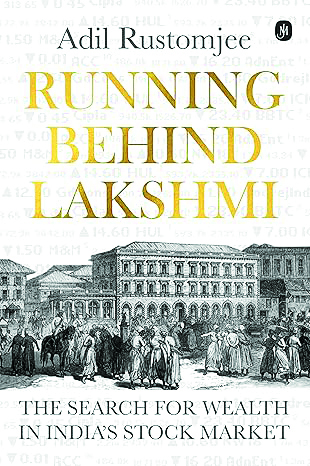 But one effort at doing so is now available in a 1,000-page history of the Bombay Stock Exchange: Running Behind Lakshmi.
Adil Rustomjee, an investment adviser, has worked assiduously on stringing together primary and secondary sources. He has brought past and present together in a lucid, often humorous, account of how the market works.
Interestingly, Rustomjee tells us that regulation and all the backend work that goes into assessing companies and choosing stocks actually makes the market safer for small investors. A lot of the ground work is being routinely done for them — even though making sense of those flickering screens may be just as tough as decoding old-style signalling by brokers on the stock market floor.
Q: Your book begins with India’s first bull market, the Cotton and Share Mania in 1865. Many present-day bubbles and manias have been similar to that one though 150 years have elapsed. Is it that nothing has intrinsically changed in the way markets are made and collapse?
Your question goes to the heart of that stock market cliché: “This time it’s different.” The issue is what changes and what remains the same. There is no easy answer to that.

Interest rates matter in all this, but the inverse connection between them and markets cannot be taken for granted; in India, bulls and bears have happened across a range of interest rates. Corporate profits matter, and yet price earnings ratios can change so much that the market’s price can justify a wide range of corporate profits.
Displacements seem to matter too — cotton, railways, radio, transistors, internet, and now AI. The fact that there is a displacement does not change, though the nature of the displacement changes.
My chapter on the software mania of the late 1990s uses the analogy of the tsunami — causing fishing boats to bob about in the open ocean as it passes under them, but leading to a huge tidal wave as it approaches shore. A displacement (and especially one caused by technological change) is a little like that, causing the venture capital/private equity crowd to bob about, while leading to a huge wave as it crashes on a market shore.
Across global markets, what does not change much is the human element. As long as people are behind the buy buttons, there will be these swings. The wide range over which markets value the moves in interest rates, profits, and displacements, implies that this human element is still quite strong. I show this for a single emerging market, but these themes are universal.
Vicarious exposure through the accounts of others at least makes the participant aware that much of this has happened before. This can be a source of comfort, to a certain temperament. The human element comes into outline in the book, but whether that translates into better decision-making in the present will depend on many things, with the usual variation in outcomes.
Q: If investing in the stock market remains a game of chance, where does that leave the small investor who shows up with precious savings? Are they as vulnerable as the small investor 150 years ago? Or have regulation and IT made the market safer and more transparent?
On balance, the small trader/investor has been the biggest beneficiary of all these changes. Remember, if we’re talking about the democratization of market activity, that, by definition, has to have benefited the little guy.
Here it is useful to separate the activities of trading and investing (handled by a market intermediary’s front office) from what happens behind all those flickering prices you see on the screen (handled by their back office).
There is a large amount of work behind those flickering prices collectively grouped under the rubrics of clearing and settlement, compliance, etc, that is handled by a back office. Before the 1990s, these areas were a hit and miss affair, but the reform to the microstructure has sorted them out. So much so that nowadays people take a clean market for granted, but it was not always like that.
So, this has led to benefits going unambiguously to the public. It has reduced the chanciness of dealing with a dodgy broker, or of non-completion on a routine transaction. That element of back-office chance has gone for the small investor and this is a huge achievement compared to the past.
Actual market risk, the chance/risk of buying high and selling low, the hazards that come from trading and investing as the public interfaces with the intermediary’s front office will remain. But it reduces if the diversification habit catches on; the spread of the SIP product has also reduced the urge to time the market. But most important to curbing chance is curbing the trading/speculative itch as the chapter on storming or laying siege to Lakshmi demonstrates.
So, regulation and tech have done away with back-office risks (in large measure) but cannot, by definition, deal with market risk, which always remains.
Q: The Indian stock market has grown manifold, especially after economic reforms. What drives it? Speculation or investment?
In previous generations, speculation was so pervasive that investing would have been seen as eccentric. Now there is an even balance between both activities in the modern Indian market that not many have noticed.
A certain amount of speculation is vital for any market. After all, if everybody put away their shares in demat accounts after being allotted them at IPOs, there would be no market. It is speculation (or its euphemism, trading) that builds the thick order books the modern buy side of mutual funds/LIC, etc. thrives on. More technically, electronic limit order books (ELOBs), those little screens you see on your computer, don’t have specialists behind them i.e. dealers who make markets in those counters. In the specialist absence, it is speculation that leads to that most vital of outcomes — the thick order books that bring about price continuity over time.
Yet the market gets more investment-oriented with each passing year. This is due to the spread of the mutual fund industry and rupee cost averaging products like the SIP. Stock picking and the search for value are also inherently investment driven activities. Long pull trades of six to 12 months combine elements of speculation and investment, and are surprisingly common among the Indian buy side.
An unrecognized irony is that the speculative element seems to have increased in the modern era, mainly because of the rise of a colossal derivatives segment, the world’s largest by some measures (like numbers of contracts traded). The aim of the reform effort was actually to bring down the speculative element by abolishing badla. But the rise of a substitute product, derivatives, put paid to that aim. The public’s need for a leveraged product is simply too strong and your friendly neighbourhood broker is always at hand to encourage that need. So, today’s market allows full play for both approaches and this distinguishes it from earlier times.
Q: It is common to equate the rise in markets with the robustness of the economy. Is it really so? As a researcher, what does history tell you about the interplay between the stock market and the national economy?
This is a vital question. Traditionally, the stock market was to be a barometer for the real economy, soaring or swooning if it sensed better or worse times ahead. (But always times “ahead”, rather than in the present moment, because of the discounting function.) The market is usually slotted into the list of Leading Economic Indicators (LEIs).
The market should reflect the real side, but that is becoming rare nowadays. That connection was tenuous in the past and, surprisingly, continues to be so.
Part of the problem has to do with what we call The Market itself. It’s usually taken to be an index, but these are narrowly constructed in India. The Nifty has 50 and the Sensex has 30 stocks, while the universe nowadays is about 3,000 stocks that trade on a (more or less) regular basis. Broader indexes exist, but are rarely taken to be “The Market”, because of past habit.
Besides, there are entire sectors like agriculture that are underrepresented in the universe, let alone the narrowly constructed indexes.
Lags also matter and these can be long and variable, making connections and interplays with the real economy difficult to discern.
There seems to be a trinity of Sentiment, Value, and Liquidity that comes into play. “The Market” evaluates the real economy through The Value leg’s discounting function. But remember Sentiment and Liquidity act as confounding elements, and especially at the great turning points.
Broadly, as I show in the book, Indian markets are biased long because of the long corner, the absence of a short selling product, hazy uptick rules, and the absence of global diversification. So rather than sense the real economy cooling (and falling as a result), they simply keep moving along. This was most apparent in the early years of the ongoing SIP Bull, and more dramatically during the Covid break and pullback.
Q: In your book you spend some time on the Keynesian beauty contest. Picking not the prettiest contestant but the one that will most likely appeal to a lot of people. Tell us about that.
The Keynesian beauty contest is a standard way to describe stock picking in liquidity constrained markets. The idea is to select counters that others fancy, because the money flow into them is what drives their prices higher. This helps avoid liquidity traps.
If practised with some common sense, it combines investment and speculative features, and note that the Indian market combines both approaches as well. It has been practised for a long time by people who have not labelled it as such.
It is particularly applicable to displacements caused by triggers like government policy. As the book illustrates, pending policy changes on, say, PSU bank recapitalization is signalled in advance by Delhi officialdom, and the participant, after sensing and confirming flows into such counters, gets on for the ride.
It was more applicable in previous generations when liquidity was an issue, but system-wide liquidity seems to be less of a problem nowadays. Nevertheless, the market is fickle and these conditions can change.
Q: It brings us back to small investors who may neither have the intuition nor the information to make a choice. They are also exposed to noise on TV and the internet about stock picks.
True. Noise — Fisher Black’s idea that a large number of small events matters more than a small number of large events — is endemic here. There’s just a colossal amount of noise in the environment and TV channels are the best example of the phenomenon. The internet and the chat boards are also dens of rumour mongering and hearsay.
Regulation is not required to curb it, as this is just how things are in the bazaar. Remember also that much of the securities business is geared towards getting the little guy into the market to trade (that’s how the wire-houses generate their commissions). These are usually less informed traders trading noise, and this is also just the way things have always been.
For such people, the vigorish (or the cost of a round trip transaction in its entirety) has to be watched carefully. Rather than the seen components (the taxes and transaction costs), it is the hidden components of the vig (the bid-ask bounce and impacts) that really mount with the trading approach.
Thankfully, most of the public exercises caution most of the time and only uses some fraction of their folios to trade. The problem is usually at the turning points, when most are long. Also, in the derivatives markets, what with the public’s tendency to abuse leverage there.
For small investors, investing is a safer option. The passage of time (in this case, accretive rather than corrosive) and the dividend cushion cover up many mishaps.
Q: What or who gave you the idea to do this book?
I never set out in life thinking I would one day write a major work on a financial market; I don’t think anyone ever does. It sort of evolved from my previous actions.
I had been writing an occasional column for a digital news site. Pranay Gupte, a New York Times and Newsweek foreign correspondent, noticed it and suggested I write a book. The initial suggestion was to put together the columns (after suitable modifications) with a sort of introductory essay for each part.
But I had always been taking notes on trades and exploring the archives. I was also struck by the lack of material on India’s market and the reflexive habit of participants of quoting foreign material. This, despite the fact that the market here went back a very long time.
After Pranay’s suggestion, the idea of putting all this together came to me one day.
Q: How challenging was it to get to the primary sources?
The conditions were challenging. Most of the primary sources are in Bombay as that city is the financial capital. Mumbai’s dominance continues into the present era as the buy side is still concentrated there.
The physical condition of archives is always an issue in India, mainly because of the monsoon, and Mumbai gets the monsoon in full force. It’s a good thing that now at least the sources are all identified and listed in one place (the book); the bibliography is the first collection of primary and secondary sources on the Indian stock market.
Increasingly, a fair amount of material is online. Some of the very early material is abroad, either at the Library of Congress or in London.
This is the first book on a stock market that deals with its history and its methods in equal measure. But only the first part of the book deals with the market’s evolution, where the focus is on the subject of your question — sources and such like. The remaining three parts deal with methods and participants, which also involves a fair amount of academic work drawn from various fields like microstructure or valuation and investment methodology.

The intellectual reviewer class tends to focus on the first part and its concerns such as primary sources; also, its novelty stands out. Practising market participants will find the remaining parts more relevant (but they don’t write the reviews.)
Q: You have put together almost 1,000 well-written pages of invaluable information. How long did it take?
It took a fair while. Ability in handling primary material had to be built first, together with facility over a wide range of subfields, some of which are outlined in the preface and the chapter on financial advisers.
The book’s size was not apparent from day one. Rather, it kept expanding with the material and the conception kept changing. Because nothing had been done in the field, it took many years for me to “see” my subject. I was also concerned with style; as part of that, one concern of writing in this genre is a certain sense of motion, of getting from A to B. There is also wrestling with the familiar trade-off between chronology and theme that dominates arrangement in such works. Arrangement and rearrangement, till it flowed well and without repetition, took time.
Comments
Currently there are no Comments. Be first to write a comment!