



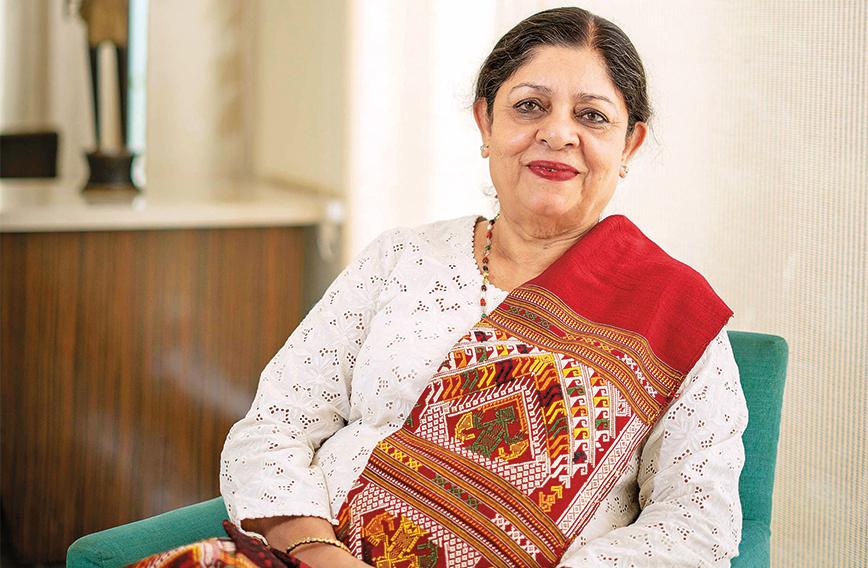
Poonam Muttreja: ‘It is important for artisans to have access to information’
‘It is not a high cost to support artisans. They have the skills’
Civil Society News, New Delhi
Almost four decades ago Poonam Muttreja was a co-founder of Dastkar, the iconic nonprofit that helps craftspeople come into their own with small enterprises. She now returns to the organization as chairperson to further strengthen its efforts to promote handicrafts in India and help artisans access the finance, marketing prowess and technology they need. Muttreja has proven organization-building and collaborative skills, often tapping into opportunities already available with government.
In addition to Dastkar, she will for the time being continue to also lead the Population Foundation of India (PFI) which has taken many strides under her.
Muttreja believes artisans’ interests can be served by accessing the wide range of government schemes relating not just to their skills but also gender, finance and information technology.
Q: What are your plans for Dastkar once you take over?
First of all, I want to focus on guiding and strengthening our current staff. One of my strengths is to mentor people, help them skill, learn more and motivate them to do things differently. For instance, in finances I want to bring in software. I want to bring in technology for greater efficiency, for scaling up and expansion, because technology is a route to that. The idea is not to have people lose their jobs, but do them better.
Working in Dastkar is a very creative experience. I want to make sure that my colleagues spend time reading, reflecting, and absorbing the creativity that Dastkar represents. So, my focus is capacity building, enjoying one's work beyond the call of duty and being as creative as possible.
Q: Are there any particular crafts which you would like to promote?
No. India has not done what it should have for its artisans. The numbers are huge. In Dastkar, under Laila’s (Tyabji) leadership, we managed to do a lot of wonderful product and design development. We brought artisans into the bazaar, with the objective of not just selling their crafts but also understanding their buyers — both individual buyers and institutional buyers.
We would like to place our close to three million weavers on the map of the country and embed them in government policies, programmes and infrastructure. I’m an advocate at heart. Whether I succeed in repositioning craft depends on the government, given that it has not invested very much in the sector.
We talk about skilling people but craftspeople are already skilled. More than 75 percent of our weavers and artisans live in villages. And if we could build much more urban-rural infrastructure, this industry could employ many more people.
And also women. One of the reasons women are not in the workforce is because there are small children to take care of at home. Given the absence of creches and of child care, this is another area I will work on. I do that in my current job too.
You know, in population issues, I always say, learn what not to do from China. But in the craft sector we need to learn from the Chinese. With very few skills, look at the way they have captured the global handicraft market. And India, with so much richness and diversity in crafts, arts, skills, is lagging far behind.
I also believe that the support artisans or weavers need is not high-cost. You are not skilling them afresh. What you need to do is upgrade their skills and create infrastructure that will help everybody. And, you know, let’s not forget that after agriculture, the highest number of skilled people are in the crafts sector.
Q: You’ve been working with government for a long time. How are you going to make them see sense in the handicraft sector?
First of all, there is the data. A majority of weavers are women, more than 50 percent. You need to invest in them.
Q: What specifically would you like the government to do? Build rural infrastructure? Provide credit?
First is upskilling. Most of our people in the sector are outright illiterate or have very low literacy levels. But we have seen they are able to use a smartphone. So, teaching them skills through use of technology in a simplified form is one. An electronic notebook or an iPad can be given to women weavers, the kind the government is giving to ASHAs (Accredited Social Health Activists) and ANMs (Auxiliary Nurse Midwives) to use. ASHAs, I understand, have studied almost to Class 8 or Class 7.
It’s important for artisans to be able to gain access to knowledge or information through the internet to find out, for instance, where do you get the cheapest raw materials? How do you do online purchases as well as sales? They do have educated younger people in their families. And these are family enterprises where they are traditionally trained.
I mean, at the AI summit they were weaving sarees with AI. The design work would become so much easier. We could use such technologies for design, and product development.
We have a huge number of people who have graduated from our design schools like NID (National Institute of Design), NIFT (National Institute of Fashion Technology), and so on. And now the education ministry is itself setting up a design school. We can definitely use their skills in the craft sector.
Second is credit. We have to have an allocated amount for artisans. We also need to undertake a market analysis of the crafts sector. I am planning to do a state of the artisan report with my colleagues in Dastkar, along with Laila who has been the lifeline of the organization.
We will assess and put down the needs of the sector in terms of credit, technology, infrastructure and, most importantly, marketing outlets. Our emporiums are lying idle. They’re becoming godowns. Three or four decades ago if you went to an emporium on a holiday, you would meet everyone. So, the idea is to once again revive the emporiums.
The emporiums should be seen as cooperatives run for the artisans and not merely as a commercial activity. It is about our cultural heritage. And it requires creative people. We have young people who come and work with us at Dastkar and do wonderful things. Senior designers have now approached me asking, Can I do a range of woodwork for you? Can I do a range of kurtas for Dastkar? I am going to make a directory of designers keen to help us.
But definitely we don’t want the government to nationalize creativity. The Khadi Village Industries Commission (KVIC) began to die when the government nationalized khadi. I hope we can learn from our mistakes and our successes.
We also have so many museums across the country which could also house craft shops. When you travel abroad, one of the most exciting things about going to a museum is visiting the museum shop where you can buy creative products. Now, these are my aspirations, but at least even if we can get some of it going, it’ll be a step in the right direction.
Q: You do have a permanent market now, the Dastkar bazaar in Delhi, and entrepreneurs are also given space. Shops keep changing hands.
The Dastkar philosophy is not to keep working with the same artisans. When groups or individuals become successful in being able to sell themselves, and get to know individual buyers and wholesale buyers, we encourage them to go independent. We can then work with newer groups of artisans. We prefer to make ourselves redundant because there are so many more to work with.
Q: There have been recent controversies regarding intellectual property rights for the sector. But, is there room here for more creative collaborations between international fashion houses and our craft and weaver sector?
Absolutely. But you have to create an atmosphere in our country where people see working with artisans not just as preservation, but as a good economic plan.
The challenge is artisans work in rural areas. How do you reach these remote areas? How do you communicate on technology? The second is finance. Artisans, by and large, do not have the money to even make samples. Designers are not going to make an exception for just that. Artisans need working capital and the ability to do product development.
We can’t also change the culture of the commercial world where they pay you after you have delivered the products. Sometimes, payments are given after six months or a year. That’s what kills these artisans who are marginalized, or are from lower caste backgrounds, and don’t have family assets or savings to be able to access credit.
The government does give soft credit to small entrepreneurs. It can be extended to the craft sector. Just like they’re saying they want ‘Lakhpati didis’, well, we want ‘Lakhpati weavers’.
Q: The government has been promoting various products under its ODOP (One District, One Product) scheme. It has also been encouraging farmer producer organizations. Is Dastkar helping artisans to form collectives or small craft companies? You have the RangSutra example.
Absolutely. See, RangSutra used to come to Dastkar when they started. Today, I am proud to say they don’t need us. The private sector, like Fab India, has also invested in RangSutra. They’re trying to get more investments. It’s a great model for us.
We must scale up as we plan for the artisans. It makes the economies of scale — purchasing, marketing, et al, work better. There’s an advantage.
Artisans live in clusters. In Moradabad, you have all the brass workers collectively working there. Similarly, across Rajasthan, in Tilonia and Jawaja you will find clusters of weavers. You’ll find a whole lane of, say, leather workers living in the same neighbourhood. It translates into economies of scale.
That cooperative concept has lived with us in Amul, but we have not pursued it. It is a Gandhian approach. For the crafts sector we need to re-establish and reimagine it in a much more technologically advanced world. And RangSutra is a great example of how to do that.
Q: Has there been any study of the clusters, the issues they face and if they can morph into cooperative models?
There is evidence in the latest handloom survey. After a long time, a study has been done. We have got access to the data, but we haven’t got the report. They’ve even given data on the education levels of handloom workers who’ve never attended school. It is one in four. In terms of education, the findings are similar in both urban and rural areas.
The report also has caste-wise data. The most marginalized communities, in terms of income, education, caste, are in the handicrafts sector. The contribution of the handicrafts sector to the economy through the business world too has been captured.
What we need to do now is see what kind of investments are needed for the clusters. In 2016, the government launched a Pehchaan scheme, to provide a new identity to handicrafts in India. They said they would be rolling out various benefits for the sector but it is taking time. One of my tasks is to monitor that and then push for it to be implemented well.
Q: We also need to export much more by tapping into global markets. How do we create an ecosystem for this?
The government and the private sector have to do their bit by integrating crafts into their regular production lines. Take the new airport in Mumbai that has been designed by Rajiv Sethi. You see millions of skills there.
If today there was an award for the most aesthetic and beautifully done airport in the world, it would go to that airport. Where do the aesthetics come from? Craft. We need to take craft into the building industry. And into households. The best example I can give is the Mumbai airport. Who funded it? People are going to be very unhappy, but I’m very glad that Gautam Adani, who’s made so much money, used his money to support that.
Comments
Currently there are no Comments. Be first to write a comment!