



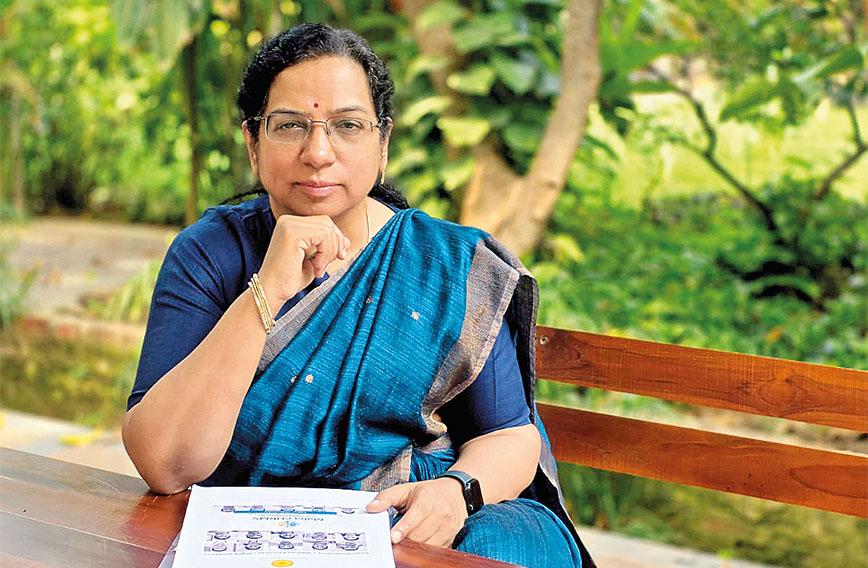
V. Radha: ‘It is not about downsizing. It is upskilling for the new requirements of the state’
‘We changed 574 hiring rules in one go to make them rational’
Praveena Sharma, Mumbai
Most state governments in India shy away from shaping up by taking a fresh look at the usefulness of positions and departments. It is just too messy and complicated to begin reassessing what people do in their official capacities. Many have outlived their relevance, but who will actually get down to saying so? Stenos, for instance, are still hired, but what do they really do in these times?
Much of the problem lies in the moribund General Administration Department (Services), which follows archaic rules framed in the 1960s and a service book written under the British in 1935.
Unsurprisingly, when V. Radha, an IAS officer, joined the General Administration Department of the Maharashtra government as the additional chief secretary (ACS) in 2024, she found herself amidst heaps of files in an office that had the vibe of India in the 1960s.
Instead of being overwhelmed, she rolled up her sleeves and got down to fixing things — beginning with a plan presented to Chief Minister Devendra Fadnavis. It entailed poring over reams of documents, rewriting outdated rules, identifying dying cadres and creating a digital backbone.
The outcome has been a repurposing of the state government’s staff, making them more gainfully employed. There has also been a streamlining of public recruitment processes.
Radha spoke to Civil Society about how she has been trying to introduce better human resources practices in the government.
Q: What led you to take up the recruitment to retirement reforms in government services in Maharashtra?
Firstly, I was really perplexed by the ridiculousness of the kind of stress we were putting on people who were economically fragile. And they were our own (government) employees. Their files would go up to the chief secretary for approval even for trivial issues.
Secondly, I would get an immense number of contempt cases. I still do. I was struck by the (legal) case load. Even today, it is the most daunting part. And thirdly, there were so many (unresolved) cases with mountain-high files, with over 10 years’ history. They were more than a foot high files. I had to literally stand up to sign them.
The way things operated looked like it was from another era. So I thought, how did we get left behind in the whole story. I joined (GAD — General Administration Department) in August 2024. The rules for simple approvals were so complex that it took me three months to understand them. There was no punishment for delays in clearing files, which, at most times, travelled over 10 years. The state was in election mode so I had time to reflect.
When the new government (Mahayuti alliance) got re-elected (in December 2025) and the chief minister (Devendra Fadnavis) asked every secretary to make a presentation of what they would do in the first 100 days, I grabbed the opportunity despite resistance from people in my department.
I visualized the logical work flow process from recruitment to retirement and then put together a wish list of what could happen. When the CM saw it, he was absolutely taken in by it and said that it was going to be his most important programme.
That gave my reforms proposal a real boost because it was not just one officer talking about it but the chief minister himself making it the highest priority of the government.
Q: To what extent have these reforms led to downsizing or removal of redundant posts?
I don’t think that question can be asked. It is not about downsizing. The real thing that happened was removing people who are doing jobs which are no more required in the government or upskilling them for the new requirements of the state — both in technology and competencies.
So, it was like relooking at everybody (in government departments) to see what is the new Viksit Maharashtra vision. For example, why do we need a stenographer? We don’t give dictation anymore. These posts have been there in thousands in the government and we still recruit them. Like that, we looked up and removed almost 200 dying cadres as they have no relevance today.
This kind of weeding out of posts happened, but replacing them with those which are more relevant was the next logical step that we took. We have the employees with us on this journey because they needed to believe that it is for their good too. There’s been no downsizing as such.
Q: Has the number of employees in the government services in Maharashtra come down after the reforms?
No. Our total employee strength is around 500,000. Out of this, we have almost 30 percent vacancies today. The government is very short-staffed even in some very critical departments including police and others.
It (such a claim of downsizing) is not a fact but perception. Yes, everybody thinks it should be downsized. On the contrary, rightly positioned would be a better word. It means rightly skilled to deliver on the jobs they are meant to do.
Q: Do you think reforms will eventually lead to a slash in the number of people in the government services?
No, no, no, not at all. We actually underserve people with a smaller number of people. We shouldn’t. It is not required. While we will use technology to become more effective and are not going to increase (the number of government employees), we are not going to decrease also as with rapid urbanization, you will require different kinds of services and different kinds of people.
Actually, it (the exercise) will become a bane to the reforms if one pitches that reforms mean people will be removed. It will put off people. We are saying it is pro-employee and at the same time talking about rationalization. It cuts both ways. The government benefits by having the right kind of employees and employees benefit from getting everything done in time. They get promoted in time. They get the training needed and other such things. It’s a win-win situation for both, and a win for the citizens too.
Q: How much is the reform purely about size and how much does it make for greater efficiency?
Our main objective is to make employees capable of being effective and efficient. That’s the core. There should be clarity on key goals in every department so that people know what skill sets are required to deliver on those special objectives of the government which are forward looking and designed for the 2047 vision.
Today, it can’t deliver because it’s using a blunt knife. So, we are sharpening it and making it deliver. What’s the point of having a talati (an administrative officer or accountant at village level in western Indian states), who is not ‘people-sensitive’? We are making him understand that he is there for that purpose.
We will not just be talking about attitudinal change but also about new skill sets required to do whatever they need to do on digital platforms, to deliver land records in time and to have the necessary skills and knowledge to work on them. So, these have to happen parallelly.
I am saying I am going to measure you. I am going to count what you have done and based on that I am going to give you promotion. I am bringing a lot more transparency in what is expected from you as an employee.
These are a series of reforms. For example, how do we train better? We can’t conduct some archaic training. We brought almost 8.5 lakh employees on a digital platform for artificial intelligence (AI) learning. We must be the most AI-enabled state in the country.
Q: How is AI being applied?
Each department is progressing on use of frontier technologies in its system whether it is blockchain or AI or other things. We are also talking about quantum computing. How to do digital data privacy? All those aspects are being inbuilt into our system.
Q: What level of digitization has been achieved?
There are two parts to the whole journey. First, we did government process editing. We rewrote rules which had been there for the past 50 to 60 years. Second, we put a digital backbone to ensure all this is digitally accessible rather than physically.
All our rewritten documents are digitized. In fact, soon our department will have digital services. Leave, promotion and everything else will be on our system. This will bring more transparency and ease of doing business. Tomorrow, if I need to know how many BTechs are there in the system I can instantly pull out the data.
We created the digital backbone and now the data feeding is happening across the state on various systems. New employees coming from next year will not have anything physical. Everything will be digital. Moving from a completely physical to a digital system requires a lot of behavioural change. So, we are doing it in phases. We’ll roll it out along with training.
Q: What is the budget for implementing the reforms?
We have a very tiny budget. The whole project is less than `40 crore. We are partnering with NIC (National Informatics Centre). All the government process re-engineering work has been done by us in-house because nobody understands better government better than us.
Q: How are the reforms impacting government services?
We have been able to clear a lot of hiring backlog by collapsing several government resolutions (GRs) into a single one. Recently, we were able to make over 5,300 compassionate appointments by crunching 45 GRs into one. In Group D (lowest level government job employees), we cleared backlog of six years in a single day. We could do this only because of changes in the rules.
I am very wary of corruption. Getting a job in government is a very big deal (and can be prone to corruption). So, we said it will be done in every district in a single day by the collector or whoever is a Palak Mantri (Guardian Minister).
We have 3,500 cadres, of which 1,400 cadres are direct recruitments. This means 1,400 exams, and each has its own syllabus and processes. We said, if we are appointing a lawyer in the Urban Development Department and another one in the Public Works Department, why don’t we combine the two? We combined and bucketed them (exams) in 47 buckets. Now, only 47 exams have to be held.
Q: How consultative was the process of preparing the reform proposal?
I would have about 300 meetings in a day in my office, which would look like a mela. I wanted it to be consultative because the unions were involved. It also impacts promotion. If I change the qualification, the next promotion of an employee will get affected. So, we looked at the promotion pyramids. Painstaking work was done by my department along with other departments. Over more than eight months and around 300 meetings later, we came to the conclusion we were on the same page. What they didn’t agree to, I didn’t push. We changed 574 recruitment rules in one go.
Earlier, a recruitment rule change would be a five-step process. I did it in one step by going directly to the cabinet. I issued a single document that said rules have changed and everybody has to follow. We centrallized (the whole process) — we issued orders, we bucketed the exams, we issued notifications. A 280-page GR was issued on May 5 after it was approved by the cabinet.
I followed a consultative approach because I did not want it to end up in the courts. We declared many dying cadres, which is a very sensitive issue because it means tomorrow we will never recruit for those cadres.
Q: How much opposition did you face?
Currently, those who are in the government (dying cadres) will not complain because I am not saying I will remove them. I am just saying your job will be dying after 30 years when you retire. There’ll be no more stenographers. I have closed the gates for people coming in as stenographers in future.
They are agitating because they say they were preparing for shorthand. All over Maharashtra protests are going on over the steno cadre. In today’s times, who gives shorthand dictation? I think even my father left it when he was old enough.
Q: Are you facing transitional challenges as most reforms processes do?
There needs to be attitudinal change (among employees). That would be a challenge. We embarked on the largest outreach programme undertaken by us.
We forcefully onboarded 850,000 people on our government digital training platform. People are not interested in learning. We started including fun activities.
Recently, the Central government launched a digital learning programme called Sadhana Saptah. Just a letter from us (about it) and we jump from 850,000 to 1.1 million. We did more than three million hours of learning in 15 days. Of this, three million hours was for AI only. We are at the top in the country. We are changing the culture in many ways.
Our CM (Fadnavis) has been leading from the front, giving the message that he wants to do these HR reforms in every meeting, and now every cabinet member literally thumps the table when I go for a presentation. They understand the implications of it in their constituencies. Even though I have got other offers, I am very convinced I have to take this to its logical end.
Comments
Currently there are no Comments. Be first to write a comment!