



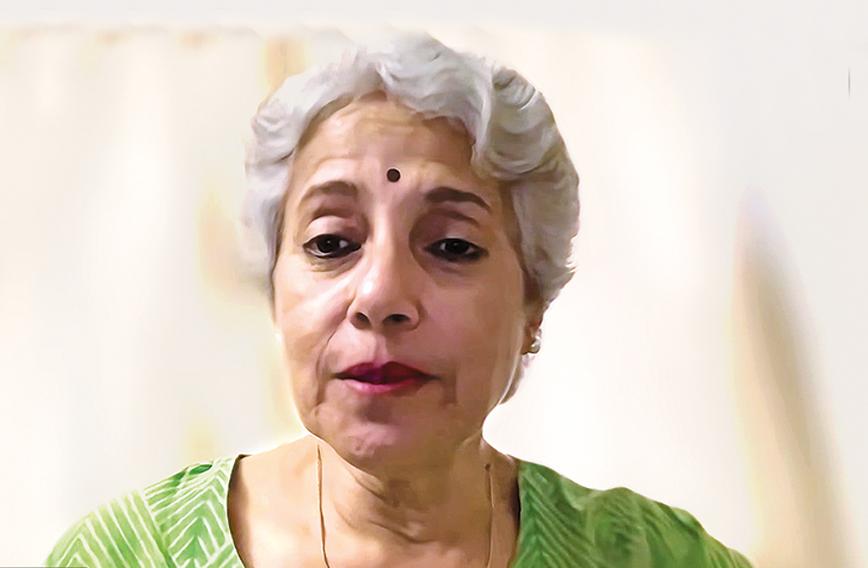
Dr Soumya Swaminathan: ‘Only a minority of women has the land in their name’
‘We are asking states to register women farmers’
Civil Society News, New Delhi
Women farmers have it tough. They work in the fields but they mostly do not have rights to the land they cultivate. Their names are invariably not included in land titles.
What this means is that they cannot access bank finance or draw benefits accruing to them under government schemes. They end up instead at the mercy of loan sharks when in need of assistance.
The MS Swaminathan Research Foundation (MSSRF) has been reaching out to states and the Central government to register women farmers and recognize their rights. This will be a way around the complications involved in retrospectively including their names in land titles.
Maharashtra’s chief minister, Devendra Fadnavis, has been quick to recognize the merits of the idea. A bill has already been drafted. Other states which have shown an interest are Odisha and Andhra Pradesh.

Civil Society spoke to Dr Soumya Swaminathan, chairperson at MSSRF, on what they are seeking from governments and how registration can be put into practice.
Q: You are reaching out to state governments to recognize the rights of women farmers. What exactly are you seeking and why?
The context is the increasing feminization of agriculture. If you look at occupations in rural India, the fact is that more women are in agriculture than men in many states. There are, of course, state to state differences. For example, in Maharashtra, 80 percent of rural women and 50 percent of men are employed in some agriculture-related activity or the other.
Second, all schemes today, especially Central government schemes, depend on land ownership. So even with the new AgriStack which the government has set up, to become eligible and be recorded as a farmer, you have to have your record of rights, basically your land records. And it is a well-known fact that only a minority of women have the land in their name. It used to be around just 14 percent. I’m told that it’s a little higher now but, again, it varies from state to state. But the average across India would still be in the range of about 15 percent, maybe maximum 20 percent.
The net result is that women who are involved in agricultural activities often lack access to credit, to loans, to government schemes, incentives, seeds. Even access to water sometimes depends on land ownership. The male farmer has easier access to technologies, marketing and so on.
Women farmers, therefore, often turn to informal sources of credit and take loans from moneylenders. And we know where that leads to. Moreover, in places where there are farmer suicides, like in Maharashtra, the woman is doubly punished because then she has to bear the responsibility for the loan taken by her husband. At the same time, she herself has no rights.
Since 2026 is the International Year of the Woman Farmer, we at MSSRF thought about what we can do to address this long-standing issue. We started having conversations with a few state governments and, of course, with the Central government as well. But since agriculture is a state subject, it actually makes more sense to work with state governments.
The first state that we approached was Maharashtra. Our idea was very enthusiastically received by Chief Minister Devendra Fadnavis. He firmly believes that something should be done for women farmers. Our discussions therefore moved very quickly from a casual conversation to an idea that I floated to him. The bill is now in the final stages of preparation and will be introduced in the Maharashtra assembly soon.
Q: What you’re looking for is a law. What does it contain? Who has drafted it?
Our partner is Vidhi Centre for Legal Policy, because obviously we don’t have the legal expertise to draft the bill. They came on board very happily as well. We realized we needed legal backing for a law like this. It was a collective decision. You could do many things through the administrative route too. But having a law would actually give rights to the women and lay out exactly how it could be done.
Q: So where would this law fit into the current matrix?
What this law will ask for is the legitimate rights and entitlements of women farmers. It will do that by issuing woman farmer certificates. So, the moment you have a woman farmer certificate, you will be entitled to all the schemes for which you would otherwise have had to produce land ownership documents. It will do away with the need for land ownership.
It will recognize that women are engaged in farming, but only a small number of them actually own the land on which they’re farming. The certification will include landless labour, women engaged in livestock activity and poultry rearing.
Agriculture includes a very broad definition of farming activities and farmers. This was articulated in the 2007 National Policy on Farmers. And a lot of the ideas here have been taken from the Women Farmers and Entitlements Bill that my father (Dr M.S. Swaminathan) proposed in the Rajya Sabha in 2011. It never saw the light of day.
The essential elements were all in that bill. But obviously 15 years have passed and things have changed. So, we’ve had to make it more contemporary and relevant.
Q: Basically, it gives women farmers rights but not ownership?
Correct. Because land ownership rights are governed by a set of different Central government laws. Vidhi told us that there are so many laws that govern land ownership it will become a quagmire and, ultimately, we’ll have to go to the President for assent.
Apparently, Uttarakhand tried doing something like this two years ago. They approached the President and they still haven’t got assent. We decided to work at state government level. They have enough powers to do things in agriculture.
We avoided the land ownership issue. Instead, incentives like waiving registration taxes can be given to men if they include the wife’s name in ownership records. Credit can be given at a discount if the woman’s name is included. These steps can be taken by state governments. Men are not going to be forced. Adding the woman’s name will be purely voluntary.
We need to find ways of bringing benefits to women farmers without their name being on land records and that’s what this certificate will do. The woman farmer certificate will ensure access to all welfare schemes. It will set up a women farmers’ fund and a gender resource cell.
Q: What would the fund do? What would it finance?
It will be called the Maharashtra State Agriculture Development Fund for Women. It will help develop woman farmer friendly technologies, for example. Technologies are all developed for male farmers. From our experience of working with women farmers at field level, it’s extremely strenuous and difficult for them to handle equipment designed for men.
The fund will also be used for training, capacity-building, creation of market facilities and infrastructure, organization of daycare and creche centres, and social security for women farmers.
This is the breadth of activities which can be covered by the fund. It can get grants and allocations from Central and state governments, contributions from the private sector like CSR funds and any other source of funding that the state government wants to use. But the state government must contribute annually to this Agriculture Development Fund for Women.
Q: Would this law be activated through the panchayats?
The woman farmer certification has to be done at the local level by the panchayats and the Nagar Palikas because the law applies to urban and peri-urban areas as well. Women could be doing horticulture or farming right in peri-urban or urban areas. So, yes, local bodies will be in charge of basically certifying that this woman is into farming. That should be sufficient for her to get a certificate. There will be appellates she can appeal to if required.
Q: You would need an awareness campaign to sensitize the panchayats and women farmers.
Absolutely. Once the bill is passed, we will transit to the next phase of engagement. We are going to have regional consultations in Maharashtra, to be held in three or four parts of the state, with a variety of stakeholders. We’ve already held extensive consultations with government departments and with the Mahila Kisan Adhikar Manch which facilitated dialogue with women farmers.
Once the bill goes to the assembly, hopefully in the monsoon session, and gets passed, there’ll have to be a whole lot of awareness and capacity building.
Q: You also mentioned the establishment of a gender resource cell. What would that do?
It will basically advise the state government on issues related to the welfare of women farmers, and organize training and capacity building programmes. It will also review the women farmers' database. As I mentioned, AgriStack doesn’t have women farmers from many states because their names are not on the record of rights. Basically, that’s been the basic document that’s required.
In Odisha, the state government used to have their own Krishi portal where they would accept women farmers with other documents. Since they have moved to AgriStack, the women are not getting enrolled because they have to produce land records.
This gender resource cell will ensure the database has gender disaggregated data, do a gender budget analysis, talk about and promote innovation of gender responsive technologies, and also provide an overview of how all this is doing.
The certification of women farmers programme needs to be monitored and implemented. The gender resource cell will do that. I understand the Central government has set up a gender resource centre. I think they are also tracking data. But the one being set up in Maharashtra will be much more specific and will also oversee implementation.
Q: Will the outreach be done by government departments? Will you also be working with other grassroots organizations?
That’s not specified in the bill, but obviously a network of NGOs would be needed to support the government. The Mahila Kisan Adhikar Manch would play a major role here. MSSRF’s role is to see this bill to fruition. After that it’s up to the state government, obviously, to take it forward.
Q: Are there other states which have shown an interest?
I think Odisha has been very progressive. They’ve had very gender responsive agricultural planning, largely thanks to Arabinda Padhee, an IAS officer who was heading the department (of agriculture) and has now moved on.
It would require a few simple steps for them to expand what they’ve already done through the administrative route and also issue woman farmer certificates. The Andhra Pradesh Agriculture Department, the state governments of Karnataka and Jharkhand have also shown an interest. We are waiting for other states to respond. If it is successfully implemented in one state, it makes it easier for other states.
Of course, they can always modify the law based on their own specific requirements, but Maharashtra could serve as a template for the other states.
Q: Will this certificate enable women farmers to get credit from banks or other credit institutions?
The state government needs to recommend that this certification is valid to government agencies, including banks, other credit agencies and the Central government. And to say that all state schemes in Maharashtra can be accessed by women farmers with the certificate. They will be fully eligible.
But this may not be true of Central government schemes. For that the Maharashtra government will have to request the Central government to allow women farmers who have the certificate to have the same rights to access schemes as a person with land ownership.
Every woman who has certification will be entitled to credit under the state credit schemes. The state can also recommend to government agencies regulating banking and credit to put in place measures that would improve women’s access to credit.
The bill also talks about promotion of women farmer collectives and of facilitating the formation and registration of women farmers, including cooperatives, collectives, federations, and so on. That’s already happening to a large extent. Technical assistance, financial support and so on will be provided by the state.
There are a lot of issues around water which have not been included here because, again, they’re governed by a number of laws and rules. There is a note on water being prepared by Vidhi that’s going to be discussed with the state government.
Q: You know, a lot of these things are somewhere mired in the social fabric of things. Isn't this a gender friendly law in a gender unfriendly environment?
I think that this was probably the simplest solution that could be implemented. There is serious intent to make it happen. The secretary of agriculture has been directly overseeing it and a couple of very progressive IAS officers. And there is of course the chief minister’s own support. Initially Vidhi had given more complicated criteria for woman farmer certification.
He said, No, we don’t want women to be producing all these documents because that will defeat the whole purpose of the bill. Certification by the gram sabha or the panchayat that the woman is engaged in agricultural activities will do.
If that doesn’t happen, she can approach the appellate or the grievance redressal mechanism. But the simplest way is your own village people recognizing you as a farmer.
Q: The other issue is the difficulty women face in trying to sell their produce on their own at the mandi.
The bill supports women’s groups, and the FPOs (farmer-producer organizations) and it also provides them access to markets. The bill recognizes that market access is one area where women farmers are at a disadvantage.
Women fisherfolk face similar issues. The men bring the fish from the sea. It’s the women who do all the work post-harvest. The entire marketing of fish rests on their shoulders. Access to markets, transport…they can’t get into buses because of the smell of the fish. So, they have to hire private transport to get to the fish market at the earliest. Then there’s spoilage. We hope to address many of these issues through collectivization.
Q: How will you as a civil society organization try to get this law working on the ground?
We would like to be closely involved in a couple of states. And Maharashtra is a good starting point. We’re also, alongside, beginning some programmes of working on the ground in Gadchiroli and Nandurbar with women farmers. We will also continue to support other NGOs. Through the consultation process, many NGOs are going to come on board.
Q: What are the improvements you would like to see thanks to the new law?
From our experience we recognize the difficulty women face regarding several aspects, including technology, machinery instrumentation and so on, in the case of fisherwomen as well, and access to markets.

We have undertaken some successful pilots of digital upskilling of fisherwomen so that they can actually look at markets, prices, and opportunities. And many of them have started doing online sales. We’re also helping them with cooling boxes, solar dryers, so they can avoid wastage. I think access to knowledge, technology and new tools play a big role.
Also, women get left behind because they don’t have the same access to mobile technology as men.
Q: This law should give a boost to farming.
Women have a lot of traditional knowledge, especially in tribal areas. We have been trying to understand that knowledge. We also have a programme on neglected and underutilized species. Millets is one, but there are other crops which are more climate resilient and nutritious.
Women know what you can eat but those wild greens have not been scientifically studied. One of our fellows has been looking at five different wild greens, which tribals regularly pluck and eat. And we found that they have amazing micronutrient content, more iron and Vitamin A than any of the saags commonly found in our markets. That could be a huge opportunity for cultivation, for business for the tribals, but also for nutrition.
Comments
Currently there are no Comments. Be first to write a comment!