



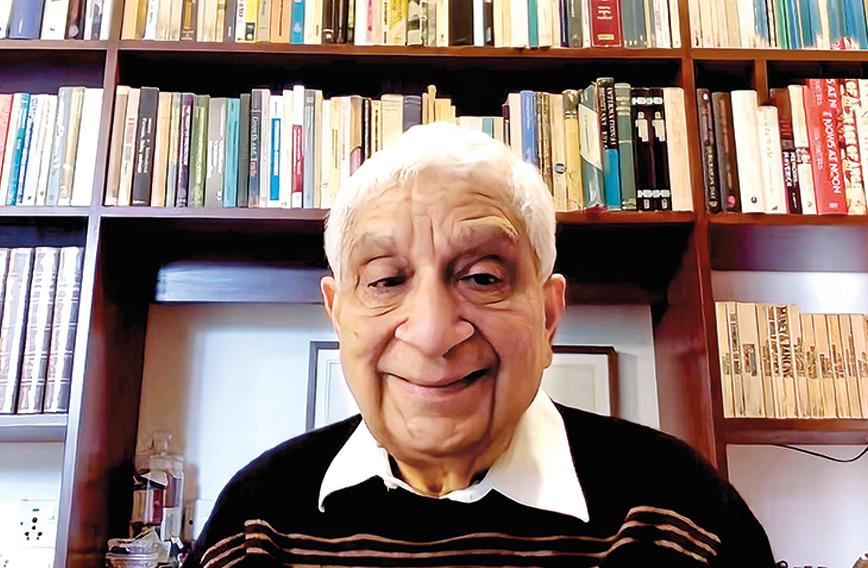
Deepak Nayyar: ‘Standardization is the worst enemy of understanding and knowledge’
‘Political intrusions putting public varsities at grave risk’
Civil Society News, New Delhi
A robust education system should be the foundation of a rising economy. Children need to get the basics in school and, as young adults, they should leave college with degrees that equip them for the jobs they will do.
India struggles on both counts. Now, to improve higher education, the Modi government has drafted a law which will create a supreme central authority to govern colleges and universities across the country. The goal is to have uniformity and standardization.
But chances are that the government is going to end up doing more harm than good. As it is, political intrusion over the years has lowered standards of curriculums and teaching. Will the envisaged central authority further stifle higher education institutions through excessive control? Civil Society spoke to Deepak Nayyar, former vice-chancellor of Delhi University and a distinguished professor of economics.
Q: Does the current system of higher education in India serve the country’s economic and social objectives?
There is a quiet crisis in higher education in India that runs deep. The educational opportunities for school-leavers are simply not enough. And those that exist are not good enough. The pockets of excellence that we have are outcomes of an enormous reservoir of talent and of Darwinian selection processes. It does little for those with average abilities or those without social opportunities.
| Watch: Sonam Wangchuk interview |
The challenges confronting higher education in India are clear. It needs a massive expansion to educate much larger numbers, but without diluting academic standards. Indeed, it is just as important to raise the average quality. What is more, in terms of access it needs to be far more inclusive than it is.
We need some institutions, each with a certain critical mass, that are exemplars of excellence on a par with the best in the world. Such excellence, sadly, is diminishing rapidly in the few pockets where it had existed.
I am not a fan of university rankings but if you look at, say, QS University Rankings for 2025, our performance is most disappointing. Of the top 100 universities in the world, 73 are in the rich countries — North America, Western Europe, Australia. Of the remainder, as many as 23 are in Asia. And, among these 23, we have none. South Korea has five, Japan has four, China has four, Hong Kong has four, Singapore has two. We are nowhere in the picture. I do believe that our universities have miles to go.
We are also diluting the brand equity of islands of excellence, such as the IITs, IIMs, the Indian Institute of Science, by creating more and more of them. Of course, the real problem is that the lifeblood of higher education is not such small elite institutes, but large universities that provide educational opportunities for young people.
Q: India has a history of good institution-building. IIM Ahmedabad is an example of an institution created with a great deal of idealism. What is it that now comes in the way of Indian higher education institutions seeking to excel and meet global standards? Is it centralization? Is it too much political interference? Is it lack of money?
Every government in India has lamented the absence of world-class universities without realizing that government interventions and the growing intrusion of political processes are an important underlying cause. The downward trajectory of universities in India is but a consequence of that political intervention.
Such political intrusion started in the early 1970s. The turning point might have been the Emergency in 1975. It increased in incidence during the quarter-century of coalition governments from 1989 to 2014. And the competitive politics unleashed by changes in government spilled over into universities as spheres of influence or arenas for political contests.
However, after 2014, intervention and encroachment by governments with an absolute majority gathered rapid momentum. It has increased rapidly since 2019 when Prime Minister Modi entered his second term in office.
In the past five years it has reached a stage where the future of public universities in India is at grave risk. Intervention now is much more systematic than it ever was. It has a cohesive pattern.
First, there is the introduction of institutionalized control mechanisms that decide what universities can or cannot do. Second, there is growing intervention in appointments of not only vice-chancellors of universities but also faculty members.
Increasingly, particularly since 2019, the ideology of the BJP and RSS has entered the higher education system in a major way. It’s not just that curriculums are straitjacketed. Reading lists are prescribed. What is included or what is excluded from readings and from courses is stipulated. There is a systematic attempt to control the academic content of what universities do by imposing on them restrictions that tell them what they can do or what they cannot do.
At the same time, the ideology of the BJP and of the RSS is exercising an enormous influence on appointments at universities. It’s not just the appointments of vice-chancellors of universities or directors of IIMs and IITs which provide the leverage in the appointment of faculty members.
If those who are appointed are not good enough to teach, what will happen to the quality of education? If someone who is not fit to teach the subject is appointed a professor at the age of 40, such a person will serve until the age of retirement at 65. If you appoint someone as a lecturer, who is not fit to teach the subject, at the age of 25, he or she will serve for another 40 years.
Thus, the damage that is being done in the process of making such appointments is going to have long-term consequences. It takes decades to build institutions. It takes months to destroy them, and it can take as much as a decade to rehabilitate them if and when there is opportunity to do so.
The problem is accentuated by the fetish for standardization of curriculum, appointments, promotions, salaries, administration, institutional structure. The outcome is that every university will move at the speed of the slowest if not drop to the quality of the lowest. Standardization, in my view, crowds out or preempts excellence because it stifles diversity, pluralism and differentiation in higher education — all of which are necessary to develop academic excellence.
Q: What you’re basically saying is that from centres of excellence come standards to aspire to. They bring others in the system up.
Absolutely. In this, I think we need to recognize that there are many things that are ongoing at the same time. Clearly, governments have become more and more intrusive, and governments interfere more and more in higher education. But the blame for the state of our universities cannot be laid at the door of politics and governments alone.
Universities as communities and as institutions are almost as much to blame. The quality of leadership at universities has declined rapidly, in part because of partisan appointments by governments of vice-chancellors who are simply not good enough as academics or even administrators, and in part because most vice-chancellors simply do not have the courage and the integrity to stand up to governments but have an eye on the next job they might get.
The professoriate is mostly either complicit, as part of the political process in teacher unions, or just silent, preferring to look the other way, engaged in their narrow academic pursuits. Those who stand up are too few. The students are either caught up in the same party-political unions or opt out to concentrate on their academic tasks.
It is imperative to recognize that such compromises by university communities are as self-destructive as acts of commission. Opting out is an act of commission. Indeed, if universities want autonomy, it will not be conferred on them by benevolent governments. They have to claim, indeed, consciously protect their autonomy simply because autonomy is as autonomy does.
To me, it is worrisome that higher education is caught in a pincer moment. For one, there is a belief that markets can solve the problem through private players, which is leading to education being seen as a business. Just as we now have healthcare as business. It is shutting the door on large numbers who cannot finance themselves. There is also the absence of regulation that would ensure quality.
For another, governments that believe in the magic of markets, UPA and NDA alike, are virtual control freaks with respect to public universities. This is motivated by their desire to exercise political influence in higher education for patronage, ideology, rents, or just vested interests. Besides, there is a terribly erroneous notion that maintenance of quality and standards is possible only through standardization and centralization. If anything, that is the worst enemy of understanding and knowledge, as well as teaching and learning.
Q: Institutions don’t have an internal robustness which could repel such attempts to weaken them. Is that correct?
Yes, that is correct. Look at what has happened at JNU (Jawaharlal Nehru University), what has happened at the University of Delhi. By and large, there has been a silent acceptance of ongoing changes. There are concerns, questions, complaints in private conversations. But very few academics speak about this in the public domain. This may be associated with the psychology of individuals, people who are risk averse or people who fear adverse consequences. And there are some, not an insignificant proportion, that simply change their belief system and become part of the reward system. That’s happened more in India than it has happened elsewhere.
Q: Society then must invest in the spirit of enquiry, must invest in the freedom of universities, the ferment of campuses…
Absolutely. Look at the unfolding reality in India. Curriculums are regulated and straitjacketed. Readings are prescribed. What is included and what is excluded in prescribed reading is decided elsewhere, not by the teachers. Some readings are explicitly excluded. Promising research that departs from the mainstream, particularly in social sciences, is stifled. Research funding is controlled by the government. Now, it’s no accident that our universities have not produced any Nobel laureates. And in fact, the probability of that, always low, has diminished sharply, indeed rapidly, in the past five years.
Q: How do you strike a balance between academic freedom and regulation?
You know, I think this balance cannot and should not be maintained by regulation. At the end of the day, governments provide resources for education almost everywhere. The United States is an exception given its philanthropic traditions. If governments provide the resources, it does not mean that they should be controlling universities. The reason is simple. It is taxpayers’ money. This is what citizens contribute.
Q: Everyone’s money.
Yes, everyone’s money. Governments should not be exercising control on universities. Of course, universities must be accountable. But that accountability should be to students and society through institutionalized mechanisms, such as periodic peer reviews of public universities to assess performance. Vice-chancellors and deans should be accountable for academic standards based on assessments of teaching and research. Teachers should also be accountable through course evaluation by students. Peer reviews, public perceptions, published research — these are ways of fixing accountability and assessing a university.
Q: There is a law before Parliament, called the Viksit Bharat Shiksha Adhishthan, which seeks to create a single, uniform and centrally controlled system. Based on all that you’re saying, this law would certainly not be the right way to go.
Absolutely not. I have always believed that the UGC (University Grants Commission) is the problem. It cannot be a solution. It has three functions: licensing or accreditation, assessment, and funding. There is no country in the world where one institution does all three things. It eliminates all checks and balances.
The proposed law, the Viksit Bharat Shiksha Adhishthan, seeks to create an apex education authority. But in my view education and authority don’t go together.
Let me say that this will be far worse than the UGC ever was. It will also be worse than the Higher Education Commission idea that was on the anvil for some time but was shelved. There was so much public protest. I hope there is major protest in the world of higher education and in Parliament about this bill.
What is it seeking to do? It is creating an apex education authority. It will have three councils, one responsible for accreditation, one responsible for assessment, and one responsible for standards. Interestingly enough, it will have no role in funding. The financing of higher education institutions will be decided upon, and disbursed, by the government. This is worrisome. The draft legislation also suggests that the government, through this authority, will have the right to take away the degree-granting status of any university. This could become arbitrary.
Universities are established by state legislatures and in some cases by acts of Parliament. How can this proposed authority have the right to override that? What is worse, the funding of universities will shift entirely to the government. The government will decide how much money university A, B, or C gets for faculty positions and research.
Taken together, all this is dangerous for the future of higher education in India. Even the erstwhile centrally-planned economies and communist countries did not have such centralization of higher education in government. It was the academies of sciences which oversaw universities, particularly in the sphere of research.
There is another problem here, which I hope state governments will recognize. In the Constitution of India, when it was originally passed in Parliament, in the Constituent Assembly, education was exclusively a state subject. It was only in 1976, during the Emergency, that education was made a concurrent subject. However, that provision essentially created a system in which the Union government could also establish some central universities and institutions such as IITs, IIMs, Institutes of Science and Research or Institutes of Medical Sciences. Similarly, it could fund some centres of excellence. But, by and large, higher education was the domain of the states. This new proposed legislation is going to substantially erode, if not undermine, the role of state governments.
Q: It will take diversity out of the system.
Yes, it is bound to do so. It will end up in stagnation. It will end up in decline. Higher education institutions are much like organisms. You cannot standardize them. You cannot transplant them. You cannot import universities from abroad. In any case, such an arbitrary law is certainly the wrong way to go.
You need to recognize that the most important component of Viksit Bharat or being a developed economy will be creating capabilities in our people. Our people are our only asset, but they are an underutilized resource. The only way that the people can contribute to this is through education, particularly higher education, which creates capabilities of different sorts and levels amongst people.
| Watch: Protesters at Jantar Mantar |
If India is to make a transition from a lower-middle income country to upper-middle income country, it needs quality higher education. This proposed Viksit Bharat Shiksha Adhishthan will make Viksit Bharat an elusive quest and an unattainable objective.
Q: Are private universities the way to go? And in your view how have the private universities that have come up fared?
Well, it is not the way to go, in my view. Even now, on average, most citizens, most young people, see public universities as being better than private institutions. However, if the present decline in public universities continues, good students and good teachers will inevitably flock to private universities. Thus, we must ensure that private universities retain their autonomy and independence.
There are a few private universities that are regarded as good. Students flock to them for admissions. A very large number of private universities are of highly uneven quality and they are in education for business. Many of the medical schools and the private engineering colleges that exist are examples of teaching shops in education for business.
There are, of course, sub-standard or poor public universities, just as there are poor private universities. Private universities also are subject to the same political milieu, and the same ethos. I will not name private universities, but vice-chancellors have been removed. Faculty members have been removed, or have been forced out, because they were politically inconvenient.
I think that promoters of private universities in India are making one big mistake. Most of them run the universities themselves. And therefore, as people who are part of the corporate sector, they are subject to all the pressures that governments and politics create.
It is not only about appointments, but also about appointing or retaining faculty members who are critical of government, or about having people who have a critical or dissenting view come to the university and speak.
If private universities are to develop, I would say promoters should actually create independent boards, as in the United States. Philanthropists should not run universities.
Comments
-

dilip thakore - Feb. 2, 2026, 12:08 p.m.
Excellent, informative interview. Also a warning agaisnt standardisation and elimination of plurality. Education must be the province of educationists, not the neta-babu brotherhood.