



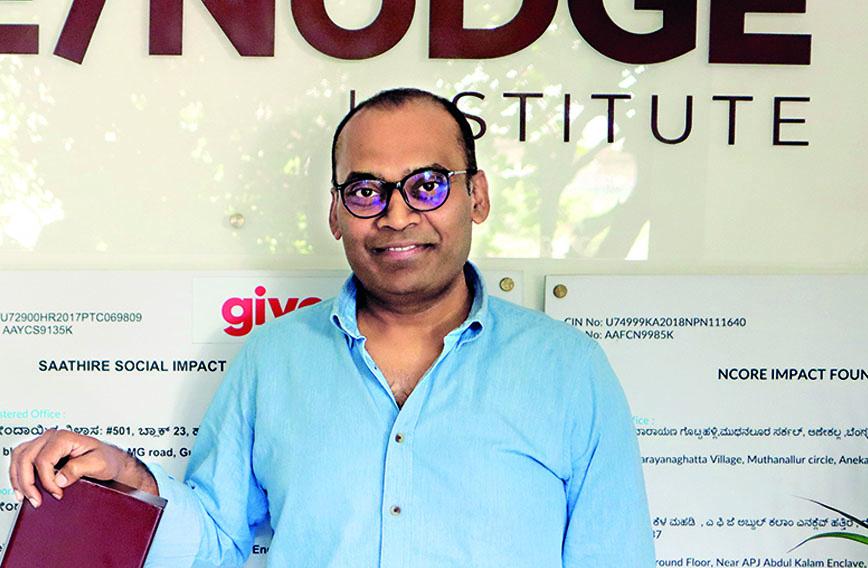
Amit Gupta: ‘We are training Ashas and they are already doing screening in 30 villages’
‘Sourced at Rs 85, we have glasses for everyone’
Civil Society News, New Delhi/Bengaluru
When The Nudge Institute first took up presbyopia as a public health issue it put out the startling data that millions of Indians have problems with near vision. It reduces the quality of their lives and makes them less capable of work.
At that time, we interviewed Amit Gupta, the lead of The Nudge Institute initiative, who said they were putting together a model involving government support, philanthropy and entrepreneurship to get affordable glasses to people. The goal was to bring down the huge number of cases of presbyopia within a meaningful timeframe.
Gupta was juggling many ideas and we went back to him recently to find out what progress had been made. Here is the update:
Q: What impact has your study on presbyopia had on policymakers? Has it brought any change?
First of all, the policy environment per se has been very conducive. We as a country never medicalized eyeglasses. What that means is that they can be dispensed by optometrists. There has been no change in that position. What does happen is that a doctor’s prescription is required when glasses are dispensed under most government schemes. And that’s not so much of a policy thing, as an assurance that if something is being distributed, it’s not being misused and so on. So, that’s where it is now.

Q: That’s more of an auditing issue.
Exactly. And now everyone we are talking to intuitively agrees that presbyopia is a very simple problem that can be dealt with by people trained for the task. There is a realization that our existing vision healthcare system is already overextended because of the high incidence of cataract, glaucoma and so on. That we should move simpler tasks to people trained for them as opposed to optometrists and ophthalmologists and so on. The thing is that we as a country haven’t done that so far.
Q: The policy shift that you would really need is in terms of government being ready to recognize that you don't need a prescription.
People in government are being very receptive. We are working in Meghalaya where we have tied up with the state administration. The departments of health and rural development are both on board. We have developed training content in partnership with the Arvind Eye Centre, our partner. The content has been vetted by two optometrists assigned by the National Health Mission (NHM) in Meghalaya. We are training Ashas (Accredited Social Health Activists) who are village-level health workers and they are already doing screening in 30 villages. We will expand it to 130 villages and so on. I’m amazed that in that terrain they are successfully distributing 500 pairs of glasses per week.
Q: Let’s get this right. You have a tie-up with the state government. The departments of health and rural development are on board. And the Arvind Eye Centre is partnering you by providing the scientific expertise, right, so as to empower health workers who are now testing eyes and dispensing glasses?
That’s correct. And the state government is giving glasses. It has already distributed around 2,000 pairs. They have committed another 4,000. We will bring in 8,000 or so from philanthropic funding. With these 14,000 glasses we will document how effective we have been and be able to know the right SOP (Standard Operating Procedure) there.
Q: How long has this project been going on?
The distribution itself has been going on for a month or so. Before distribution starts, a lot of legwork needs to be done in terms of community mobilization, training, getting all the stakeholders on board and so on and so forth. We have been at it for almost six months.
Q: How is it that you came to choose Meghalaya or did Meghalaya choose you?
There is a very forward-looking, very dynamic administration there. The Nudge Institute also has credibility with the Meghalaya government because we are doing our economic inclusion programme there.
Q: How easy or difficult has it been to train Ashas to dispense glasses?
Not difficult at all. The trick is not to make it overwhelming. The moment we get into the anatomy of the eye and all the technical details, different kinds of refractive errors and so on, you know, even I can’t get it anymore. We need to keep it very, very simple. That’s number one. Second, the tool which we are using for data collection for digital workflow is something new for them and that also requires certain training. But they actually get it very well. NHM is there to supervise it.
Q: How long does it take to train them?
We have a two-day training programme. It entails basic training about vision and how to test for presbyopia. Half a day is for how to use the tool and enter the data and the workflow and so on. And let’s say the rest of the time is for them to practise with each other to make sure that they get comfortable.
Q: This is a centrallized training programme, so they all come to one place, spend two days there and then disperse?
Absolutely.
Q: What is the mechanism that you have for knowing that Ashas are getting it right in the field?
There are two or three mechanisms. First is mathematical validation against global presbyopia data by age demographics. Data analysis provides strong indication of screening problems. Second is random secondary checks with trained optometrists. And the third is field monitoring with user feedback. A team monitors and evaluates user comfort and effectiveness of the glasses.
Q: These are random tests?
Yeah, random. We pick up a few and see if it is kind of consistent.
Q: How does the pricing of glasses work in Meghalaya?
We are procuring glasses at `85, including logistics, and these are certified glasses.
Q: Where are you getting them from?
Multiple players.
Q: In the country?
Yes. The glasses are as good as the ones you are wearing. It’s a nice plastic frame with a spring. It is properly certified. It comes in a box with a cloth to clean the glasses and so.
Q: How has the Meghalaya government wrapped its head around the pricing?
I was pleasantly surprised at how appreciative they were of the simplicity of the model and the impact it will have. They were very, very supportive. They have, being public servants, certain responsibilities. They want to be sure that it is done well and that’s why they asked for a small pilot before we get on to a larger state-wide scheme.
Q: You had no problem getting approval from the government?
It’s work in progress for the scheme. Approval needs to come. But the buy-in is there. I’m pleasantly surprised with the speed of execution. The state programme officer, joint secretary, development commissioner and other officials have been very supportive.
Q: How much is the Meghalaya government ready to spend on this?
Well, I can’t speak for them. But my guess is that there would be about 400,000 people with presbyopia. All things put together, you can say that the fully loaded cost per pair is about `120, including logistics and Asha payments. It is not a humongous cost and manageable in terms of the state’s budget.
Q: Apart from Meghalaya, is there anywhere else you have experienced success?
We have been experimenting with the village entrepreneur model. Entrepreneurs buy glasses at `85 and sell at `150 to `300, depending on the market. If they sell six to eight pairs daily, they earn `15,000 to `20,000 a month in net income.
The cost economics works out really well if six to eight pairs are sold in a day. If they’re selling it at `150, then they can make about `15,000 to `20,000 per month which is pretty good in rural Uttar Pradesh. We had an instance in Tamil Nadu where a highly dynamic lady sold around 300 pairs in the first month itself and at a price of `300. So that has been very successful and encouraging.
Q: Is that because it’s Tamil Nadu?
Yes. It is actually a misconception that people can’t afford reading glasses. People don’t know that reading glasses are such a simple device and so cheap. And that’s the problem. It is highly affordable at the price at which it should be available.
Q: It’s really an access issue.
Yeah, it’s an access issue. What we realize is that more than anything else it is the attitude that matters. If you have an entrepreneurial mindset, you find your way around all the hurdles. People who want to treat it like a job and work three hours a day don’t get it right. But then we see people who will show up at 7 am because they know that that’s when people are available to get tested. They know how to talk to people, to convince them by taking someone in the local community along when they are doing the testing and selling.
I’m very enthusiastic about this model. We need to think how we can scale it and if we can scale it. It will be self-sustainable. You don’t need philanthropy. You don’t need government funding. You are providing employment to so many people in rural areas.

Q: How much seed capital does an entrepreneur need?
For an inventory of glasses, not too much perhaps and a Snellen chart. We make sure that the person we choose already has a functional smartphone and a way to move around, be it a cycle, a scooty or something like that. Even if they have to invest in some of these things an initial investment of no more than `35,000 may be needed.
Q: Are you going to be supporting the entrepreneur financially in any way?
Right now, we choose people who have those assets already. It is still an experiment and we need to work on what is the proper business plan. If we were to scale it up, we might not be averse to providing an initial loan if that’s what it takes. And there are other ways. There are multiple government schemes where they provide loans and other facilities for entrepreneurship. We will explore that option as well.
Q: Is there any flexibility? For instance, if a Deputy Commissioner (DC) in a district wants to take it up?
Theoretically it is possible because the law of the land allows you to do that. But I haven’t yet launched any such initiative. I think what it will come down to is whether or not at district level there’s a budget to do something like that. The DC might also want some kind of buy-in from the state government.
We have started working in Keonjhar in Odisha. We have signed a Memorandum of Understanding (MoU) to distribute 200,000 pairs of reading glasses. This is philanthropically funded. This is not government funded but we want to showcase what is possible. So that’s where we are working with a district administration. But we are also working with the state administration to get all the approvals and so on. Similarly, I’m having discussions in Bihar to distribute glasses in three districts using the same model. ν
Comments
Currently there are no Comments. Be first to write a comment!