



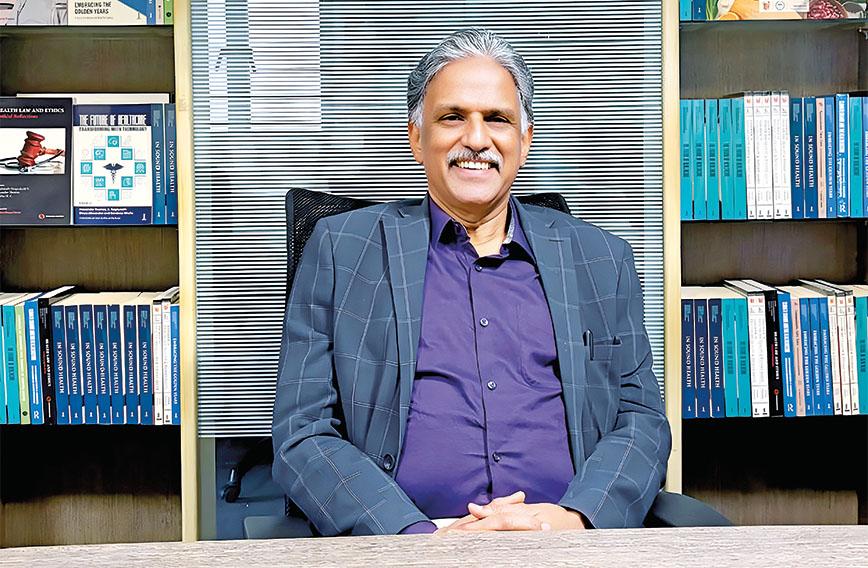
Dr Alexander Thomas: ‘The intention is to ultimately benefit patients’
‘In patient-doctor disputes it is better to talk first’
Civil Society News, New Delhi
HOLDING a doctor to account for malpractice or negligence is a long and complicated process, anybody will tell you. A resolution when it does finally arrive may not be worth the years spent in pursuing it. Both doctors and patients suffer because of prolonged wrangling.
Dr Alexander Thomas, founder of the Association of Healthcare Providers India and other key organizations, believes it need not be so. In his view, instead of rushing off to the courts under the Consumer Protection Act, a simpler mechanism — using mediation, for instance — could resolve a great many disputes at the hospital level itself.
Doctors and patients need to talk to each other a lot more, says Dr Thomas, who has gone to the Supreme Court seeking a better system than what is available under the Consumer Protection Act.
Q: How widespread is medical malpractice in India?
If we look at the figures, a significant number of complaints are filed across the country every year. In 2024 alone, there were close to 550,000 cases pending across various forums. At the same time, many cases are resolved each year, while others continue for prolonged periods.

It is equally important to recognize that there are patients with genuine grievances who are often unable to access timely justice because of the complexity, delays, and inefficiencies within the system.
Q: What does it say of the system?
It highlights the need for a grievance redressal mechanism that is more accessible, transparent, efficient, and patient-friendly. The relationship between patients and healthcare providers is built on trust, and any system we create should aim to preserve and strengthen that trust while ensuring accountability and fairness.
Q: Are we getting you right: There are complaints, both genuine and false. And complaints that don’t get articulated?
Yes, absolutely. There must always be accountability within the healthcare system. At the same time, many patients with legitimate grievances are unable to navigate the present system effectively because of delays, costs, lack of awareness, or procedural difficulties.
Q: There have been cases of negligence which have been fought in the courts and they’ve gone on and on for ever. The system is skewed against the patient. Could you tell us something about the PIL that you have filed relating to this in the Supreme Court?
The PIL seeks to remove doctors from the ambit of the Consumer Protection Act framework in matters relating to medical negligence and to explore more effective, balanced, and less adversarial mechanisms for grievance redressal.
The objective is not to reduce accountability, but to create systems that encourage quicker resolution, transparency, dialogue, and patient-centred review. I believe there is value in strengthening hospital-level grievance mechanisms, mediation processes, and independent review systems that can address concerns more efficiently and compassionately.
The intention is ultimately to benefit patients by ensuring timely explanations, fair review, appropriate corrective action where necessary, and preservation of trust between doctors and patients.
One important approach is mediation and structured communication. Many patients primarily want clarity about what happened and reassurance that their concerns are being taken seriously.
Several quality frameworks, including standards encouraged by the National Accreditation Board for Hospitals and Healthcare Providers (NABH), already emphasize patient grievance systems, communication, and structured review mechanisms at the hospital level itself.
A more collaborative and transparent approach can help reduce misunderstanding, improve patient satisfaction, and preserve trust between patients and healthcare providers.
Q: Isn’t mediation supposed to be at the heart of the consumer Act?
Mediation does exist, but in practice disputes can sometimes become formal, adversarial, and prolonged very early in the process. It may help if hospitals and healthcare institutions strengthen internal grievance systems where patients and families can receive timely explanations, support, and opportunities for dialogue before matters escalate.
Importantly, patients should always retain the right to approach courts, regulatory bodies, or other authorities if they are not satisfied. The intention is not to replace legal rights, but to provide additional pathways for quicker, fairer, and more compassionate resolution.
Q: Wouldn’t there be a conflict of interest if the mechanism to find a solution is at the hospital level? After all, the patient is holding the hospital and doctor to account. In the courts, hospitals have dragged on cases for years. They don’t want to take responsibility and pay compensation.
That concern is understandable, which is why any such mechanism must be transparent, accountable, patient-inclusive, and subject to oversight. The purpose is not to shield anyone from responsibility, but to encourage early resolution wherever possible.
Most doctors and hospitals also prefer systems that are fair, balanced, and focused on learning, improvement, and patient welfare rather than prolonged confrontation alone. Both patients and healthcare providers contribute to delays in cases for various reasons. It is in the interest of all stakeholders to conclude these matters quickly and fairly.
Q: So, this is limited to doctors. If the doctor was not negligent and it was the hospital to blame, the patient can take the hospital to court.
The PIL is limited to doctors. Hospitals will still come under the ambit of the consumer forum.
Q: Is there a difference between malpractice and negligence?
Yes, there is an important distinction. Malpractice generally implies deliberate wrongdoing or undertaking medical procedures without adequate competence, training, or infrastructure. Negligence, on the other hand, may involve lapses, errors in judgement, communication failures, or unforeseen complications in a highly complex field.
Medicine is not always an exact science, and outcomes can vary despite appropriate treatment. This is why communication, informed consent, and proper documentation are extremely important.
Q: Can one have an example of this?
For instance, before a major surgery, patients are naturally reassured and encouraged. However, even when procedures are performed correctly, complications can occasionally occur because every individual responds differently.
Sometimes dissatisfaction arises not only because of the outcome itself, but because expectations, risks, and possible complications were not discussed adequately beforehand. Better communication can significantly reduce misunderstanding, anxiety, and distress for patients and families.
Q: Is it a worldwide phenomenon?
Yes, these are global challenges. However, Indian doctors often work under extremely demanding conditions, managing very large patient volumes along with surgeries, emergency care, administrative responsibilities, and hospital rounds. When I compare India to Australia, where I worked, the environment here is far more demanding.
In the US and several other developed countries, doctors are not certified unless they pass examinations in communication skills. In India, this was not the case until recently, when we lobbied with the National Medical Commission to introduce communication and ethics in the undergraduate and postgraduate curricula. I hope this will make a significant difference.
Q: What would you call a hard case of malpractice?
A serious case of malpractice occurs when an incompetent or inadequately trained person performs a procedure negligently, thereby placing the patient’s life or safety at significant risk.
Q: And if a totally competent, well-qualified doctor gets something wrong, that’s negligence?
Not necessarily. Medicine is not an exact science. There are many things that cannot be predicted. Let me give you an example. We were treating a young child following a road traffic accident.
The child was recovering very well but suddenly suffered a cardiac arrest because of a blood clot.
Each patient is unique and reacts differently to various situations and treatments.
Q: Then it’s really quite difficult to determine the culpability of the doctor.
Not entirely. There are established standards and guidelines. What is needed is an accountability system in which the patient’s grievance is properly addressed. In consumer courts, matters often become confrontational, further eroding trust between doctors and patients.
The interests of the patient community are also being harmed in some ways. Today, because of consumer litigation and violence against healthcare workers, defensive medicine is increasingly being practised. Defensive medicine significantly increases the cost of treatment because doctors may order unnecessary investigations or procedures primarily out of fear of litigation rather than clinical necessity.
Q: There’s been a great deal of commercialization of healthcare. Has this lowered public trust in doctors?
Rising healthcare costs and commercialization in some sectors have certainly influenced public perceptions and contributed to concerns about trust. This is an important issue that the healthcare community must address thoughtfully and responsibly.
Publicly listed corporate hospitals are often primarily profit-driven, and this can affect public perception of both doctors and hospitals.
At the same time, private healthcare institutions have also contributed significantly by introducing advanced technologies, specialized care, innovation, and improved treatment outcomes for many patients.
The challenge before us is to ensure that healthcare remains ethical, affordable, compassionate, transparent, and patient-centred.
Q: Are we better off with private or public sector healthcare? Both have their problems, but which sector are we better off with?
Both sectors play extremely important and complementary roles. Government hospitals provide essential access to millions of people, especially those from economically weaker backgrounds, while private institutions have often led innovation, specialization, infrastructure development, and technological advancement.
India’s healthcare system will become stronger through meaningful collaboration between the public and private sectors, particularly in areas such as training, infrastructure, affordability, and access to specialized care.
Q: To the average citizen it appears that the healthcare system in this country is at a point of crisis. Is that the perception within the profession as well?
Yes, there is certainly concern about rising healthcare costs, increasing expectations, workforce pressures, violence against healthcare workers, and the changing nature of healthcare delivery.

At the same time, it is important to acknowledge the extraordinary dedication of thousands of small and medium hospitals and healthcare professionals across the country who continue to work long hours with a strong sense of service and commitment.
The future of healthcare must focus on restoring trust, strengthening communication, improving accountability systems, and ensuring that patient welfare remains at the centre of all reforms.
Q: But is there within the profession a concern that the profession has just drifted?
Yes, there are some concerns. There is significant inequity within the system, where a few doctors earn enormous amounts while many other healthcare workers earn far less, despite medicine being a team effort.
We must also recognize that most healthcare in India is delivered by small and medium-sized hospitals with dedicated doctors and staff. India has some of the finest healthcare professionals and institutions in the world. We have also made major progress in medical education, technology, public health, healthcare access, and specialized care.
The way forward lies not in blame, but in collaboration — between patients, doctors, hospitals, policymakers, regulators, and society. If we focus on communication, transparency, ethics, accountability, and patient-centred care, we can build a healthcare system that is both compassionate and trusted.
Comments
Currently there are no Comments. Be first to write a comment!